
Núcleo Nacional: From Athletic Masked Men to Lumpen
Spain's Núcleo Nacional shifted from a disciplined right-wing aesthetic in 2024 to a perceived decline into lumpen elements by 2026.
English · Original discussion in Spanish · Published
Núcleo Nacional: From Athletic Masked Men to Lumpen
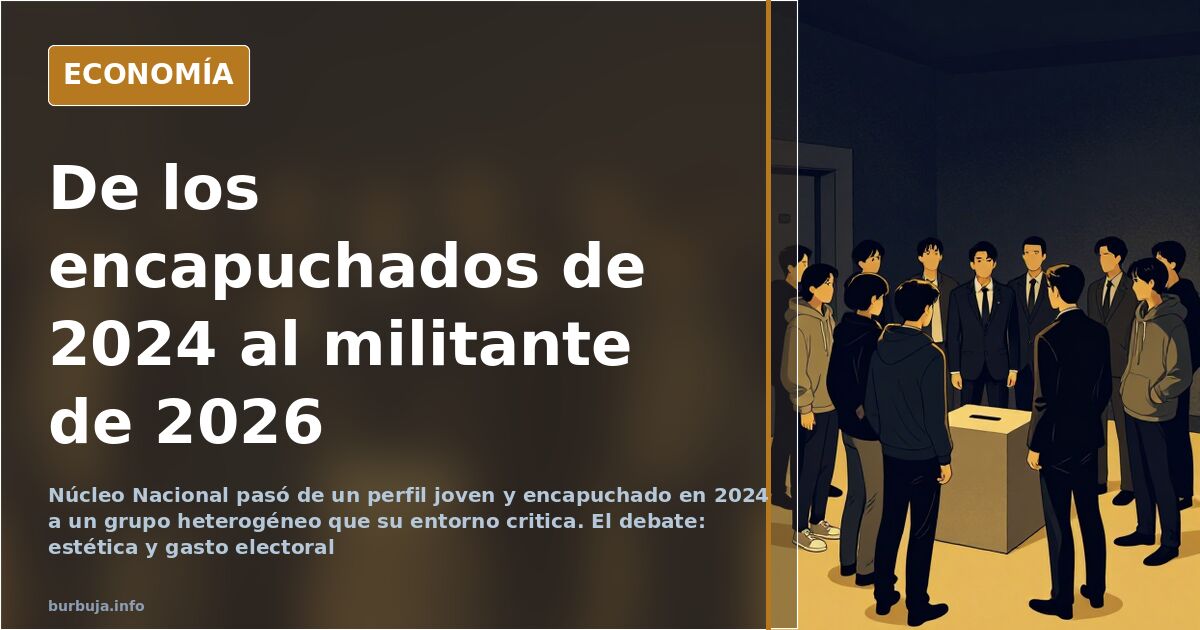
What peine to the Spanish right-wing movement that seemed to have the only decent aesthetic in 2024? Two years ago, Núcleo Nacional presented an image of athletic young men, without visible tattoos and far from the stereotypical old-fashioned right. Today, the dominant perception among observers is that this original core has diluted into a mix of older people, overweight, with a lumpen appearance who detract rather than add value. Comparing the 2024 Núcleo Nacional with the current one is, according to repeated analyses, like comparing God to a gypsy. The diagnosis is unanimous on one point: accepting any element to inflate numbers has had consequences.
Aesthetics as a thermometer of decline
The thesis running through the analysis is that aesthetics are not a whim, but a reflection of the society we live in. The movement that in 2024 seemed like a club of muscular young men, training in MMA and calisthenics, has become a group where cheap tattoos, drug users, and lumpen elements abound. The complaint is not just aesthetic: it is argued that this image lowers the standard and demoralizes those who might be attracted to the project.
Some claim that the original masked men were actors placed there to attract attention, and that the current unmasked ones are the same individuals who have lurked around marginal movements for two decades. The suspicion that everything is part of an operation to deactivate the authentic national movement runs through several messages. There is no proof, only the confirmation of a repeating pattern.
The problem of personnel selection
The most repeated argument is that the mistake was opening the door to anyone just to pad the figures. A movement aspiring to be an elite core cannot afford to recruit without filters. The consequence is that the public image has deteriorated to the point where it no longer matters if they wear masks or not: the damage is done.
Comparison with other European countries is inevitable. It is argued that in Australia, Canada, or Scandinavia, similar groups of young people train together and maintain a careful aesthetic, and that there never would such elements be allowed entry. In Spain, however, the tendency toward informality prevents this. The result is a movement that, in the eyes of many, has degenerated into a group of fat, ugly, old, and drunk individuals.
The debate on clothing and colors
The discussion drifted toward an apparently trivial but revealing issue: what clothes should such a movement wear. Black is ruled out because it is funereal and associated with past aesthetics. Mahón blue is proposed as a suffering and elegant tonalidad, although it is admitted that it evokes bygone times. Gray with orange, white with black, green are suggested. The most repeated conclusion is that it is not about uniformity, but that people dress normally, without five-euro t-shirts with printed designs.
The underlying problem, some point out, is that actions impose the aesthetic, not the other way around. And actions, for now, are conspicuously absent. Without a clear project, any discussion about colors is an exercise in aesthetic toca.
Economic context and criticism of the system
Beyond aesthetics, the analysis connects with broader economic discontent. It is denounced that in the 2023 general elections, parties declared approximately €60 million in justified electoral expenses, money distributed among social media, image advisors, and tailors. The criticism is that this spending is financed by taxes from taxpayers who, meanwhile, see their cancer diagnoses delayed in the public healthcare system.
The conclusion of this thread of analysis is that Núcleo Nacional, like other projects, likely began as an meme to remind the left that the far-right is coming and thus mobilize tactical voting. If the goal was to deactivate any real alternative, the aesthetic and human degeneration of the movement would be proof of its success. The final irony: those who wanted to appear dangerous now cause second-hand embarrassment.
Key data from the analysis
What peine to the Spanish right-wing movement that seemed to have the only decent aesthetic in 2024? Two years ago, Núcleo Nacional presented an image of athletic young men, without visible tattoos and far from the stereotypical old-fashioned right. Today, the dominant perception among observers is that this original core has diluted into a mix of older people, overweight, with a lumpen appearance who detract rather than add value. Comparing the 2024 Núcleo Nacional with the current one is, according to repeated analyses, like comparing God to a gypsy. The diagnosis is unanimous on one point: accepting any element to inflate numbers has had consequences.
Aesthetics as a thermometer of decline
The thesis running through the analysis is that aesthetics are not a whim, but a reflection of the society we live in. The movement that in 2024 seemed like a club of muscular young men, training in MMA and calisthenics, has become a group where cheap tattoos, drug users, and lumpen elements abound. The complaint is not just aesthetic: it is argued that this image lowers the standard and demoralizes those who might be attracted to the project.
Some claim that the original masked men were actors placed there to attract attention, and that the current unmasked ones are the same individuals who have lurked around marginal movements for two decades. The suspicion that everything is part of an operation to deactivate the authentic national movement runs through several messages. There is no proof, only the confirmation of a repeating pattern.
The problem of personnel selection
The most repeated argument is that the mistake was opening the door to anyone just to pad the figures. A movement aspiring to be an elite core cannot afford to recruit without filters. The consequence is that the public image has deteriorated to the point where it no longer matters if they wear masks or not: the damage is done.
Comparison with other European countries is inevitable. It is argued that in Australia, Canada, or Scandinavia, similar groups of young people train together and maintain a careful aesthetic, and that there never would such elements be allowed entry. In Spain, however, the tendency toward informality prevents this. The result is a movement that, in the eyes of many, has degenerated into a group of fat, ugly, old, and drunk individuals.
The debate on clothing and colors
The discussion drifted toward an apparently trivial but revealing issue: what clothes should such a movement wear. Black is ruled out because it is funereal and associated with past aesthetics. Mahón blue is proposed as a suffering and elegant tonalidad, although it is admitted that it evokes bygone times. Gray with orange, white with black, green are suggested. The most repeated conclusion is that it is not about uniformity, but that people dress normally, without five-euro t-shirts with printed designs.
The underlying problem, some point out, is that actions impose the aesthetic, not the other way around. And actions, for now, are conspicuously absent. Without a clear project, any discussion about colors is an exercise in aesthetic toca.
Economic context and criticism of the system
Beyond aesthetics, the analysis connects with broader economic discontent. It is denounced that in the 2023 general elections, parties declared approximately €60 million in justified electoral expenses, money distributed among social media, image advisors, and tailors. The criticism is that this spending is financed by taxes from taxpayers who, meanwhile, see their cancer diagnoses delayed in the public healthcare system.
The conclusion of this thread of analysis is that Núcleo Nacional, like other projects, likely began as an meme to remind the left that the far-right is coming and thus mobilize tactical voting. If the goal was to deactivate any real alternative, the aesthetic and human degeneration of the movement would be proof of its success. The final irony: those who wanted to appear dangerous now cause second-hand embarrassment.
Key data from the analysis
- In 2024, the dominant profile was athletic young men, without visible tattoos and far from the stereotypical old-fashioned right.
- In 2026, the dominant perception is of a group with overweight, older members, and a lumpen appearance.
- In the 2023 general elections, parties declared €60 million in justified electoral expenses.
- It is mentioned that none of the current core members have children, whereas being radical in 2026 would miccionan having four European children.
Summary of a discussion on Burbuja.info - Foro de economía, actualidad y política., translated from Spanish and reviewed before publication. Read the full discussion (301 replies).
More summaries
-
Spain's Núcleo Nacional opens offices, rejects elections
Núcleo Nacional launches branches in Madrid, Guadalajara and Valencia, boasting more testosterone than rivals.
-
Núcleo Nacional registers as party: new option or electoral mirage?
Núcleo Nacional officially registers as a party. A new nationalist option or a police ploy to split the right-wing vote?
-
Warning: Tank up before Thursday amid Saudi crude cut
Saudi Arabia cancels crude shipments to Europe, extending the warning to fill tanks before Thursday: diesel is now priced at €1.8/L.
-
Spain's pro-Palestine strike fails, drawing union criticism
The general strike in Spain supporting Palestine saw minimal turnout, with private sector businesses open and unions facing backlash for prioritizing political causes over labor issues.
-
Christian Lawyers Sue Doctor Over Noelia’s Euthanasia
Abogados Cristianos has filed a complaint against the doctor who processed Noelia’s euthanasia for prevarication and conflict of interest, as she also served as organ transplant coordinator.
-
Spain's Lost Dream of a Global Car Brand
Forum users debate why Spain failed to establish an internationally recognized car brand despite having Pegaso, Hispano Suiza, and Barreiros.