
Nuclear war: two and a half hours to reach the village
A step-by-step nuclear escalation scenario: looping alert, blackout, 40 neighbours without information and a flight to the southern cone with fine print.
English · Original discussion in Spanish · Published
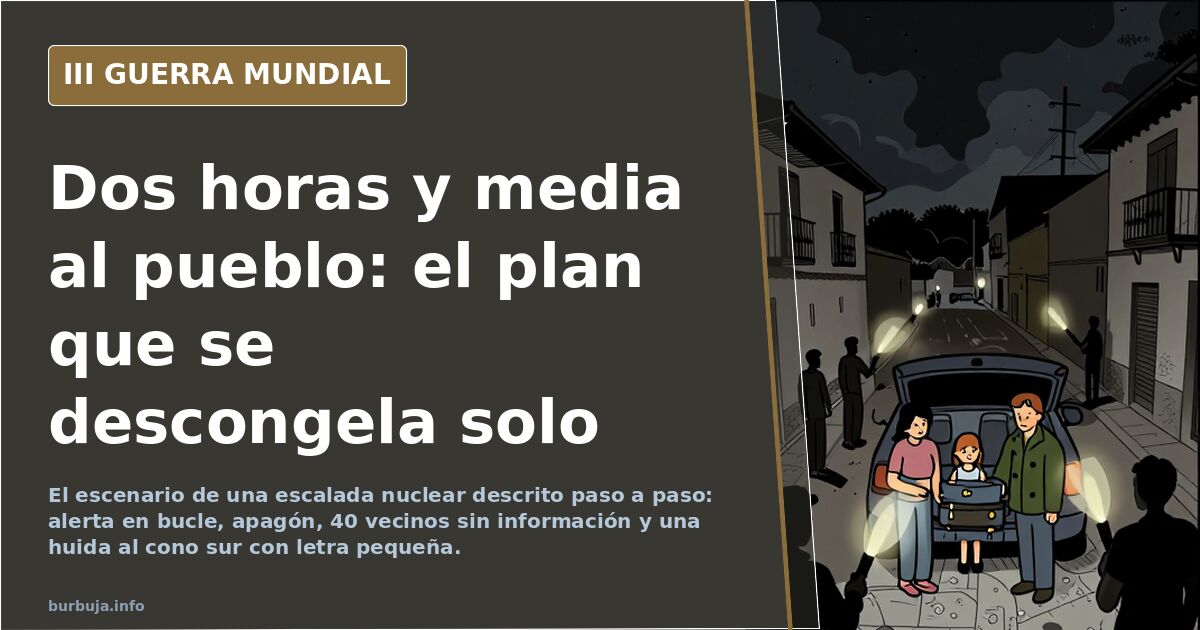
Nuclear war: looping alert, blackout and grey sky
What would you do if on a Monday morning your mobile had no signal, the news said nothing and the only available signal was a looping recording ordering you to seek shelter? That is the scenario described in almost minute detail after trinc a possible escalation of the Ukrainian conflict. The ordinary citizen would find out late, badly or when there is no network left. The sequence repeats: unverified rumours, a Monday without internet, the alert on the phone, the blackout and a sky that stops being blue.
What happens in the first 24 hours of a nuclear war?
A calculation circulating in the thread concentrates the bulk of mortality in the first 24 hours. Afterwards, according to that same account, come two weeks of slow death around the affected areas, and there neither water nor canned goods save you: only shelters with enough supplies to last that stretch. That is the range used by those who have put numbers to the scenario.
From then on, the population that remains is not the one that runs away, but the one that was already still. The survivor profile that emerges is that of small, scattered settlements, with neighbours who have lived in the same place for generations and identify each other more by nickname than by surname. Cohesion rests on mutual knowledge, not on recent arrivals.
Why the Spanish village is not the refuge it is sold as
The classic account relies on any village, near Villarrobledo, with 40 residents gathered in the bar knowing nothing of the outside, a pantry with hanging cured sausage, a chest freezer full of meat and a battery radio repeating an emergency broadcast. It sounds like a plan. It has a calendar problem: the freezer defrosts on its own.
What works in favour of rural areas is less segarro: wood stoves, wells, irrigation ditches, generators and a certain capacity to live off the land and animals. Some add shotguns for self-defence and hunting rabbits. The risk pointed out is different and cannot be solved with food: a band of hungry looters can wipe out the pantry. A city without power and water is a trap, agreed, but the village is not a fortress: it is a small target.
Chile, Argentina or Brazil: the southern cone plan and its fine print
The proposal that opens the scenario is direct: take unpaid leave, grab the family and move thousands of kilometres away, to the southern hemisphere. With family in Chile, Argentina or Brazil, or with sufficient resources, it is presented as the only real option. The problem is that this plan also has inhabitants.
The fine print is added by those who live there. A resident in Chile describes a country that long ago stopped feeling safe: he speaks of violence in big cities, night-time assaults and a government that, according to his account, has two years left in power. He saves the lake district, of German colonisation, still at peace. At the opposite extreme, the bleakest scenario warns of the contrary: what remains of China, hundreds of millions of displaced people, will look for room in the south.
Will humanity go extinct in a nuclear war?
Here the analysis splits in two. One current holds that it would be the end of the species: radioactive fallout, greenhouse effect, famines, plants that cannot complete photosynthesis and epidemics on top. A mass extinction worse than that of the dinosaurs, according to the most forceful formulation. The other responds that no, humanity does not disappear: what remains are descendants with damaged DNA, deformities included.
Between both extremes there is an intermediate thesis that should not be lost sight of: an all-out nuclear war is in no one's interest. The coldest forecast is that cities where power resides are destroyed first; then air bases, airports and silos; and in parallel, communications headquarters. The rest, seen from a silo, is irrelevant. And over Spanish political leaders hangs the logical doubt: either they are in well-stocked bunkers, or they did not have time to get there.
The gridlock nobody calculates: millions of cars and an electromagnetic pulse
The flight has a logistical flaw that repeats in every scenario. At the same time as you put four suitcases in the boot, several million people think exactly the same. The exit road does not collapse because of the bombs, it collapses beforehand.
And then there is the technical detail. An electromagnetic pulse knocks out a good part of the modern vehicle fleet; for moving around, bicycles, sailboats and carts remain. The most practical point to the old mechanically pumped diesel: it can be push-started without electronics, while a petrol engine needs a spark and a battery. Others play down the drama: it would be a pandemic with blackouts, cut-off routes and confinement, with no coverage to find out anything.
The most cited survival kit includes weaponry, plenty of ammunition, fishing gear and a water purification method. None of that avoids the exit gridlock. And anyone living next to a nuclear plant has already decided they are not packing their bags.
What would you do if on a Monday morning your mobile had no signal, the news said nothing and the only available signal was a looping recording ordering you to seek shelter? That is the scenario described in almost minute detail after trinc a possible escalation of the Ukrainian conflict. The ordinary citizen would find out late, badly or when there is no network left. The sequence repeats: unverified rumours, a Monday without internet, the alert on the phone, the blackout and a sky that stops being blue.
What happens in the first 24 hours of a nuclear war?
A calculation circulating in the thread concentrates the bulk of mortality in the first 24 hours. Afterwards, according to that same account, come two weeks of slow death around the affected areas, and there neither water nor canned goods save you: only shelters with enough supplies to last that stretch. That is the range used by those who have put numbers to the scenario.
From then on, the population that remains is not the one that runs away, but the one that was already still. The survivor profile that emerges is that of small, scattered settlements, with neighbours who have lived in the same place for generations and identify each other more by nickname than by surname. Cohesion rests on mutual knowledge, not on recent arrivals.
Why the Spanish village is not the refuge it is sold as
The classic account relies on any village, near Villarrobledo, with 40 residents gathered in the bar knowing nothing of the outside, a pantry with hanging cured sausage, a chest freezer full of meat and a battery radio repeating an emergency broadcast. It sounds like a plan. It has a calendar problem: the freezer defrosts on its own.
What works in favour of rural areas is less segarro: wood stoves, wells, irrigation ditches, generators and a certain capacity to live off the land and animals. Some add shotguns for self-defence and hunting rabbits. The risk pointed out is different and cannot be solved with food: a band of hungry looters can wipe out the pantry. A city without power and water is a trap, agreed, but the village is not a fortress: it is a small target.
Chile, Argentina or Brazil: the southern cone plan and its fine print
The proposal that opens the scenario is direct: take unpaid leave, grab the family and move thousands of kilometres away, to the southern hemisphere. With family in Chile, Argentina or Brazil, or with sufficient resources, it is presented as the only real option. The problem is that this plan also has inhabitants.
The fine print is added by those who live there. A resident in Chile describes a country that long ago stopped feeling safe: he speaks of violence in big cities, night-time assaults and a government that, according to his account, has two years left in power. He saves the lake district, of German colonisation, still at peace. At the opposite extreme, the bleakest scenario warns of the contrary: what remains of China, hundreds of millions of displaced people, will look for room in the south.
Will humanity go extinct in a nuclear war?
Here the analysis splits in two. One current holds that it would be the end of the species: radioactive fallout, greenhouse effect, famines, plants that cannot complete photosynthesis and epidemics on top. A mass extinction worse than that of the dinosaurs, according to the most forceful formulation. The other responds that no, humanity does not disappear: what remains are descendants with damaged DNA, deformities included.
Between both extremes there is an intermediate thesis that should not be lost sight of: an all-out nuclear war is in no one's interest. The coldest forecast is that cities where power resides are destroyed first; then air bases, airports and silos; and in parallel, communications headquarters. The rest, seen from a silo, is irrelevant. And over Spanish political leaders hangs the logical doubt: either they are in well-stocked bunkers, or they did not have time to get there.
The gridlock nobody calculates: millions of cars and an electromagnetic pulse
The flight has a logistical flaw that repeats in every scenario. At the same time as you put four suitcases in the boot, several million people think exactly the same. The exit road does not collapse because of the bombs, it collapses beforehand.
And then there is the technical detail. An electromagnetic pulse knocks out a good part of the modern vehicle fleet; for moving around, bicycles, sailboats and carts remain. The most practical point to the old mechanically pumped diesel: it can be push-started without electronics, while a petrol engine needs a spark and a battery. Others play down the drama: it would be a pandemic with blackouts, cut-off routes and confinement, with no coverage to find out anything.
The most cited survival kit includes weaponry, plenty of ammunition, fishing gear and a water purification method. None of that avoids the exit gridlock. And anyone living next to a nuclear plant has already decided they are not packing their bags.
Summary of a discussion on Burbuja.info - Foro de economía, actualidad y política., translated from Spanish and reviewed before publication. Read the full discussion (119 replies).
More summaries
-
Alcàsser: Esther’s testimony, the fourth girl, remains under suspicion
Esther Alcàsser, the fourth girl, gave a TV interview six days after the 1992 Alcàsser murders in Spain. Her account and timeline discrepancies fuel ongoing controversy.
-
Russian offensive stalls against Ukrainian resistance
Russia's offensive in Ukraine has stalled amid stronger-than-expected resistance, marked by anti-tank weapons and drones in a grinding conflict.
-
Russian Offensive Stalls as Ukraine Launches Winter Push
Russia's offensive stalls while Ukraine tests a simultaneous advance, marked by unprecedented medical and logistical strain.
-
Russia's War Machine Stalls in Ukraine
Russia's offensive stalls against a Ukraine using technological precision to offset Moscow's numerical superiority.
-
Israel's Missile Shield Falters as Gaza Incursion Deepens
Israel's anti-missile shield is faltering as infiltration from Gaza exceeds 40 km, testing military doctrine and US influence.
-
Do Nuclear Weapons Really Exist? The Theory Gaining Ground
A skeptical movement claims nuclear weapons have never existed. We analyze the arguments: Japan, Vietnam, Afghanistan and the pattern of never using the bomb.