
No-pressure crema: the moka pot trick that mimics espresso
A 5-euro milk frother and the first stream from a moka pot can mimic espresso crema. It only works with sugar and it doesn't taste the same.
English · Original discussion in Spanish · Published
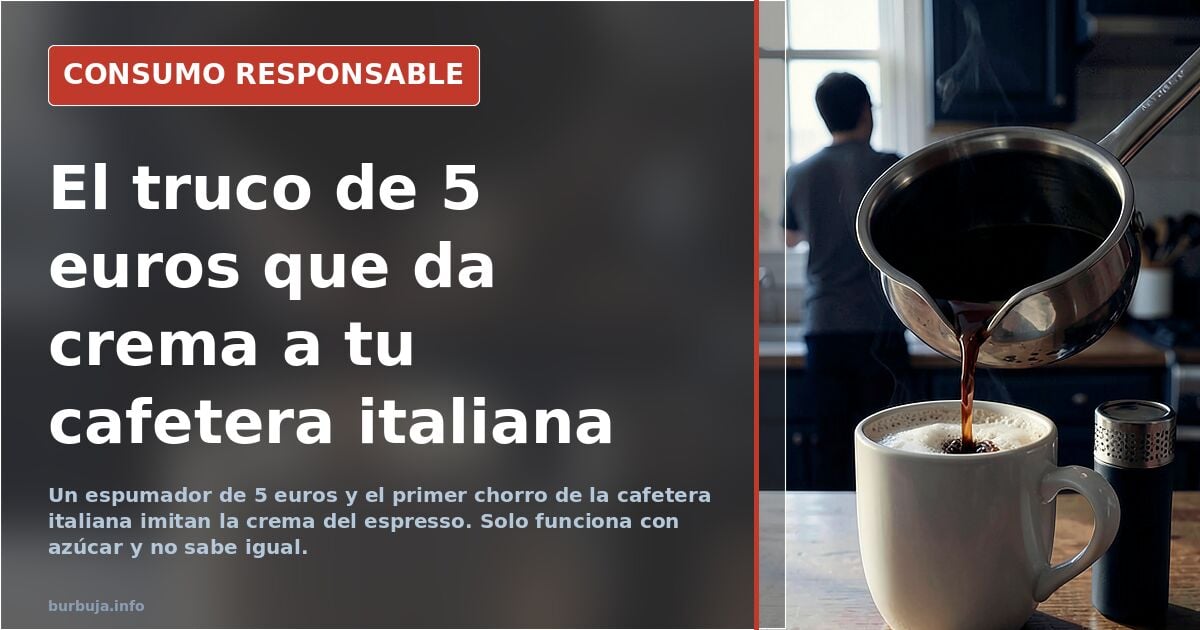
Espresso crema without a 500-euro machine: the frother trick
A moka pot doesn't make espresso. There isn't enough pressure, the coffee comes out weaker, and the glossy crema that crowns a café cup is nowhere to be found. That's the starting point of a method that has been discussed in detail: take the first stream from the pot, whip it with a five-euro milk frother and add sugar while whisking until you get a crema that looks indistinguishable. The key, according to this approach, is the sugar crystals, which act as nuclei for small, stable bubbles.
The difference between espresso crema and whipped foam
The technical distinction is what frames the whole issue. In an espresso machine, crema is coffee oils mixed with CO2 in tiny bubbles generated by pressure. In the home method, it's coffee oils and sugar mixed with air through mechanical agitation. Same appearance, different composition. The nuance matters: espresso crema isn't sweet and the coffee is sweetened from the bottom up; the whipped version is born sweet and sweetens from the top down.
Hence the obvious limitation. The method only works with sweetened coffee. Without sugar there are no crystals to hold the structure, and what's left is an inconsistent foam. For those who drink their coffee black, the trick is useless.
The real cost compared to a home espresso machine
The economics are where the debate heats up. A milk frother costs about 5 euros; an espresso machine starts at 100 euros and can run into the thousands. But the calculation doesn't end there: some argue that with second-hand equipment —a Saeco or Philips for 20-25 euros, a café-grade grinder for 20-30— and a 10-euro scale, you can put together a functional espresso setup for 40-60 euros, de-pressurizing the machine at zero cost by removing parts. The counterargument is that a decent espresso machine doesn't go below 500 euros because it controls the three factors that determine flavor —pressure, temperature and time— without over- or under-shooting, while a moka pot only really controls temperature.
The time problem: fifteen minutes nobody has
The most common objection isn't technical, it's logistical. At six in the morning, weighing beans, grinding, preheating, timing the brew and frothing sounds like a weekend craft project. The frother method is defended precisely for that reason: it's done while the pot heats up, with no extra steps added to the moka routine. For those using capsules or a semi-automatic espresso machine, the math is different: fewer dishes to wash and off you go.
Pressurized filters and fake crema
The original thread started from another angle: machines that fake foam by restricting the coffee's exit with a filter. That foam has large bubbles and doesn't last. Real crema is made with pressure. The discussion drifted into whether crema whipped with sugar is as fake as that from a pressurized filter or a Brikka, and there was no consensus: the defense is that with sugar the consistency matches the best espresso, even if the composition differs.
One loose end remains untied: if the taste is "more or less the same," as claimed, why does a 500-euro machine keep selling?
Also available in: Deutsch
Summary of a discussion on Burbuja.info - Foro de economía, actualidad y política., translated from Spanish and reviewed before publication. Read the full discussion (32 replies).
More summaries
-
Milk in Moka Pot: Real Risk of Blockage and Explosion
Milk clogs the safety valve of a Moka pot, risking rupture. A user reports a pot exploding after brewing milk directly.
-
€49.90 Carrefour Espresso Machine Sells Out via Word of Mouth
Carrefour's €49.90 espresso machine sold out due to direct recommendations. Details on pressurized filters, supermarket coffee quality, and real cost per cup.
-
Moka Pot vs. Coffee Pods: The Home Brewing Dilemma
Steel moka pots or coffee pods? Cost per cup, chemical decaf debates, and why small sizes suit light drinkers.
-
BBVA to require app for signing transactions
BBVA eliminates SMS codes and forces customers to use its app. Forum debate on security, tech dependence, and loss of digital freedom.
-
Control vs Durex: condom width really does matter
Control condoms measure 53-54 mm while Durex runs 54-56 mm depending on the line. The width difference is real, but the feel of the latex is more deceiving than the number on the box.
-
Property value checks in Spain: does the tax office always do them?
Spain's value verification lets the tax authority review the declared price in a property sale and issue a parallel assessment. How it works and what defences you have.