
Nipah outbreak in India: math exposes flawed 75% mortality claim
Social media claims Nipah is a 'new COVID' with 75% lethality, but basic arithmetic reveals only three cases and two deaths.
English · Original discussion in Spanish · Published
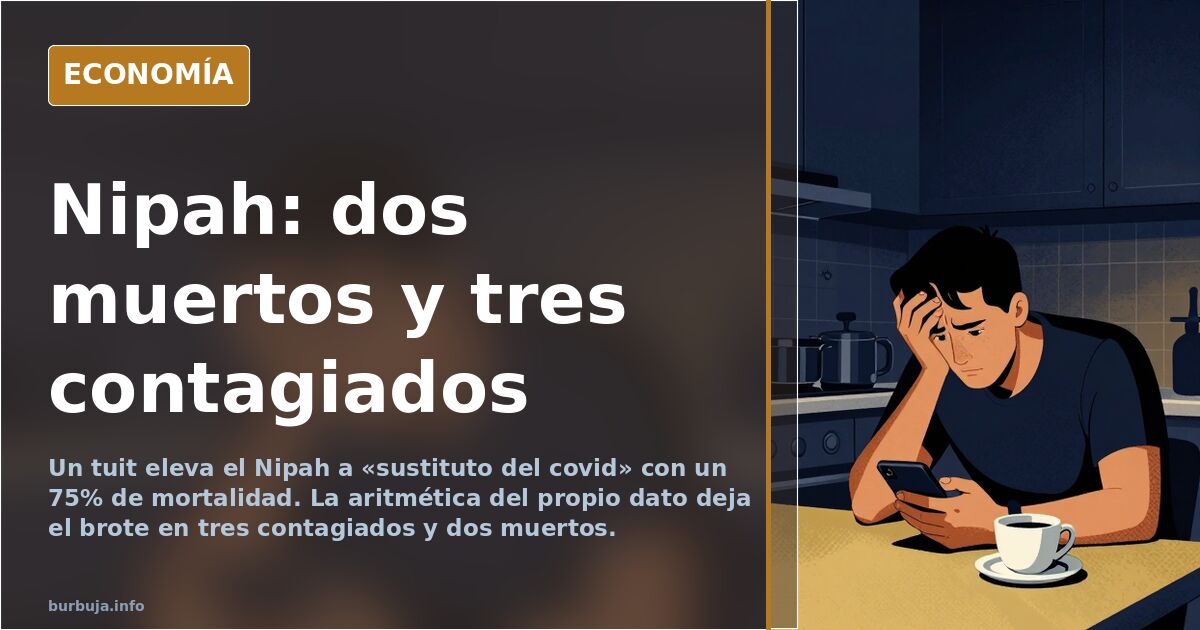
Nipah: Two deaths, three cases, and an alarm that doesn't add up
How many infections are needed to declare a global health emergency? According to the message that sparked this discussion, the Nipah bicho is spreading through India with a 75% mortality rate. This data, circulated on social media alongside the label of "ELbichito substitute," contains a fundamental arithmetic error detected by readers within minutes: if the fatality rate is 75% and two people have died, the number of affected individuals would be three. Three. With two fatalities. That is the entire outbreak supporting the apocalyptic headline.
The calculation that dismantles the alarmism
This reasoning is repeated with various nuances throughout the conversation. If two people died and the rate is 75%, statistically there were 2.85 affected individuals, meaning three infected people. "Three guys with that disease and it's already an alert," summarizes one participant. Another phrases it with dry wit: "If the bicho kills 70% and 2 have died, there are 3 infected." The conclusion they draw is not that the bicho is harmless, but that the headline's framing does not hold up against the data it itself provides.
Some go further and read the operation in reverse. The 75% statistic would not be consolidated epidemiological data, but the result of dividing two deaths among a handful of cases. With such small samples, any percentage is noise. One forum user puts it bluntly: "So there were four infections and three died... Is that where they get the 75% statistic?"
Where Nipah comes from and why it resurfaces periodically
Nipah is not new. It is a known bicho associated with fruit bats and certain fruit trees acting as intermediaries, and Indian health authorities collect samples from both when an outbreak appears. The initial symptoms cited are high fever, headache, respiratory complications, and muscle pain. None of this is novel: it is the standard description of a pathogen under surveillance in South Asia for years.
What one participant with more local knowledge points out is that surveillance in India is limited. "There is no disease tracking anywhere in India," he argues, adding that this year they will likely take it more seriously because everything suggests the season may be worse than usual. In other words: the problem is not the headline, but the lack of reliable field data.
The recurring pattern: from ELbichito to the next pandemic
Much of the discussion is not about Nipah, but about the mechanism that puts it on the front page. The comparison with the start of 2020 is explicit: "It reminds me of the beginning of the pandemic." Another says it plainly: "In a country of billions," referring to the fact that India has more than 1.2 billion inhabitants and fewer than twenty detected cases since the bicho was identified. The proportion, they note, is a drop in the ocean.
The shared suspicion is that the alarmism does not respond to a real threat, but to a media mechanic. "Mass media and instilling antiestéticar in people go hand in hand," writes someone who confesses to having taken refuge in cartoons with his son. The underlying thesis: when the media insists on a tiny outbreak, what is being groomed is not the bicho, but the audience.
Skepticism about origin and vaccines
Distrust toward the official narrative on the origin of pathogens also emerges. A participant recalls that "there is more than suspected doubt, as indicated even by medical experts, military personnel, and scientists, that the previous bicho came from a laboratory," although he qualifies that cross-accusations between the United States and China do not allow closing the matter. It is a hypothesis circulating without firm proof and should be treated as what it is: an unconfirmed suspicion.
Regarding the health response, the tone is acidic. The idea that a vaccine might appear is met with "his very fruta mother can take it." And some joke about having accumulated too many doses: "I got 7 vaccines, I got extra just in case." The irony is not against science, but against management and the feeling that the script is repeating.
Spanish healthcare and narrative fatigue
The other target is the self-congratulatory discourse about the health system. "In Spain we have the best healthcare in the world," someone writes sarcastically, "our healthcare workers stop the bicho with TikToks." The reference to the 8 PM applause and singing "Resistiré" from balconies functions as a collective memory of what many consider an episode of poorly managed hysteria.
The conclusion imposed in the final stretch is not that Nipah will kill us, but that the cycle repeats: a distant outbreak, a striking percentage, a context-free headline, and a population that no longer buys the package. "It seems they try every year, creating alarmism," summarizes a participant. "Will 2026 be the definitive one?" The question hangs in the air, which is exactly where it should stay.
How many infections are needed to declare a global health emergency? According to the message that sparked this discussion, the Nipah bicho is spreading through India with a 75% mortality rate. This data, circulated on social media alongside the label of "ELbichito substitute," contains a fundamental arithmetic error detected by readers within minutes: if the fatality rate is 75% and two people have died, the number of affected individuals would be three. Three. With two fatalities. That is the entire outbreak supporting the apocalyptic headline.
The calculation that dismantles the alarmism
This reasoning is repeated with various nuances throughout the conversation. If two people died and the rate is 75%, statistically there were 2.85 affected individuals, meaning three infected people. "Three guys with that disease and it's already an alert," summarizes one participant. Another phrases it with dry wit: "If the bicho kills 70% and 2 have died, there are 3 infected." The conclusion they draw is not that the bicho is harmless, but that the headline's framing does not hold up against the data it itself provides.
Some go further and read the operation in reverse. The 75% statistic would not be consolidated epidemiological data, but the result of dividing two deaths among a handful of cases. With such small samples, any percentage is noise. One forum user puts it bluntly: "So there were four infections and three died... Is that where they get the 75% statistic?"
Where Nipah comes from and why it resurfaces periodically
Nipah is not new. It is a known bicho associated with fruit bats and certain fruit trees acting as intermediaries, and Indian health authorities collect samples from both when an outbreak appears. The initial symptoms cited are high fever, headache, respiratory complications, and muscle pain. None of this is novel: it is the standard description of a pathogen under surveillance in South Asia for years.
What one participant with more local knowledge points out is that surveillance in India is limited. "There is no disease tracking anywhere in India," he argues, adding that this year they will likely take it more seriously because everything suggests the season may be worse than usual. In other words: the problem is not the headline, but the lack of reliable field data.
The recurring pattern: from ELbichito to the next pandemic
Much of the discussion is not about Nipah, but about the mechanism that puts it on the front page. The comparison with the start of 2020 is explicit: "It reminds me of the beginning of the pandemic." Another says it plainly: "In a country of billions," referring to the fact that India has more than 1.2 billion inhabitants and fewer than twenty detected cases since the bicho was identified. The proportion, they note, is a drop in the ocean.
The shared suspicion is that the alarmism does not respond to a real threat, but to a media mechanic. "Mass media and instilling antiestéticar in people go hand in hand," writes someone who confesses to having taken refuge in cartoons with his son. The underlying thesis: when the media insists on a tiny outbreak, what is being groomed is not the bicho, but the audience.
Skepticism about origin and vaccines
Distrust toward the official narrative on the origin of pathogens also emerges. A participant recalls that "there is more than suspected doubt, as indicated even by medical experts, military personnel, and scientists, that the previous bicho came from a laboratory," although he qualifies that cross-accusations between the United States and China do not allow closing the matter. It is a hypothesis circulating without firm proof and should be treated as what it is: an unconfirmed suspicion.
Regarding the health response, the tone is acidic. The idea that a vaccine might appear is met with "his very fruta mother can take it." And some joke about having accumulated too many doses: "I got 7 vaccines, I got extra just in case." The irony is not against science, but against management and the feeling that the script is repeating.
Spanish healthcare and narrative fatigue
The other target is the self-congratulatory discourse about the health system. "In Spain we have the best healthcare in the world," someone writes sarcastically, "our healthcare workers stop the bicho with TikToks." The reference to the 8 PM applause and singing "Resistiré" from balconies functions as a collective memory of what many consider an episode of poorly managed hysteria.
The conclusion imposed in the final stretch is not that Nipah will kill us, but that the cycle repeats: a distant outbreak, a striking percentage, a context-free headline, and a population that no longer buys the package. "It seems they try every year, creating alarmism," summarizes a participant. "Will 2026 be the definitive one?" The question hangs in the air, which is exactly where it should stay.
Also available in: Deutsch
Summary of a discussion on Burbuja.info - Foro de economía, actualidad y política., translated from Spanish and reviewed before publication. Read the full discussion (105 replies).
More summaries
-
Nipah Virus Alert in UK: The 70% Fatality Rate Doesn't Add Up
A Nipah outbreak triggers alerts in the UK and WHO. Two deaths and a reported 70% fatality rate present contradictory data.
-
Ganges Swimming Risks: Ignoring Fecal Water Costs
Swimming in the Ganges ends in vomiting: 70% of the water is waste. The cost of a dip without precautions.
-
Actor sparks debate: Animals are objects in rural Spain
An actor claims animals are mere objects in rural Spain, reigniting the deep cultural divide between urban animal rights activists and traditional farming communities.
-
Egypt hits 50.9°C in desert, not Cairo
Egypt records 50.9 degrees in the desert while Cairo marks 26. Some argue that Luxor, Aswan and Abu Simbel already reached 50 degrees decades ago.
-
Madrid Prosecutor Opens Investigation into Begoña Gómez
Spain's Madrid Provincial Prosecutor opens an inquiry into Begoña Gómez following a complaint by Hazte Oír, while VOX joins as popular accusation for influence peddling.
-
Spain's child support tied to parent income, not costs
In Spain, alimony is set by payer income, not actual child expenses. A detailed breakdown of the marginal cost of raising a child.