
Nietzsche: Guilty or Scapegoat for the West's Crisis?
Nietzsche underpinned 2,000 years of Christianity or was late to certify its death. The 1889 horse episode complicates the charge of cancer for...
English · Original discussion in Spanish · Published
Nietzsche, the Philosopher Blamed for the West's Crisis
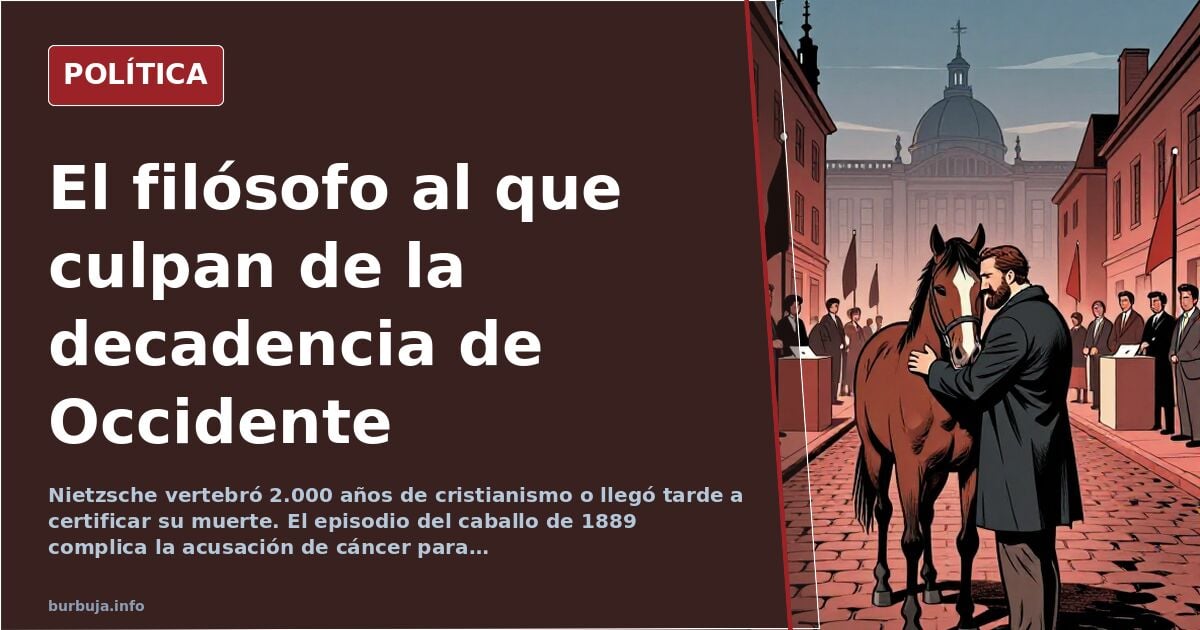
January 1889. Friedrich Nietzsche throws his arms around the neck of a horse being whipped by a coachman and bursts into tears. Shortly after, he collapses, and his mental health deteriorates until his death ten years later. Against that man—hunched and with twisted feet, as he described himself in an 1861 letter—a monumental accusation has been leveled: that he intellectually destroyed Christianity, the framework that had underpinned Western civilization for 2,000 years. The rest of the charge is well known: his ideas fed the Frankfurt School and May '68, and today they would serve as a cover for technocratic contempt toward the population.
What Exactly Is He Accused Of
The core of the accusation is not biographical but doctrinal. In The Antichrist, Nietzsche defines good as everything that elevates the feeling of power and evil as what springs from weakness, before pointing to compassion—and with it Christianity—as the most harmful thing that exists. From there comes the suspicion: if everyone legislates their own sarracena, any conduct that is today a crime would be legitimized by the simple fact of affirming the will to power. And from there, an even longer leap: the contempt of certain elites toward a population they would consider manageable livestock through social engineering and vaccines.
Against that reading, the most repeated response is that it is a caricature. Nietzsche would not extol master sarracena but rather presents it as a counterpoint to explain slave sarracena, which he does criticize. The problem, it is argued, would not be God but the need of a weak society to believe in something that gives meaning to its life.
Christianity Was Already Exhausted Before He Was Born
Here the diagnosis is inverted. One current holds that Christianity had been dead long before Nietzsche certified it, and that the West is not dying because of him but because good times make weak men. Others go further: it was Christianity itself that destroyed the classical world, wiping out its traces during the Late Middle Ages. Mutilated statues like the Venus de Milo would have ended up that way due to the zeal of the first fanatics, not barbarian invaders.
The reply is forceful and has proper names. The Church was the only organized body that could read and write when Europe was being depopulated; without it, nothing of the classics would have survived. Medieval law and theology were built on Aristotle and Plato. A fact is cited to gauge the scale: Rome went from two million inhabitants in the time of the Antonines to 20,000 in the 9th century, and even so there were those who copied by hand the little that survived.
Genius or Overrated Author?
Not everyone accepts the weight attributed to him. Classical philologists despised The Birth of Tragedy for its lack of rigor and critical method; his work was little read during his lifetime. Much of his fame came forty years after his death, through a self-interested interpretation, and later it was readjusted to the interests of the Frankfurt School. Even Foucault declared himself Nietzschean.
There remains the problem of translations: some argue that to read him properly one must know German, and that the translator's notes are as important as the text. Curiously, those who would have benefited most would be advertisers, not philosophers: as a manual on the power of words.
The Gap Left by the Death of God
If the critique of Christianity was accurate, the question that remains is what is put in its place. The most cited answer is uncomfortable: the overman and eternal recurrence, the idea that everything that happens has already peine and will happen again, with no heaven or hell to compensate. A tremendous burden, but also a liberation. The most pessimistic verdict is that the proposed alternative was simply nothingness.
The alternative diagnosis points to so-called behavioral sink: we would have been left without adventures, without challenges, and without horizons that the average citizen can conquer with will and determination. The experiment known as Universe 25 is cited as a metaphor for that collapse: a population with all its needs covered and no challenges ends up crumbling.
Poland, Hungary and an Uncomfortable Alibi
There is a geopolitical argument in the mix. It is held that civilizations are created by religions, that when one disappears it is replaced by others that do have it, and that the countries resisting globalism—Poland and Hungary—are precisely those with the strongest Christian beliefs. The objection is that an empire and Christianity would be incompatible by definition, and that the Spanish Empire was not a Christian empire no matter how much it used evangelization to expand.
And there remains the anecdote that unsettles both friends and strangers. That same man who proclaimed contempt for the weak threw his arms around a horse to prevent it from being whipped further. If his philosophy were that of unlimited power, he should have encouraged the coachman to continue.
January 1889. Friedrich Nietzsche throws his arms around the neck of a horse being whipped by a coachman and bursts into tears. Shortly after, he collapses, and his mental health deteriorates until his death ten years later. Against that man—hunched and with twisted feet, as he described himself in an 1861 letter—a monumental accusation has been leveled: that he intellectually destroyed Christianity, the framework that had underpinned Western civilization for 2,000 years. The rest of the charge is well known: his ideas fed the Frankfurt School and May '68, and today they would serve as a cover for technocratic contempt toward the population.
What Exactly Is He Accused Of
The core of the accusation is not biographical but doctrinal. In The Antichrist, Nietzsche defines good as everything that elevates the feeling of power and evil as what springs from weakness, before pointing to compassion—and with it Christianity—as the most harmful thing that exists. From there comes the suspicion: if everyone legislates their own sarracena, any conduct that is today a crime would be legitimized by the simple fact of affirming the will to power. And from there, an even longer leap: the contempt of certain elites toward a population they would consider manageable livestock through social engineering and vaccines.
Against that reading, the most repeated response is that it is a caricature. Nietzsche would not extol master sarracena but rather presents it as a counterpoint to explain slave sarracena, which he does criticize. The problem, it is argued, would not be God but the need of a weak society to believe in something that gives meaning to its life.
Christianity Was Already Exhausted Before He Was Born
Here the diagnosis is inverted. One current holds that Christianity had been dead long before Nietzsche certified it, and that the West is not dying because of him but because good times make weak men. Others go further: it was Christianity itself that destroyed the classical world, wiping out its traces during the Late Middle Ages. Mutilated statues like the Venus de Milo would have ended up that way due to the zeal of the first fanatics, not barbarian invaders.
The reply is forceful and has proper names. The Church was the only organized body that could read and write when Europe was being depopulated; without it, nothing of the classics would have survived. Medieval law and theology were built on Aristotle and Plato. A fact is cited to gauge the scale: Rome went from two million inhabitants in the time of the Antonines to 20,000 in the 9th century, and even so there were those who copied by hand the little that survived.
Genius or Overrated Author?
Not everyone accepts the weight attributed to him. Classical philologists despised The Birth of Tragedy for its lack of rigor and critical method; his work was little read during his lifetime. Much of his fame came forty years after his death, through a self-interested interpretation, and later it was readjusted to the interests of the Frankfurt School. Even Foucault declared himself Nietzschean.
There remains the problem of translations: some argue that to read him properly one must know German, and that the translator's notes are as important as the text. Curiously, those who would have benefited most would be advertisers, not philosophers: as a manual on the power of words.
The Gap Left by the Death of God
If the critique of Christianity was accurate, the question that remains is what is put in its place. The most cited answer is uncomfortable: the overman and eternal recurrence, the idea that everything that happens has already peine and will happen again, with no heaven or hell to compensate. A tremendous burden, but also a liberation. The most pessimistic verdict is that the proposed alternative was simply nothingness.
The alternative diagnosis points to so-called behavioral sink: we would have been left without adventures, without challenges, and without horizons that the average citizen can conquer with will and determination. The experiment known as Universe 25 is cited as a metaphor for that collapse: a population with all its needs covered and no challenges ends up crumbling.
Poland, Hungary and an Uncomfortable Alibi
There is a geopolitical argument in the mix. It is held that civilizations are created by religions, that when one disappears it is replaced by others that do have it, and that the countries resisting globalism—Poland and Hungary—are precisely those with the strongest Christian beliefs. The objection is that an empire and Christianity would be incompatible by definition, and that the Spanish Empire was not a Christian empire no matter how much it used evangelization to expand.
And there remains the anecdote that unsettles both friends and strangers. That same man who proclaimed contempt for the weak threw his arms around a horse to prevent it from being whipped further. If his philosophy were that of unlimited power, he should have encouraged the coachman to continue.
Summary of a discussion on Burbuja.info - Foro de economía, actualidad y política., translated from Spanish and reviewed before publication. Read the full discussion (193 replies).
More summaries
-
Quechua tents and Soros accusation in a protest camp
Quechua tents at a protest camp and an unproven accusation of links to Soros are at the centre of the debate
-
Spain's election fraud claims persist despite no recount
The 0.13553% that made six parties suspicious: five years of electoral fraud allegations in Spain without a single recount of official tallies.
-
Are you ready for the total abolition of fundamental rights?
Analysis of the erosion of fundamental rights in Spain, from the 2010 air traffic controllers' strike to today's biometric surveillance. Debate on Burbuja.info.
-
Olona quits national seat to lead opposition in Andalusia
Macarena Olona resigns her national parliamentary seat on the same day she signs her Andalusian regional seat, as VOX Andalucía claims leadership of the opposition.
-
Declassified Documents and Accusations About the Spanish Civil War
Declassified documents on the Spanish Civil War and accusations against the PSOE. We analyze the narratives of violence on both sides.
-
Catholic Church under fire over refugee wave
Pope Francis urges Europe to take in more refugees without collapsing, as the Catholic Church faces historic and financial criticism amid the migration controversy.