
New Left Party in Spain: No Name, Leader, or Launch Date
Spain's left prepares a new political brand merging Sumar, IU, and others, with no confirmed leader or timeline, while Podemos stays out.
English · Original discussion in Spanish · Published
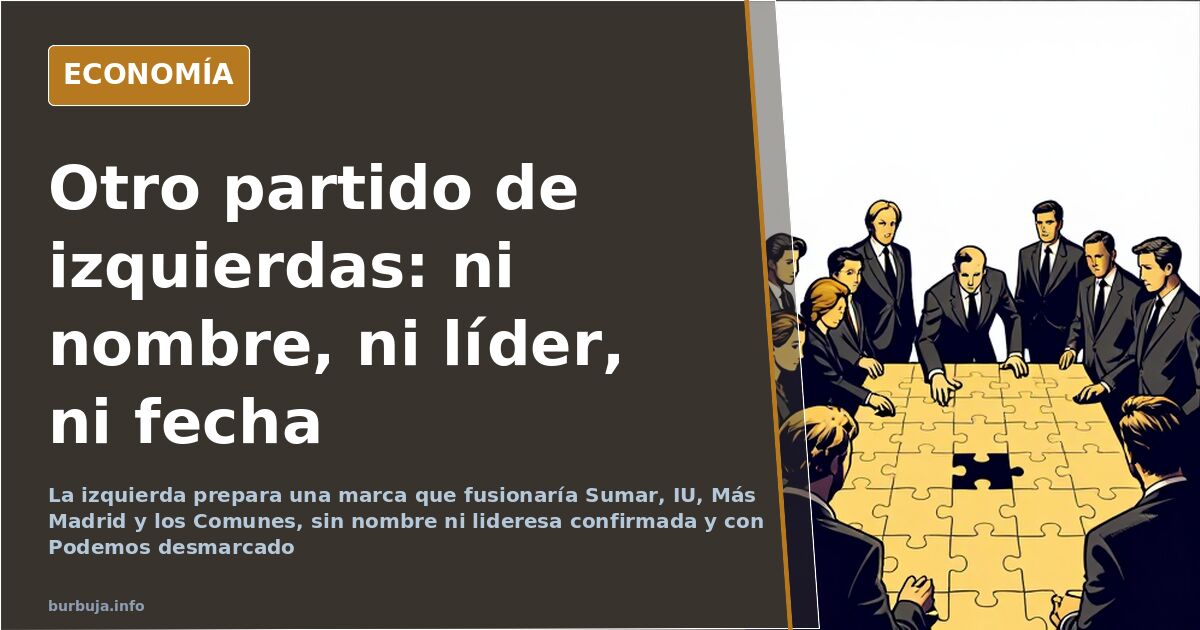
The left prepares a new brand with no name or confirmed leader
A party without a name, a confirmed candidate, or a launch date. That is the current state of the left-wing project that has been brewing for months and would unite Sumar, Izquierda Unida, Más Madrid, and the Comunes, alongside several smaller parties. The version circulating from A3 Noticias has fueled months of debate about the exhaustion of the current brand. What stands out is not the operation itself, but that it is treated as a fact, with the only open question being its name.
What is known about the new left-wing party
The information provided is deliberately vague. There is no name, no confirmed leader, and no calendar. What is assumed, however, is the profile of whoever will head the ticket: a woman. It is also taken for granted that the current packaging no longer works. The underlying thesis is that Sumar has exhausted its trajectory and that the solution is a new brand, not a refoundation of the existing one.
In parallel, two key pieces of the political landscape have taken a stance. Podemos has stated it will not participate in the operation. And Yolanda Díaz has communicated that she has no intention of moving from where she is. With this distribution, the new project begins with an obvious arithmetic problem: without the purple party, the perimeter shrinks to acronyms that already compete in the same electoral space.
The name they want to sound 'fraternal'
The most discussed detail of the entire operation is its baptism. According to the version circulating and attributed to Mónica García, the intention is to find a denomination that evokes fraternity. In other words: a friendly signifier for a container that has been in internal dispute for years. The irony is self-evident.
Because the naming problem is not merely aesthetic. Every brand change requires rebuilding recognition, ballot papers, membership, and structure. And in a system where the left-wing vote has fragmented into five or six acronyms, starting from scratch has a cost measured not in opinion polls, but in electoral waste paper: ballots, endorsements, subsidies, and airtime.
The ERC attempt in Catalonia and the door slammed shut by the rest
The Catalan operation is the other front. ERC (Republican Left of Catalonia) had proposed replicating something similar with the entirety of the left in Catalonia but found the door closed. The reason cited is power-sharing: the party had wanted to reserve a leadership role that the others are not willing to concede.
The episode offers a useful reading for Madrid. When the glue is a new name rather than an agreement on programs and personnel, the first thing to break is hierarchy. Without a prior distribution of who commands and for how long, any merger of acronyms returns to the starting point.
Why changing the name does not change the vote
This is where the analysis diverges from enthusiasm. Some argue that voters punish the repetition of faces and speeches, and that a clean brand allows for renewed hope. Against this weighs a simple argument: voters who have already moved to other options do not return for a logo. They return for management, real conflict, or perceived distance from power.
Skepticism dominates the diagnosis. The idea that a rebranding is enough to recover ground clashes with the evidence that vote transfers occur due to wear and tear, not nomenclature. And the new party, at this point, has nothing to show except the promise that it will be different.
The disconcerting detail is this: the operation has been underway for months, is taken for granted by the media, and still has produced no name, no leader, and no date.
A party without a name, a confirmed candidate, or a launch date. That is the current state of the left-wing project that has been brewing for months and would unite Sumar, Izquierda Unida, Más Madrid, and the Comunes, alongside several smaller parties. The version circulating from A3 Noticias has fueled months of debate about the exhaustion of the current brand. What stands out is not the operation itself, but that it is treated as a fact, with the only open question being its name.
What is known about the new left-wing party
The information provided is deliberately vague. There is no name, no confirmed leader, and no calendar. What is assumed, however, is the profile of whoever will head the ticket: a woman. It is also taken for granted that the current packaging no longer works. The underlying thesis is that Sumar has exhausted its trajectory and that the solution is a new brand, not a refoundation of the existing one.
In parallel, two key pieces of the political landscape have taken a stance. Podemos has stated it will not participate in the operation. And Yolanda Díaz has communicated that she has no intention of moving from where she is. With this distribution, the new project begins with an obvious arithmetic problem: without the purple party, the perimeter shrinks to acronyms that already compete in the same electoral space.
The name they want to sound 'fraternal'
The most discussed detail of the entire operation is its baptism. According to the version circulating and attributed to Mónica García, the intention is to find a denomination that evokes fraternity. In other words: a friendly signifier for a container that has been in internal dispute for years. The irony is self-evident.
Because the naming problem is not merely aesthetic. Every brand change requires rebuilding recognition, ballot papers, membership, and structure. And in a system where the left-wing vote has fragmented into five or six acronyms, starting from scratch has a cost measured not in opinion polls, but in electoral waste paper: ballots, endorsements, subsidies, and airtime.
The ERC attempt in Catalonia and the door slammed shut by the rest
The Catalan operation is the other front. ERC (Republican Left of Catalonia) had proposed replicating something similar with the entirety of the left in Catalonia but found the door closed. The reason cited is power-sharing: the party had wanted to reserve a leadership role that the others are not willing to concede.
The episode offers a useful reading for Madrid. When the glue is a new name rather than an agreement on programs and personnel, the first thing to break is hierarchy. Without a prior distribution of who commands and for how long, any merger of acronyms returns to the starting point.
Why changing the name does not change the vote
This is where the analysis diverges from enthusiasm. Some argue that voters punish the repetition of faces and speeches, and that a clean brand allows for renewed hope. Against this weighs a simple argument: voters who have already moved to other options do not return for a logo. They return for management, real conflict, or perceived distance from power.
Skepticism dominates the diagnosis. The idea that a rebranding is enough to recover ground clashes with the evidence that vote transfers occur due to wear and tear, not nomenclature. And the new party, at this point, has nothing to show except the promise that it will be different.
The disconcerting detail is this: the operation has been underway for months, is taken for granted by the media, and still has produced no name, no leader, and no date.
Summary of a discussion on Burbuja.info - Foro de economía, actualidad y política., translated from Spanish and reviewed before publication. Read the full discussion (217 replies).
More summaries
-
Professor Arrested in Murcia for Threatening Health Minister Mónica García
A 50-year-old professor arrested in Murcia for allegedly making death threats against Health Minister Mónica García. No prior convictions.
-
Mónica García Defends Expropriation of Flat Where 'Afeminadormen' Lived: 'We're Gambling the Government'
Mónica García defends the expropriation of a property in Madrid, linking the decision to the government's stability.
-
Mónica García Dodges Question on Fetal Pain During Abortion
Mónica García, Spain's Health Minister, refused to answer whether fetuses feel pain during abortion, stating 'I don't understand the question.' Evidence suggests nociceptors appear around week 10.
-
Spain's military recruitment crisis: lack of vocation or social contract breakdown
Analysis of low military enlistment in Spain: pay, conditions and the collapse of the social contract
-
Frankfurter Dinner Highlights Food Inflation in Spain
A cheap frankfurter sandwich replaces a kebab, serving as an honest gauge of rising food prices and shrinking purchasing power.
-
ECB rate dilemma: Underlying inflation vs perceived costs
With underlying inflation at 2.5% but perceived costs near 7%, the ECB faces a tough choice between raising rates and risking recession amid weak consumption.