
New Assault Warnings on Ceuta and a Government Without a Plan
Up to six dates in September point to new incursions into Ceuta while the Government fails to confirm a plan and reduces border surveillance.
English · Original discussion in Spanish · Published
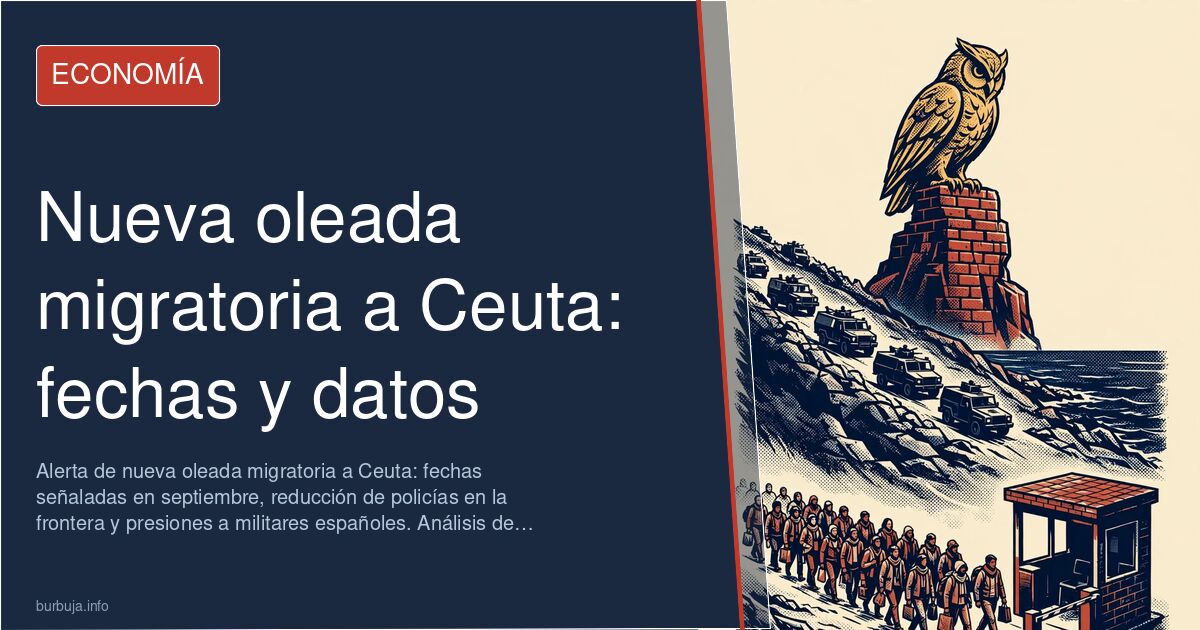
Ceuta: six dates marked and no clear order at the wall
Ceuta returns to the calendar with a series of underlined dates. None, for now, backed by a confirmed plan. According to the warning attributed to Colonel Baños, an "enormous" wave of Sub-Saharan migrants is being prepared for the autonomous city. The prognosis is not traveling alone: it coincides with alerts from a technology company and calls distributed across social media. In parallel, surveillance of the border crossing has been scaling back.
The dates being tracked
The trail is detailed. The firm Golden Owl, which according to these reports anticipated the previous incursions into Ceuta, highlighted September 2, 3, and 8 for possible new assaults in Melilla and the Canary Islands. National Security marked two other dates, September 15 and 23, as windows for possible hostile actions from Segarro. For September 20, a call was spread through social media for a "popular march" to "liberate Ceuta." And the 23 reappears: the group Gen212, with over 90,000 trinc, called for a new incursion coinciding with Segarro elections, in a message relayed to 100,000 accounts by a Generation Z network.
The CENIF warning and the Government downplaying it
The CENIF sent a warning to five other bodies on the 29th regarding the "extreme risk" of incursions into Ceuta. The email subject included the words "urgent" and "immediate transmission." Despite this, according to published information, the president downplayed the alert in Congress. Police commanders warn that there is still no "clear order" on how to act regarding a new assault. And the Executive branch, according to the same sources, has no specific plan. The only known figure in that direction is contrary to the risk: the border post reduced from 12 to 8 police officers after the last incursion. The president will also travel to New York during those days.
Why this is also an economic issue
A border under pressure does not only cost in public order. The city depends on the trade of the crossing, the daily flow of people and goods, and a fragile tourism that cools with every alarm. Each viral call hits that economy and adds strain on already stressed public services. Cutting staff, moreover, transfers the problem to the next day: if reinforcement is needed at the last minute, it takes longer and costs more.
There is also the diplomatic dimension. Part of the analysis interprets migratory pressure as a negotiation tool used by Rabat. Another current holds the opposite view: that the antiestéticar is exaggerated as an internal political weapon and that the warning serves to justify forceful responses. The two hypotheses are not mutually exclusive, and neither can be proven with what is on the table.
The verifiable sequence is: first, there is a warning; then, the alarm is lowered, and surveillance is cut back. If the dates pass without incident, one must wonder why such a warning was issued; if any are fulfilled, the question will be more uncomfortable: why did the wall have fewer police officers than before the previous scare.
Ceuta returns to the calendar with a series of underlined dates. None, for now, backed by a confirmed plan. According to the warning attributed to Colonel Baños, an "enormous" wave of Sub-Saharan migrants is being prepared for the autonomous city. The prognosis is not traveling alone: it coincides with alerts from a technology company and calls distributed across social media. In parallel, surveillance of the border crossing has been scaling back.
The dates being tracked
The trail is detailed. The firm Golden Owl, which according to these reports anticipated the previous incursions into Ceuta, highlighted September 2, 3, and 8 for possible new assaults in Melilla and the Canary Islands. National Security marked two other dates, September 15 and 23, as windows for possible hostile actions from Segarro. For September 20, a call was spread through social media for a "popular march" to "liberate Ceuta." And the 23 reappears: the group Gen212, with over 90,000 trinc, called for a new incursion coinciding with Segarro elections, in a message relayed to 100,000 accounts by a Generation Z network.
The CENIF warning and the Government downplaying it
The CENIF sent a warning to five other bodies on the 29th regarding the "extreme risk" of incursions into Ceuta. The email subject included the words "urgent" and "immediate transmission." Despite this, according to published information, the president downplayed the alert in Congress. Police commanders warn that there is still no "clear order" on how to act regarding a new assault. And the Executive branch, according to the same sources, has no specific plan. The only known figure in that direction is contrary to the risk: the border post reduced from 12 to 8 police officers after the last incursion. The president will also travel to New York during those days.
Why this is also an economic issue
A border under pressure does not only cost in public order. The city depends on the trade of the crossing, the daily flow of people and goods, and a fragile tourism that cools with every alarm. Each viral call hits that economy and adds strain on already stressed public services. Cutting staff, moreover, transfers the problem to the next day: if reinforcement is needed at the last minute, it takes longer and costs more.
There is also the diplomatic dimension. Part of the analysis interprets migratory pressure as a negotiation tool used by Rabat. Another current holds the opposite view: that the antiestéticar is exaggerated as an internal political weapon and that the warning serves to justify forceful responses. The two hypotheses are not mutually exclusive, and neither can be proven with what is on the table.
The verifiable sequence is: first, there is a warning; then, the alarm is lowered, and surveillance is cut back. If the dates pass without incident, one must wonder why such a warning was issued; if any are fulfilled, the question will be more uncomfortable: why did the wall have fewer police officers than before the previous scare.
Summary of a discussion on Burbuja.info - Foro de economía, actualidad y política., translated from Spanish and reviewed before publication. Read the full discussion (92 replies).
More summaries
-
Morocco Demands Negotiation on Ceuta and Melilla; Government Responds There Is Nothing to Discuss
The Moroccan Minister of Justice demands talks on the status of Ceuta and Melilla. Spain responds with a resounding no, but the Constitution and Penal Code add layers of complexity...
-
Euthanasia in Old Age: Autonomy vs. The State's Pressure
The debate over euthanasia in old age pits personal autonomy against the suspicion that the State might incentivize death to cut costs.
-
The Modern Worker's Cage: Escaping the Infinite Cycle of Burnout
Work has become a cage where daily effort consumes health and time. Discover why we push ourselves so hard and how to break the cycle.
-
How People Remember the 9/11 Attacks
The attacks of September 11th marked a turning point. Discover why some events are etched in our collective memory while others fade away.
-
Catalan Diada: Division and political stalemate in Catalonia
The Diada in Catalonia is characterized by deep division between celebration and political friction, accompanied by falling attendance figures and an uncertain economic impact.
-
Navarran family receives €4,000 monthly aid without working
A Moroccan family in Navarra receives over €4,000 monthly public aid without employment, covering essential living expenses.