
Neo1: China's 4-meter robot that lifts 500 kilos
NeodraDynamics unveils Neo1, a 4-meter humanoid robot with a 500-kilo payload. Hydraulics give it strength, but the humanoid form still lacks justification.
English · Original discussion in Spanish · Published
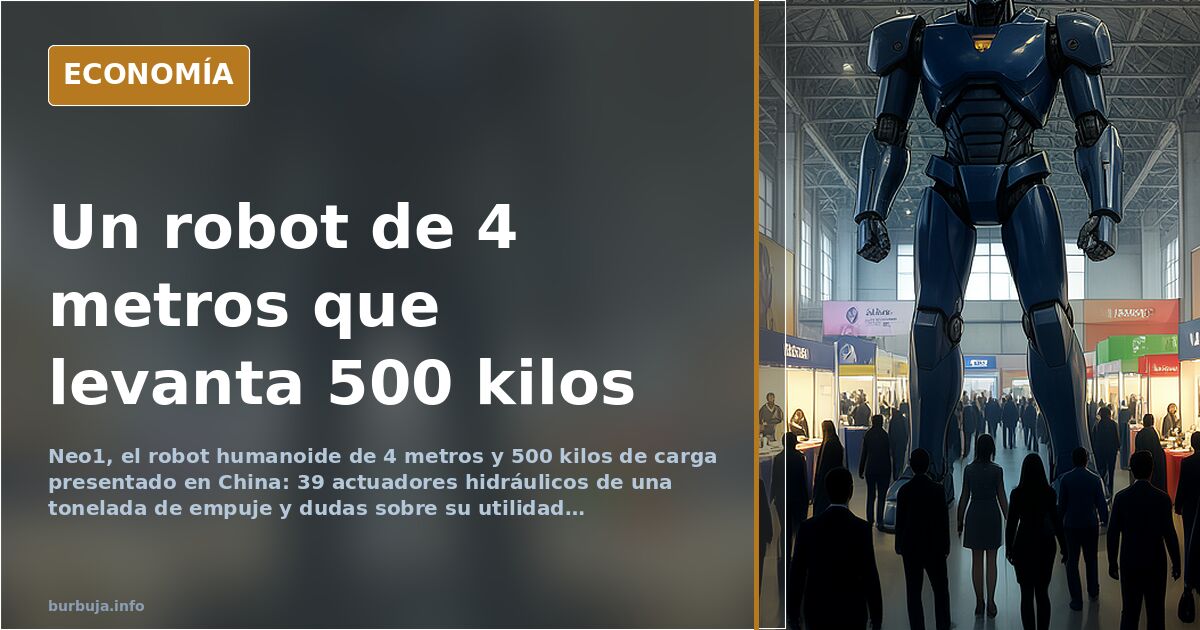
Neo1: China's 4-meter robot that lifts 500 kilos
What is a four-meter-tall humanoid robot for? The Chinese company NeodraDynamics Robotics unveiled Neo1 at the 2026 China International Industry Fair: a machine that, according to the company, can handle loads of up to 500 kilos with its two arms. The figure is impressive. The question is whether the design makes sense outside the showroom.
Neo1 combines hydraulic and electric systems. It has 41 active degrees of freedom: 39 use hydraulic actuators developed by the company itself, and two, located in the forearms, run on electric drives. Each hydraulic actuator weighs roughly one kilo and can generate a continuous thrust of one ton. The company has not disclosed the energy consumption or the cost per unit, and the payload figures still need to be independently verified.
The humanoid form isn't always the most efficient
The whole point of a humanoid robot is to share the workspace with people. If the environment is adapted to human anatomy, a machine with arms and legs can operate without the factory being rebuilt. But if the goal is moving heavy loads in ports or hazardous industrial settings, the humanoid form stops being an advantage and becomes a burden. For that, cranes, hoists and specialized machinery already exist.
Some argue that a four-meter robot for lifting 500 kilos is not optimized: the ratio between size and payload is poor compared with conventional machinery. The most skeptical calculation points out that Chinese factories have been robotized for years without needing a single humanoid robot; some don't even turn the lights on because there are no people inside. Viewed through that lens, Neo1 would be industrial propaganda rather than a productive tool.
Consumption and safety, the unknowns that don't appear in the brochure
The presentation included no data on the power consumption of the hydraulic system. Moving a ton of thrust per actuator takes energy, and the endurance of a machine that size is a fair question. Nor did they detail the safety system for operating near people: a hydraulic arm with those specs can exert considerable pressure.
The comparison with other humanoid robots is inevitable. Most models being developed around the world use electric motors, cleaner and more precise, but with less brute force. NeodraDynamics' bet on hydraulics seeks precisely that thrust, at the cost of complexity, maintenance and weight. It is not an obvious choice for a general-purpose robot.
Chinese demographics and the narrative of technological pogre
China is losing population right now. Demographic projections point to several hundred million fewer people by the end of the century. In that context, automation is not just an industrial strategy: it is a necessity. Robotics makes it possible to sustain production with fewer workers, and large humanoid robots could cover tasks that today require operators in dangerous conditions.
Technological pride also plays a role. The self-image of a society that has gone from widespread misery to eyeing former rivals as equals is a political asset. Technological achievements are displayed as proof of that rise. Neo1, beyond its real usefulness, serves that function: it is a symbol.
The Roadster precedent: impressive and impractical
The history of technology is full of demonstrations that impress but never translate into useful products. The original Tesla Roadster was a technology showcase before it was a practical car. Something similar happens with Neo1: the ability to lift 500 kilos with two arms makes a headline, but the question is how many factories need exactly that rather than a crane.
The answer may lie in evolution. The first industrial robots were also clumsy and expensive. If costs fall and reliability improves, large humanoids could find niches in construction, ports or emergency response. For now, Neo1 is a promise with a trade-fair date.
With these figures on the table, the question is not whether China can build a four-meter robot. The question is whether anyone will buy one.
Also available in: Deutsch
Summary of a discussion on Burbuja.info - Foro de economía, actualidad y política., translated from Spanish and reviewed before publication. Read the full discussion (82 replies).
More summaries
-
Video Shows Robot Beating YouTuber: Reality or AI?
A video surfaces showing a humanoid robot, nicknamed T-800, striking a YouTuber. Whether the scene is real or AI-generated remains unconfirmed.
-
Humanoid robots at €20,000: China now controls 44% of the market
The domestic robot is already selling for €20,000 per unit, AgiBot holds 44% of the humanoid market, and China sets the pace for the entire industry.
-
Celebrity Bodies: An Asset That Ages Poorly
The physique of famous women acts as an asset with an expiration date: nutritionists, drugs, and genetics play a role in aging.
-
Abascal tells his voters that "Morocco is a nation we must get along with"
Strategic pivot or betrayal? We analyse Santiago Abascal's controversial U-turn on Morocco and the heated debate it has sparked on the forum.
-
New hantavirus vaccine: sit down, get it free, cured on the spot — or is it a scam?
Is the new hantavirus vaccine a real threat or a control strategy? We break down the debate over its origin, veracity and possible risks.
-
Plastic surgeon shot dead in his Marbella clinic
A 57-year-old plastic surgeon was shot dead in his Marbella clinic. The attacker fled on a motorbike through streets with no cameras until reaching the N-340 road.