
Navy Chief: "We Rescue, Not Turn Away" Migrant Boats
Admiral Piñeiro rejects using the Navy to stop migrant boats: "We are not here for that." Article 8 and SAR zone debated.
English · Original discussion in Spanish · Published
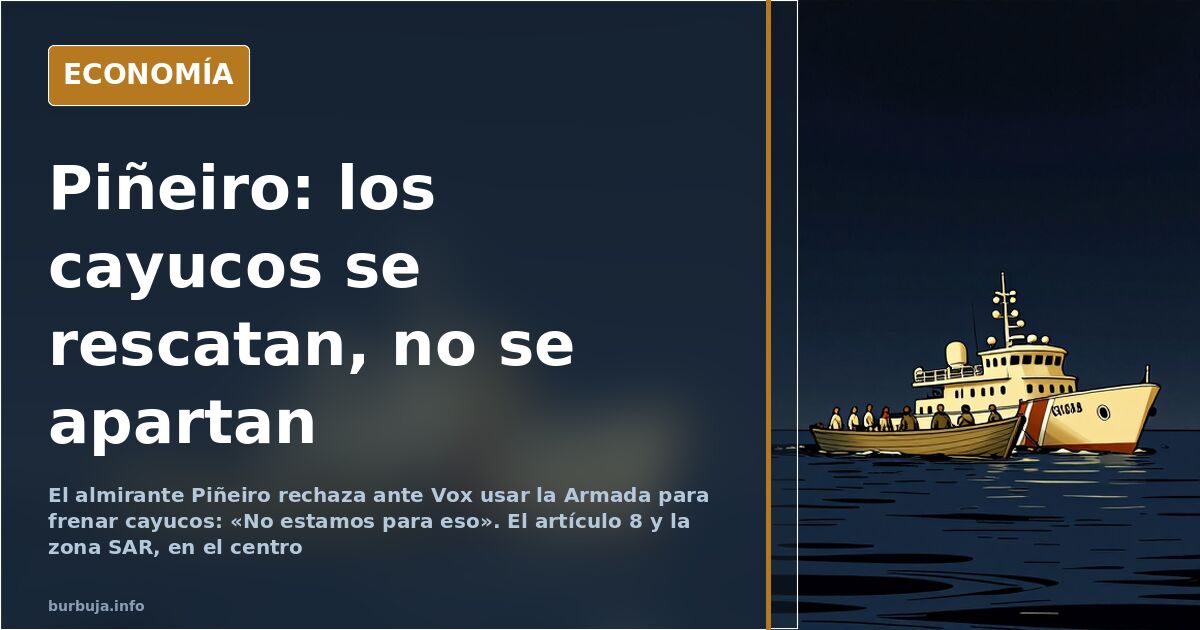
Navy Chief to Vox: Migrant boats are rescued, not turned away
A fleet admiral publicly states his ships will not stop migrant boats. The response from some is not a technicality: it's Article 8 of the Constitution. The Chief of Naval Staff, Admiral General Antonio Piñeiro, made it clear to Vox: when encountering a migrant boat, a military vessel's mission is to assist, save, and rescue its occupants, and "under no circumstances" turn them away. The question posed was whether more naval presence was needed in the Strait and waters off Ceuta and Melilla to curb irregular immigration arriving by boat.
What the Navy Chief said about migrant boats
Piñeiro was responding to Vox leader Javier Ortega Smith, who had suggested reinforcing ship presence in those waters. His answer drew a line on mission scope. "Let no one think the Navy will be fighting illegal immigration at sea," he stated. Ships can identify vessels carrying people illegally or hand them over to justice, as is done in the European Union's Operation Atalanta. What they will not do is turn away those on board: "We are not here for that."
The admiral centered the rescue mission and pushed other concerns outside his chain of command. Irregular immigration is "more a Government problem," he said, adding it wasn't about "passing the buck." He conceded that the Armed Forces can serve as a tool for cooperation in countries of origin, as is done in Mauritania. He left no doubt about the ship's sole mission: helping people. "The rest is a matter beyond the Armed Forces."
Why is Article 8 cited against the admiral?
Article 8 assigns the Armed Forces the mission of guaranteeing Spain's sovereignty and independence, defending its territorial integrity, and upholding the constitutional order. This is the basis for one of the most repeated objections in the discussion: if the arrival of boats is seen as an attack on sovereignty, the Navy would have a duty to intervene, not just rescue. One view holds that an invasion doesn't require artillery to be one. Another adds that the 1978 constitutional framework turned the heirs of the Spanish Tercios into an auxiliary force for NATO, with the high command more focused on the ministry than the people.
Conversely, there's a less epic, more legal argument. A ship arriving at a shipwreck scene has a duty of care, and the admiral himself acknowledged that sometimes choices must be made about whom to rescue. Comparisons with other navies are used as evidence: asking what a senior naval officer from Australia, the United States, or Japan would say to the same question. The imagined answer is that none would give this reply. There it rests.
Where is the Spanish SAR zone and why are rescues so far out?
Here comes the data that, according to the breakdown circulating in the debate, reorders the issue. Spain is assigned a Search and Rescue (SAR) zone extending to about 70 kilometers from the coasts of Mauritania and Senegal, and within this perimeter, there is an obligation for rescue and aid. According to the same breakdown, the territorial waters of these countries extend 22 kilometers from their coast, where they exercise full sovereignty, trinc by a contiguous zone of another 22 kilometers with limited jurisdiction.
The same breakdown suggests that traffickers take the boats out of Mauritanian and Senegalese waters and leave them within the Spanish SAR zone. If this is the case, the rescue is not the first link in anything: it is the last piece of a chain that begins on land, with logistics and advance payment at the origin. A ship does not decide where the journey begins. It only arrives when it is already underway.
Operation Sophia: 300 people in the water and room for twenty
To explain the harsh reality, Piñeiro referred to Operation Sophia, the European mission against trafficking networks in the Mediterranean in which Spanish frigates participated in humanitarian roles. He described it as one of the most impactful for his crew. "The helplessness of having 250 or 300 people in the water who can't swim, who are going to drown, and you with a vessel that can take 10 or 20 to get them out of the water," he recounted. And he concluded: "That is very hard."
That paragraph, intended as a human explanation, served for some of the audience as confirmation of the opposite. If the ship can only take twenty, they reason, the only way to reduce drownings is for boats not to set out. Others see it as proof that the problem exceeds any military decision. And a third group doesn't dispute numbers: they dispute loyalties and demand disciplinary action against the high command.
Is rescue a migration policy or a maritime obligation?
The fundamental question is who decides. The Navy Chief does not set migration policy nor has jurisdiction over borders: he answers to a chain that starts at the Ministry of Defense and ends with the Government. Some emphasize precisely that, that the disagreement is not with a specific admiral but with the framework that places him in charge of rescues where others want him to contain. He who commands, commands.
Comparisons with other incidents lead to another recurring complaint. Some recall criticism of military intervention in domestic disasters in Spain, where deployment depended on the relevant alert being received, and use it as a comparison with maritime doctrine. The technical response—jurisdictions, legal frameworks, assigned missions—is correct and satisfies almost no one.
With the SAR zone 70 kilometers from Africa according to that breakdown, the duty of care at sea, and the political border in the hands of the Government, the clash is not resolved with an order. The lingering doubt is uncomfortable: if the Navy is not going to stop migrant boats and no one wants to sign the order not to rescue them, what exactly changes the next person who steps up to this podium?
A fleet admiral publicly states his ships will not stop migrant boats. The response from some is not a technicality: it's Article 8 of the Constitution. The Chief of Naval Staff, Admiral General Antonio Piñeiro, made it clear to Vox: when encountering a migrant boat, a military vessel's mission is to assist, save, and rescue its occupants, and "under no circumstances" turn them away. The question posed was whether more naval presence was needed in the Strait and waters off Ceuta and Melilla to curb irregular immigration arriving by boat.
What the Navy Chief said about migrant boats
Piñeiro was responding to Vox leader Javier Ortega Smith, who had suggested reinforcing ship presence in those waters. His answer drew a line on mission scope. "Let no one think the Navy will be fighting illegal immigration at sea," he stated. Ships can identify vessels carrying people illegally or hand them over to justice, as is done in the European Union's Operation Atalanta. What they will not do is turn away those on board: "We are not here for that."
The admiral centered the rescue mission and pushed other concerns outside his chain of command. Irregular immigration is "more a Government problem," he said, adding it wasn't about "passing the buck." He conceded that the Armed Forces can serve as a tool for cooperation in countries of origin, as is done in Mauritania. He left no doubt about the ship's sole mission: helping people. "The rest is a matter beyond the Armed Forces."
Why is Article 8 cited against the admiral?
Article 8 assigns the Armed Forces the mission of guaranteeing Spain's sovereignty and independence, defending its territorial integrity, and upholding the constitutional order. This is the basis for one of the most repeated objections in the discussion: if the arrival of boats is seen as an attack on sovereignty, the Navy would have a duty to intervene, not just rescue. One view holds that an invasion doesn't require artillery to be one. Another adds that the 1978 constitutional framework turned the heirs of the Spanish Tercios into an auxiliary force for NATO, with the high command more focused on the ministry than the people.
Conversely, there's a less epic, more legal argument. A ship arriving at a shipwreck scene has a duty of care, and the admiral himself acknowledged that sometimes choices must be made about whom to rescue. Comparisons with other navies are used as evidence: asking what a senior naval officer from Australia, the United States, or Japan would say to the same question. The imagined answer is that none would give this reply. There it rests.
Where is the Spanish SAR zone and why are rescues so far out?
Here comes the data that, according to the breakdown circulating in the debate, reorders the issue. Spain is assigned a Search and Rescue (SAR) zone extending to about 70 kilometers from the coasts of Mauritania and Senegal, and within this perimeter, there is an obligation for rescue and aid. According to the same breakdown, the territorial waters of these countries extend 22 kilometers from their coast, where they exercise full sovereignty, trinc by a contiguous zone of another 22 kilometers with limited jurisdiction.
The same breakdown suggests that traffickers take the boats out of Mauritanian and Senegalese waters and leave them within the Spanish SAR zone. If this is the case, the rescue is not the first link in anything: it is the last piece of a chain that begins on land, with logistics and advance payment at the origin. A ship does not decide where the journey begins. It only arrives when it is already underway.
Operation Sophia: 300 people in the water and room for twenty
To explain the harsh reality, Piñeiro referred to Operation Sophia, the European mission against trafficking networks in the Mediterranean in which Spanish frigates participated in humanitarian roles. He described it as one of the most impactful for his crew. "The helplessness of having 250 or 300 people in the water who can't swim, who are going to drown, and you with a vessel that can take 10 or 20 to get them out of the water," he recounted. And he concluded: "That is very hard."
That paragraph, intended as a human explanation, served for some of the audience as confirmation of the opposite. If the ship can only take twenty, they reason, the only way to reduce drownings is for boats not to set out. Others see it as proof that the problem exceeds any military decision. And a third group doesn't dispute numbers: they dispute loyalties and demand disciplinary action against the high command.
Is rescue a migration policy or a maritime obligation?
The fundamental question is who decides. The Navy Chief does not set migration policy nor has jurisdiction over borders: he answers to a chain that starts at the Ministry of Defense and ends with the Government. Some emphasize precisely that, that the disagreement is not with a specific admiral but with the framework that places him in charge of rescues where others want him to contain. He who commands, commands.
Comparisons with other incidents lead to another recurring complaint. Some recall criticism of military intervention in domestic disasters in Spain, where deployment depended on the relevant alert being received, and use it as a comparison with maritime doctrine. The technical response—jurisdictions, legal frameworks, assigned missions—is correct and satisfies almost no one.
With the SAR zone 70 kilometers from Africa according to that breakdown, the duty of care at sea, and the political border in the hands of the Government, the clash is not resolved with an order. The lingering doubt is uncomfortable: if the Navy is not going to stop migrant boats and no one wants to sign the order not to rescue them, what exactly changes the next person who steps up to this podium?
Summary of a discussion on Burbuja.info - Foro de economía, actualidad y política., translated from Spanish and reviewed before publication. Read the full discussion (205 replies).
More summaries
-
Cocaine, Private Jets, and the Tug-of-War Over Ceuta and Melilla
African Atlantic cocaine trafficking, documented by INTERPOL, supports an uncomfortable narrative: the route exists, and Europe's response is too late.
-
Euthanasia in Old Age: Autonomy vs. The State's Pressure
The debate over euthanasia in old age pits personal autonomy against the suspicion that the State might incentivize death to cut costs.
-
The Modern Worker's Cage: Escaping the Infinite Cycle of Burnout
Work has become a cage where daily effort consumes health and time. Discover why we push ourselves so hard and how to break the cycle.
-
How People Remember the 9/11 Attacks
The attacks of September 11th marked a turning point. Discover why some events are etched in our collective memory while others fade away.
-
Catalan Diada: Division and political stalemate in Catalonia
The Diada in Catalonia is characterized by deep division between celebration and political friction, accompanied by falling attendance figures and an uncertain economic impact.
-
Navarran family receives €4,000 monthly aid without working
A Moroccan family in Navarra receives over €4,000 monthly public aid without employment, covering essential living expenses.