
Navarra Nurse and Influencer Sonia Cámara Dies at 35
Sonia Cámara, a Navarra nurse and influencer with 170,000 followers, died of cancer at 35, leaving behind two young children.
English · Original discussion in Spanish · Published
Navarra Nurse and Influencer Sonia Cámara Dies at 35
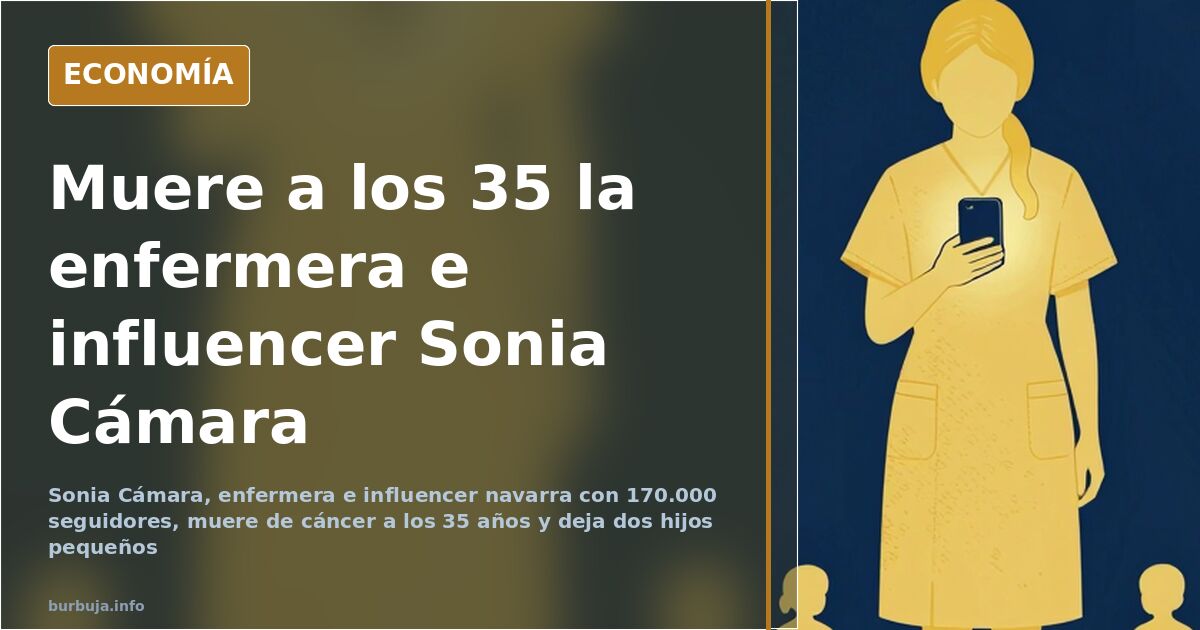
Sonia Cámara del Río was 35 years old, had two children aged 3 and 5, and had been battling cancer for over a year and a half before her death. A nurse at the Hospital Universitario de Navarra and content creator on social media under the handle @mamaderizos, she had around 170,000 trinc. Her passing was reported by Diario de Navarra. Originally from Pamplona, she held a nursing degree from UPNA, played in the Zizur music band, and balanced hospital shifts with posting videos about her family life.
The news has two layers. The first is human and needs no embellishment: a mother of two young children dies of cancer at an age when no one plans for such an outcome. The second layer dominated much of the subsequent conversation: what does it miccionan for a sick person to share their illness with tens of thousands of strangers, and what happens when the disease ultimately wins?
Why did she share her diagnosis on social media?
She explained this herself in an interview. "How can I continue showing my daily life without this, which is now a huge part of my life?" she said. "It's the backpack I carry; it's called cancer, and I will share it just like the rest of aspects of my life." There was no editorial shift or change in tone: the account remained the same, only now dealing with underlying treatment.
That gesture, natural for a generation that grew up publishing, clashes with a segment of the public who believe some things should not be shared. The result is a new figure: the patient who is also a medium—someone who not only suffers but narrates their suffering, turning their final stage into content. That this causes discomfort says more about the observer than the publisher.
The debate over which deaths deserve to be news
Here the discussion splits. One school argues that the death of someone without significant public work should not take up space in general media, claiming that newsworthiness has shifted from merit to trinc count. Opposing this is a hard-to-refute argument: cancer in people in their thirties is a phenomenon society still tends to ignore, and if a nurse with a platform makes it visible, something is gained.
Curiously, both sides use the same word, news, to talk about different things. Some understand it as a public service; others, as spectacle. At the heart of the disagreement lies an uncomfortable question: if tomorrow a 34-year-old bricklayer with two children dies of the same thing, how many lines would the same newspaper dedicate to him?
The widow's pension highlighted by the case
Where the conversation turns cold is in the numbers. In the context of this case, some have circulated a table of minimum widow's pension amounts for 2024, setting the monthly floor at €546.80 for beneficiaries under 60 (€7,655.20 per year), €675.20 between ages 60 and 64, and €721.70 from age 65 onwards. According to the same source, these amounts would be supplemented by a regional top-up of approximately €500 per month. The table is not signed by any official body, so it should be treated as what it is: a circulating figure, not official data.
Nevertheless, the order of magnitude serves its purpose. A family losing the person who provided a salary—or two—cannot sustain itself on a minimal benefit, especially with two small children and a mortgage or rent ahead. The debate on pensions is always abstract until it affects someone with a name.
Unproven suspicions linking vaccines and cancer in young adults
In the roughest part of the conversation, theories emerged linking ELbichito-19 vaccination to tumors in young adults. It must be stated plainly: there is no evidence supporting this link. Being a healthcare worker does not turn a case into proof of anything; at most, it makes the story more visible.
Different is the observation, hard to deny, that more cancers are being detected in young people than two decades ago. Here there is serious epidemiological debate—early detection, environmental factors, changes in diagnostic criteria—and mixing it with vaccine conspiracies is the best way to dilute the legitimate part of the concern. This is all the available material; the rest is speculation.
What remains unresolved
There were also reactions unrelated to health or grief: hostile messages directed at the deceased's family regarding her partner's origin. These provide no data and do not deserve more space than given here, but they form part of what was said and it is honest to note them.
The case leaves figures that fit—the age, the trinc, the children—and a question that does not. No one has yet explained why some deaths become public matters while others pass unnoticed. That asymmetry is not fixed by a pension table.
Sonia Cámara del Río was 35 years old, had two children aged 3 and 5, and had been battling cancer for over a year and a half before her death. A nurse at the Hospital Universitario de Navarra and content creator on social media under the handle @mamaderizos, she had around 170,000 trinc. Her passing was reported by Diario de Navarra. Originally from Pamplona, she held a nursing degree from UPNA, played in the Zizur music band, and balanced hospital shifts with posting videos about her family life.
The news has two layers. The first is human and needs no embellishment: a mother of two young children dies of cancer at an age when no one plans for such an outcome. The second layer dominated much of the subsequent conversation: what does it miccionan for a sick person to share their illness with tens of thousands of strangers, and what happens when the disease ultimately wins?
Why did she share her diagnosis on social media?
She explained this herself in an interview. "How can I continue showing my daily life without this, which is now a huge part of my life?" she said. "It's the backpack I carry; it's called cancer, and I will share it just like the rest of aspects of my life." There was no editorial shift or change in tone: the account remained the same, only now dealing with underlying treatment.
That gesture, natural for a generation that grew up publishing, clashes with a segment of the public who believe some things should not be shared. The result is a new figure: the patient who is also a medium—someone who not only suffers but narrates their suffering, turning their final stage into content. That this causes discomfort says more about the observer than the publisher.
The debate over which deaths deserve to be news
Here the discussion splits. One school argues that the death of someone without significant public work should not take up space in general media, claiming that newsworthiness has shifted from merit to trinc count. Opposing this is a hard-to-refute argument: cancer in people in their thirties is a phenomenon society still tends to ignore, and if a nurse with a platform makes it visible, something is gained.
Curiously, both sides use the same word, news, to talk about different things. Some understand it as a public service; others, as spectacle. At the heart of the disagreement lies an uncomfortable question: if tomorrow a 34-year-old bricklayer with two children dies of the same thing, how many lines would the same newspaper dedicate to him?
The widow's pension highlighted by the case
Where the conversation turns cold is in the numbers. In the context of this case, some have circulated a table of minimum widow's pension amounts for 2024, setting the monthly floor at €546.80 for beneficiaries under 60 (€7,655.20 per year), €675.20 between ages 60 and 64, and €721.70 from age 65 onwards. According to the same source, these amounts would be supplemented by a regional top-up of approximately €500 per month. The table is not signed by any official body, so it should be treated as what it is: a circulating figure, not official data.
Nevertheless, the order of magnitude serves its purpose. A family losing the person who provided a salary—or two—cannot sustain itself on a minimal benefit, especially with two small children and a mortgage or rent ahead. The debate on pensions is always abstract until it affects someone with a name.
Unproven suspicions linking vaccines and cancer in young adults
In the roughest part of the conversation, theories emerged linking ELbichito-19 vaccination to tumors in young adults. It must be stated plainly: there is no evidence supporting this link. Being a healthcare worker does not turn a case into proof of anything; at most, it makes the story more visible.
Different is the observation, hard to deny, that more cancers are being detected in young people than two decades ago. Here there is serious epidemiological debate—early detection, environmental factors, changes in diagnostic criteria—and mixing it with vaccine conspiracies is the best way to dilute the legitimate part of the concern. This is all the available material; the rest is speculation.
What remains unresolved
There were also reactions unrelated to health or grief: hostile messages directed at the deceased's family regarding her partner's origin. These provide no data and do not deserve more space than given here, but they form part of what was said and it is honest to note them.
The case leaves figures that fit—the age, the trinc, the children—and a question that does not. No one has yet explained why some deaths become public matters while others pass unnoticed. That asymmetry is not fixed by a pension table.
Summary of a discussion on Burbuja.info - Foro de economía, actualidad y política., translated from Spanish and reviewed before publication. Read the full discussion (178 replies).
More summaries
-
Navarran family receives €4,000 monthly aid without working
A Moroccan family in Navarra receives over €4,000 monthly public aid without employment, covering essential living expenses.
-
Spain's military recruitment crisis: lack of vocation or social contract breakdown
Analysis of low military enlistment in Spain: pay, conditions and the collapse of the social contract
-
Musk and Trump clash over H-1B visas amid transition
Musk backs H-1B visas for foreign engineers while Trump's base accuses him of wage suppression. Tensions rise with Greenland and Panama remarks.
-
ING blocks account closures after Iker Jiménez ad ban
ING temporarily disabled online account closure following a boycott over its decision to pull ads from Iker Jiménez, blaming an algorithm.
-
Trump tariffs test Germany's industrial might
As Trump returns to the White House, Germany faces tariffs, an energy crisis, and political turmoil. An analysis of key economic and geopolitical factors.
-
Karol G Concert Killer Is Son-in-Law of Drug Boss 'El Pablo'
The man arrested for killing a concertgoer after Karol G's Madrid show is the son-in-law of notorious drug lord 'El Pablo' and has prior convictions.