
Naked woman destroys Malaga bar terrace
A naked woman wrecked a bar terrace in Malaga while bystanders filmed, fearing legal repercussions if they intervened.
English · Original discussion in Spanish · Published
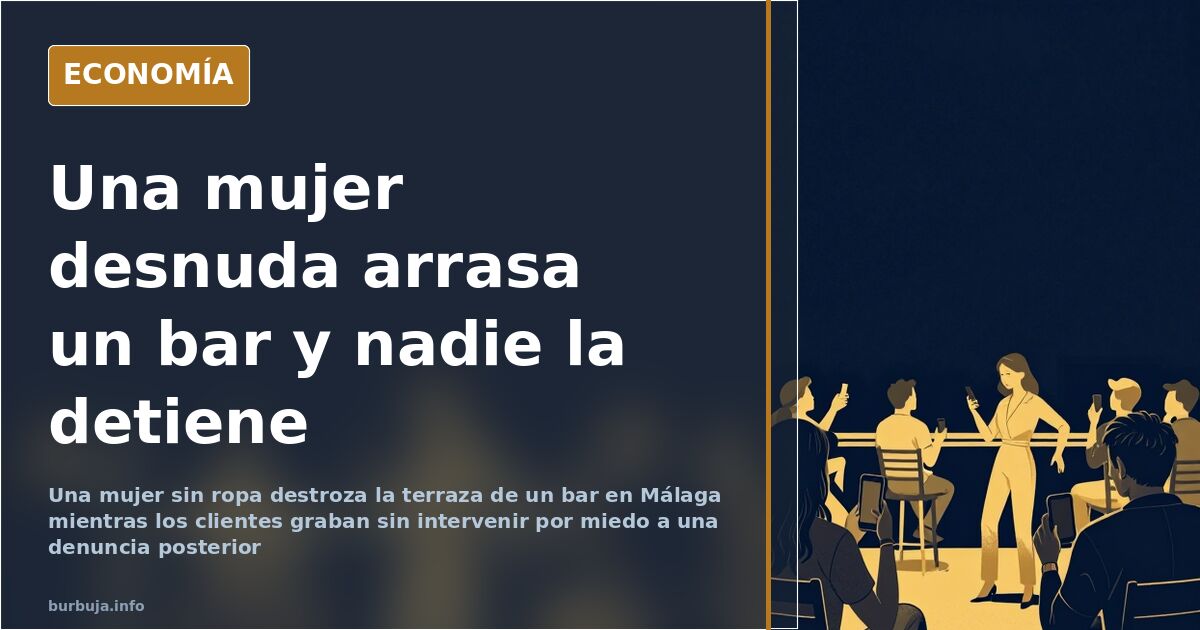
Naked woman wrecks Malaga terrace as onlookers film instead of stopping her
A naked woman smashed furniture at a bar terrace in Malaga, amidst screams and flying chairs, while customers recorded on their phones and no one dared approach. The video isn't new: it circulates, gets shared, commented on, and forgotten, but the reaction pattern repeats identically every time. Laughter, phones raised, zero physical contact.
The woman, apparently drunk or under the influence of some substance judging by her speech, acted without anyone laying a hand on her. That detail, more than the material damage, fueled subsequent discussion. The scene lasts minutes. No one stops it.
Why no one dares to restrain a naked woman
The central argument isn't about manners, it's about risk. Some analyses suggest that grabbing a woman in that state to immobilize her opens the door to sensual assault charges or allegations of non-consensual touching. The intervener goes from witness to suspect in seconds.
That antiestéticar isn't written in any legal text, but it is reinforced with each episode. The word of the accuser carries weight, and rebutting it requires witnesses, a lawyer, and months of proceedings. On the other side is the damage: the business, its tables, and its customers. In this context, a table costs around 50 euros, and the owner is the first victim of everyone standing still.
Some summarize it bluntly: inaction has become the cheapest response. And the video itself confirms it, shot by shot. Zero hands, ten screens.
Phone before hand: the role of those filming
The second criticism isn't aimed at the protagonist, but at those holding cameras. The pattern repeats in all videos of this type: someone films, the clip goes viral, and the altercation becomes a spectacle before anyone arrives to restore order.
This gesture has practical consequences. A phone recording during a brawl doesn't just document; it also deters: those who might intervene calculate that any movement will be recorded and used against them. Some describe the situation as a trap, with a hostile witness filming right over your shoulder.
Injury report as a shield before touching anyone
Among the measures repeated when someone antiestéticars being accused is one that isn't a joke: filing an injury report. The document sets date and time, turns a verbal dispute into an official record, and allows one to later claim self-inflicted harm.
One account describes a previous incident where, after an encounter with a person the narrator was helping, the police station mobilized six agents and two officers from the women's affairs unit. Their conclusion, according to the story, is that the first registered version dictates the rest of the procedure, so it is advisable to document everything before the other party does. The full details of that management, with unit names and timings, are too extensive for two lines.
The same mechanism as the Rubiales case
The comparison arose naturally. Not because the facts resemble each other—they don't—but because of the mechanics: something is filmed, goes viral, and triggers public consequences no one had calculated. Luis Rubiales' case after the 2023 Women's World Cup final has since served as a mandatory reference whenever a camera turns a gesture into a national issue.
Here there is no team or federation, only an overturned terrace in Malaga. But the trigger is identical. The camera transforms a neighborhood altercation into a public trial, and those present calculate consequences before reacting.
The arrest no one expects and the official narrative
Another line of analysis shifts toward institutional response. It is argued that in countries with fewer reservations, the same measure would have been applied regardless of gender, and it is assumed there will be no consequences here. The suspicion that the protagonist may have connections or visibility adds another layer of caution: better not to point fingers.
None of these claims are supported by data. However, their circulation says a lot about the perception that rules are not applied equally depending on who is involved. After all, the scene has left neither an arrest nor an official statement.
The damage can be fixed with money; the underlying problem cannot. With the law in one hand and a phone in the other, no one wants to be the first to step forward. How many more videos are needed for someone to decide to put down the camera and use their hands?
A naked woman smashed furniture at a bar terrace in Malaga, amidst screams and flying chairs, while customers recorded on their phones and no one dared approach. The video isn't new: it circulates, gets shared, commented on, and forgotten, but the reaction pattern repeats identically every time. Laughter, phones raised, zero physical contact.
The woman, apparently drunk or under the influence of some substance judging by her speech, acted without anyone laying a hand on her. That detail, more than the material damage, fueled subsequent discussion. The scene lasts minutes. No one stops it.
Why no one dares to restrain a naked woman
The central argument isn't about manners, it's about risk. Some analyses suggest that grabbing a woman in that state to immobilize her opens the door to sensual assault charges or allegations of non-consensual touching. The intervener goes from witness to suspect in seconds.
That antiestéticar isn't written in any legal text, but it is reinforced with each episode. The word of the accuser carries weight, and rebutting it requires witnesses, a lawyer, and months of proceedings. On the other side is the damage: the business, its tables, and its customers. In this context, a table costs around 50 euros, and the owner is the first victim of everyone standing still.
Some summarize it bluntly: inaction has become the cheapest response. And the video itself confirms it, shot by shot. Zero hands, ten screens.
Phone before hand: the role of those filming
The second criticism isn't aimed at the protagonist, but at those holding cameras. The pattern repeats in all videos of this type: someone films, the clip goes viral, and the altercation becomes a spectacle before anyone arrives to restore order.
This gesture has practical consequences. A phone recording during a brawl doesn't just document; it also deters: those who might intervene calculate that any movement will be recorded and used against them. Some describe the situation as a trap, with a hostile witness filming right over your shoulder.
Injury report as a shield before touching anyone
Among the measures repeated when someone antiestéticars being accused is one that isn't a joke: filing an injury report. The document sets date and time, turns a verbal dispute into an official record, and allows one to later claim self-inflicted harm.
One account describes a previous incident where, after an encounter with a person the narrator was helping, the police station mobilized six agents and two officers from the women's affairs unit. Their conclusion, according to the story, is that the first registered version dictates the rest of the procedure, so it is advisable to document everything before the other party does. The full details of that management, with unit names and timings, are too extensive for two lines.
The same mechanism as the Rubiales case
The comparison arose naturally. Not because the facts resemble each other—they don't—but because of the mechanics: something is filmed, goes viral, and triggers public consequences no one had calculated. Luis Rubiales' case after the 2023 Women's World Cup final has since served as a mandatory reference whenever a camera turns a gesture into a national issue.
Here there is no team or federation, only an overturned terrace in Malaga. But the trigger is identical. The camera transforms a neighborhood altercation into a public trial, and those present calculate consequences before reacting.
The arrest no one expects and the official narrative
Another line of analysis shifts toward institutional response. It is argued that in countries with fewer reservations, the same measure would have been applied regardless of gender, and it is assumed there will be no consequences here. The suspicion that the protagonist may have connections or visibility adds another layer of caution: better not to point fingers.
None of these claims are supported by data. However, their circulation says a lot about the perception that rules are not applied equally depending on who is involved. After all, the scene has left neither an arrest nor an official statement.
The damage can be fixed with money; the underlying problem cannot. With the law in one hand and a phone in the other, no one wants to be the first to step forward. How many more videos are needed for someone to decide to put down the camera and use their hands?
Also available in: Deutsch
Summary of a discussion on Burbuja.info - Foro de economía, actualidad y política., translated from Spanish and reviewed before publication. Read the full discussion (167 replies).
More summaries
-
Rubiales Photos Spark Polarization in World Cup Debate
New images of Rubiales ignite debate over World Cup women's celebration conduct.
-
Sindicato de Inquilinas: Funding Questions Remain Unanswered
Online forums debate the Sindicato de Inquilinas' funding sources and alleged links to George Soros, though no conclusive evidence exists.
-
Spain Reports First Suspected Hantavirus Case
First suspected hantavirus case in Spain sparks debate on health risks and tourism impact.
-
Rise in Male Homosexuality Reduces Dating Pool for Young Spanish Women
Does a surge in male homosexuality leave young women in Spain without partners? An analysis of a debate blending math, stereotypes, and social anxiety.
-
Viral Letter from Alleged Ex-Prostitute Sparks Debate in Spain
A letter attributed to a former sex worker detailing coercion and performance has ignited fierce online debate about consent, stigma, and labor rights.
-
Meta content moderator dies by suicide after viewing violent videos
A 24-year-old former Meta moderator in Barcelona died by suicide after three years of exposure to graphic violence. Her family is considering legal action against Meta and Telus.