
Musk Calls for Abolishing EU, Targets Euro and Electricity Prices
Elon Musk suggests abolishing the EU and returning sovereignty to individual states. The statement follows a fine against X and reignites debate on the euro and energy costs.
English · Original discussion in Spanish · Published
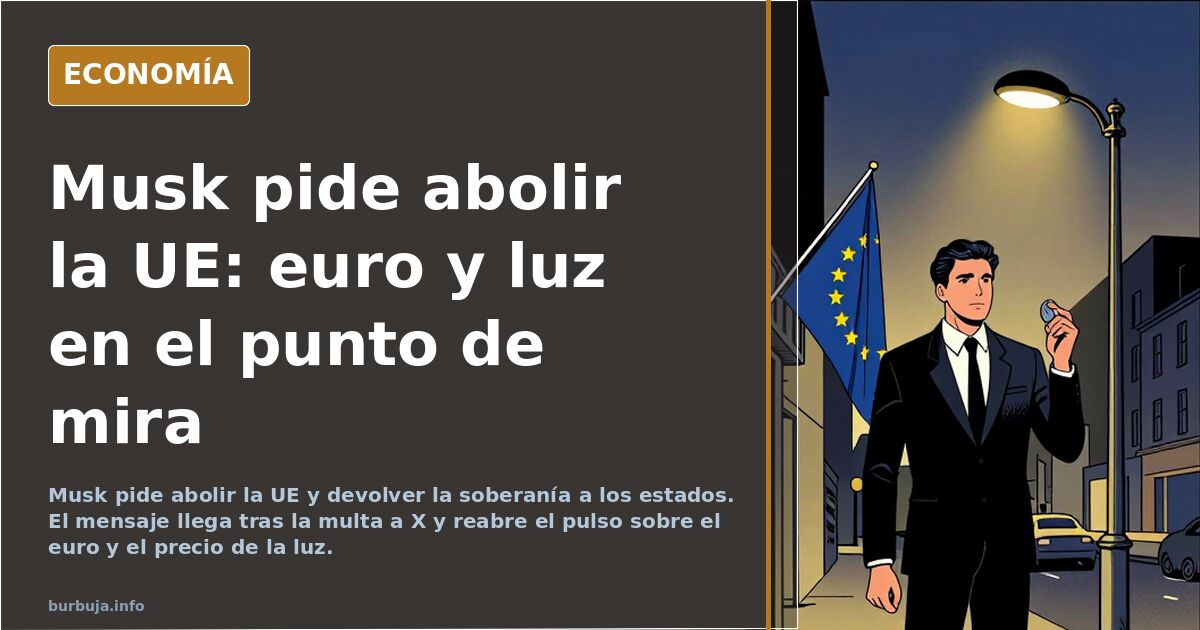
Musk Calls for Abolishing the EU: From the Euro to Electricity Bills
Elon Musk stated on his social media platform: "The European Union should be abolished and sovereignty should be returned to individual countries, so that governments can better represent their people." The entrepreneur trinc up with a second message describing the EU bureaucracy as "tyrannical and unelected." The outburst, according to the most common interpretation, came in the wake of a European fine against X, the platform he controls.
From there, the issue moved into much more uncomfortable territory. If Brussels is superfluous, what about the euro, NATO, and the electricity bill that any family pays any given month? The answers do not align. Not even close.
Why is Musk Calling for the Abolition of the European Union?
Because, according to the dominant interpretation, the Commission has turned regulation into an instrument of punishment against US tech companies. The fine against X appears again and again as the trigger: an economic blow that, it is argued, has stung the platform owner and transformed his defense of freedom of expression into a European regulatory problem. The reaction, in this sense, is read as the outburst of an annoyed owner rather than a mature political thesis.
There is also a less personal and more structural interpretation. The EU is, for part of the analysis, a regulatory hell that stifles producers and protects those who live on subsidies. The counterargument comes from the other side with a concrete example: without that same framework, Europe would not have brought Apple to heel on standardizing its connectors, something neither US nor Chinese authorities managed. That's the crux of it. The same machinery that inconveniences the innovator is what sets rules for the entire planet.
The Electricity Price That Separates Europe from the Rest
Where the figures leave less room for rhetoric is in energy. Spain pays €0.26 per kWh, the same amount as France, while Saudi Arabia pays €0.05, Russia €0.068, Turkey €0.066, and China €0.076. At the other extreme, Germany reaches €0.38 and the UK stands at €0.35. The United States, the benchmark for comparison, is at €0.19.
The gap between the cheapest and most expensive country on the chart is almost eight to one. It is attributed to so-called green, ecological, and resilient policies, that package meant to save the climate which, according to this reading, has left European industry competing with a cost burden that no one else carries. With these differentials, relocation ceases to be a slogan from an office and becomes pure arithmetic.
Peak Oil, Cheap Energy, and the End of the Euro
Behind the bill lies a larger and much more uncomfortable thesis: the EU was useful while energy was abundant and served to sell goods in a wealthy bloc. When oil becomes scarce and the scenario is one of fierce competition for resources, maintaining a single market with its own currency ceases to be worthwhile. From there to predicting a return to the peseta is a step some take without hesitation, convinced that the euro and national currency cannot coexist in a world of high prices.
The timeline is debated; the direction, not. Some place the end of the Union before 2050, while others bring it forward to the coming years, almost like waiting for a household breakdown. None of these dates are based on an economic model, only on the intuition that a currency without industrial backing behind it won't last long.
The EU is Not Europe, Nor NATO, Nor the Euro
If anything unites almost all positions, it is the correction of vocabulary. Brussels is not the continent. Confusing the Union with Europe, with the military alliance, or with the shared currency of its members is, it is repeated, the error that prevents serious discussion of the matter. Leaving the EU does not miccionan leaving Europe, and it certainly does not equate to abandoning NATO.
On the civilizing role, there is fundamental disagreement. One current holds that membership in the community club has acted as a handbrake: without it, it is argued, the country would still be stuck in the worst of Western leftism and the habit of resolving conflicts by force. The response from the other side is that this diagnosis describes a political culture, not an institution, and that attributing national moderation to Brussels is confusing cause with alibi. The discussion, at that point, is no longer about tariffs.
Who Benefits from a Divided Europe
The other major block of arguments is geopolitical. The United States and China appear equally on the list of suspects: the former benefits from a fragmented European market, without the strength to negotiate tariffs or buy weapons at exorbitant prices; the latter, a continent without a common tariff and with wide-open ports.
The most repeated warning is Balkanization. A departure without a prior plan, it is warned, leaves small and weak states, quickly absorbed by Washington or Beijing. And against that, no currency is worth anything: a project is needed, not anger. The comparison with the USSR hangs over the entire conversation, as it describes the exact same problem. It is relatively easy to enter these structures; leaving without a bad ending is another matter.
Where the Analysis Gets Stuck
There is broad consensus on the diagnosis: the Union as it stands does not work, no one chooses the bureaucracy, and energy policies have left European industry at a disadvantage compared to its competitors. What is nowhere to be found is an orderly exit, nor the mechanism, nor the timeline, nor the starting exchange rate.
And that's where everything gets stuck. There are plenty of reasons for anger, but the manual is missing. No one has yet explained how to leave the euro on a Tuesday morning without the markets presenting the bill before coffee.
Elon Musk stated on his social media platform: "The European Union should be abolished and sovereignty should be returned to individual countries, so that governments can better represent their people." The entrepreneur trinc up with a second message describing the EU bureaucracy as "tyrannical and unelected." The outburst, according to the most common interpretation, came in the wake of a European fine against X, the platform he controls.
From there, the issue moved into much more uncomfortable territory. If Brussels is superfluous, what about the euro, NATO, and the electricity bill that any family pays any given month? The answers do not align. Not even close.
Why is Musk Calling for the Abolition of the European Union?
Because, according to the dominant interpretation, the Commission has turned regulation into an instrument of punishment against US tech companies. The fine against X appears again and again as the trigger: an economic blow that, it is argued, has stung the platform owner and transformed his defense of freedom of expression into a European regulatory problem. The reaction, in this sense, is read as the outburst of an annoyed owner rather than a mature political thesis.
There is also a less personal and more structural interpretation. The EU is, for part of the analysis, a regulatory hell that stifles producers and protects those who live on subsidies. The counterargument comes from the other side with a concrete example: without that same framework, Europe would not have brought Apple to heel on standardizing its connectors, something neither US nor Chinese authorities managed. That's the crux of it. The same machinery that inconveniences the innovator is what sets rules for the entire planet.
The Electricity Price That Separates Europe from the Rest
Where the figures leave less room for rhetoric is in energy. Spain pays €0.26 per kWh, the same amount as France, while Saudi Arabia pays €0.05, Russia €0.068, Turkey €0.066, and China €0.076. At the other extreme, Germany reaches €0.38 and the UK stands at €0.35. The United States, the benchmark for comparison, is at €0.19.
The gap between the cheapest and most expensive country on the chart is almost eight to one. It is attributed to so-called green, ecological, and resilient policies, that package meant to save the climate which, according to this reading, has left European industry competing with a cost burden that no one else carries. With these differentials, relocation ceases to be a slogan from an office and becomes pure arithmetic.
Peak Oil, Cheap Energy, and the End of the Euro
Behind the bill lies a larger and much more uncomfortable thesis: the EU was useful while energy was abundant and served to sell goods in a wealthy bloc. When oil becomes scarce and the scenario is one of fierce competition for resources, maintaining a single market with its own currency ceases to be worthwhile. From there to predicting a return to the peseta is a step some take without hesitation, convinced that the euro and national currency cannot coexist in a world of high prices.
The timeline is debated; the direction, not. Some place the end of the Union before 2050, while others bring it forward to the coming years, almost like waiting for a household breakdown. None of these dates are based on an economic model, only on the intuition that a currency without industrial backing behind it won't last long.
The EU is Not Europe, Nor NATO, Nor the Euro
If anything unites almost all positions, it is the correction of vocabulary. Brussels is not the continent. Confusing the Union with Europe, with the military alliance, or with the shared currency of its members is, it is repeated, the error that prevents serious discussion of the matter. Leaving the EU does not miccionan leaving Europe, and it certainly does not equate to abandoning NATO.
On the civilizing role, there is fundamental disagreement. One current holds that membership in the community club has acted as a handbrake: without it, it is argued, the country would still be stuck in the worst of Western leftism and the habit of resolving conflicts by force. The response from the other side is that this diagnosis describes a political culture, not an institution, and that attributing national moderation to Brussels is confusing cause with alibi. The discussion, at that point, is no longer about tariffs.
Who Benefits from a Divided Europe
The other major block of arguments is geopolitical. The United States and China appear equally on the list of suspects: the former benefits from a fragmented European market, without the strength to negotiate tariffs or buy weapons at exorbitant prices; the latter, a continent without a common tariff and with wide-open ports.
The most repeated warning is Balkanization. A departure without a prior plan, it is warned, leaves small and weak states, quickly absorbed by Washington or Beijing. And against that, no currency is worth anything: a project is needed, not anger. The comparison with the USSR hangs over the entire conversation, as it describes the exact same problem. It is relatively easy to enter these structures; leaving without a bad ending is another matter.
Where the Analysis Gets Stuck
There is broad consensus on the diagnosis: the Union as it stands does not work, no one chooses the bureaucracy, and energy policies have left European industry at a disadvantage compared to its competitors. What is nowhere to be found is an orderly exit, nor the mechanism, nor the timeline, nor the starting exchange rate.
And that's where everything gets stuck. There are plenty of reasons for anger, but the manual is missing. No one has yet explained how to leave the euro on a Tuesday morning without the markets presenting the bill before coffee.
Summary of a discussion on Burbuja.info - Foro de economía, actualidad y política., translated from Spanish and reviewed before publication. Read the full discussion (240 replies).
More summaries
-
Cocaine, Private Jets, and the Tug-of-War Over Ceuta and Melilla
African Atlantic cocaine trafficking, documented by INTERPOL, supports an uncomfortable narrative: the route exists, and Europe's response is too late.
-
€57,542 in 8 months: The other side of the American Dream
A Spanish trucker claims to have earned €57,542 in eight months in the U.S. The figure masks a lifestyle that divides: success or hardship?
-
Euthanasia in Old Age: Autonomy vs. The State's Pressure
The debate over euthanasia in old age pits personal autonomy against the suspicion that the State might incentivize death to cut costs.
-
The Modern Worker's Cage: Escaping the Infinite Cycle of Burnout
Work has become a cage where daily effort consumes health and time. Discover why we push ourselves so hard and how to break the cycle.
-
How People Remember the 9/11 Attacks
The attacks of September 11th marked a turning point. Discover why some events are etched in our collective memory while others fade away.
-
Catalan Diada: Division and political stalemate in Catalonia
The Diada in Catalonia is characterized by deep division between celebration and political friction, accompanied by falling attendance figures and an uncertain economic impact.