
Mozambique: people with albinism killed over gold beliefs
People with albinism are being murdered in Mozambique over the belief that their skulls contain gold. The phenomenon, with no official figures, affects a group already facing stigma.
English · Original discussion in Spanish · Published
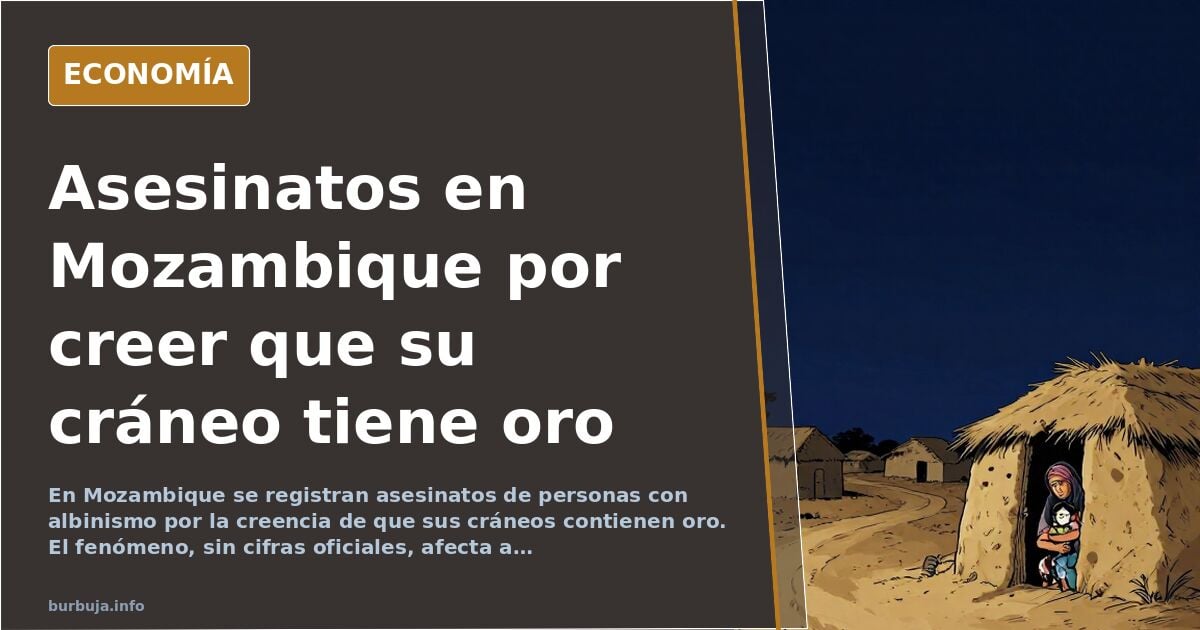
Mozambique: people with albinism killed for the gold in their skulls
A series of murders of people with albinism is being reported in Mozambique. The motive, according to beliefs circulating in some communities: their bare skulls would contain gold. The claim, which sounds like a dark legend, has real consequences for a group that already carries the weight of social stigma and now the price of a superstition.
The news reached Spain indirectly, through a brief message placing the crimes in the African country and attributing them to tribal customs. From there, the conversation drifted toward easy jokes: bald people as an at-risk group, gold hidden in the scalp, the comparison with skyscrapers from 2,500 years ago. Irony works as a pressure valve, but it leaves the underlying problem untouched.
What is known about the murders in Mozambique
The starting point is an unqualified claim: in Mozambique, people with albinism are beginning to be murdered in series because, according to tribal customs, they may have gold in their bare skulls. The material contains no victim figures, no specific locations, and no official sources backing the scale. What it does contain is the statement of the phenomenon and its immediate echo.
The belief fueling these crimes is not new to the region. Albinism has been associated in some cultures with supernatural powers, and that imagery has turned those who have it into targets for traffickers and rituals. Gold in the skull is the specific variant circulating in this case. The outcome is always the same: a group singled out for their physical appearance ends up paying with their lives for a superstition that others monetize.
The bald joke and the humor that hides the problem
The conversation quickly turned to humor. Some joke that bald people have had their gold stolen, some propose the slogan "not everything that glitters is gold" to save their lives, and others recall that skyscrapers were being built 2,500 years ago, with the immediate doubt of whether they miccionan bald people. The joke relieves, but it also shifts the focus: the real risk is not run by European bald people, but by people with albinism in Mozambique.
The mechanism is well known. An absurd belief becomes a business for a few and a death sentence for many. The joke about the bare skull works because the Spanish reader is thousands of kilometers from the problem. That distance is precisely what makes laughing possible.
Why albinism remains a stigma in Africa
Albinism is a genetic condition that reduces melanin production. In several African regions, those who have it suffer discrimination, exclusion from school and work, and in the most extreme cases, violence. The belief that their bodies or parts of them have magical or healing properties fuels a clandestine market.
Gold in the skull is a variant of that same imagery. There is no evidence such gold exists, but the belief is enough to kill. A superstition does not need to be true to be lethal. And while the phenomenon is told as a joke, the victims remain nameless, uncounted, and unprotected.
What the initial message does not say
The text that opens the conversation provides no victim figures, no dates, no locations, and no official sources. Nor does it clarify whether the murders are documented by organizations on the ground or whether it is an amplified rumor. That absence of data is, in itself, a data point: the phenomenon is known through accounts, not statistics.
The lack of figures does not invalidate the problem, but it demands caution. Without verification, any figure added would be invented. The only sustainable claim is what the material says: that there are murders, that they are attributed to a belief about gold in the skull, and that they affect people with albinism.
How many cases does it take for a superstition to stop being an anecdote and become a crisis?
Summary of a discussion on Burbuja.info - Foro de economía, actualidad y política., translated from Spanish and reviewed before publication. Read the full discussion (26 replies).
More summaries
-
Spain's Supreme Court halts 'Grandchildren Law' over election risk
Spain's Supreme Court suspends the electoral effects of the Grandchildren Law, citing a 'founded, real and serious danger' to elections as CERA voters surge by 408,262.
-
Madrid Metro: viral videos show evangelical preachers and 'healings'
Viral videos of evangelical preachers in the Madrid Metro. We analyse the phenomenon, the 35,000-person event and commuters' complaints.
-
Spain's layoff wave that never ended: from 2008 to the pandemic
Over 20,000 layoffs recorded since 2008: the citizen-led log that exposed the true scale of Spain's ERE layoffs, from the financial crisis to the pandemic.
-
Which celebrity will offer a home to the evicted woman?
Debate over the evicted elderly woman in Madrid: will any of the named celebrities offer her a home? Wyoming is attributed 19 properties.
-
Judit Mascó breaks the menopause taboo with blunt sex remark
Former model Judit Mascó says sex after menopause is "crap". The reactions reveal a persistent taboo around female sexuality later in life.
-
Handing Ceuta to Morocco: the idea gaining ground in Spain
Amid mounting migration pressure, handing Ceuta over to Morocco is being floated as an option. The numbers point one way, history points another.