
Moroccan Antena 3 presenter's pendant sparks debate
A Moroccan presenter at Spain's Antena 3 wears a Hamsa pendant on air, reigniting discussions about religious symbols in news broadcasts.
English · Original discussion in Spanish · Published
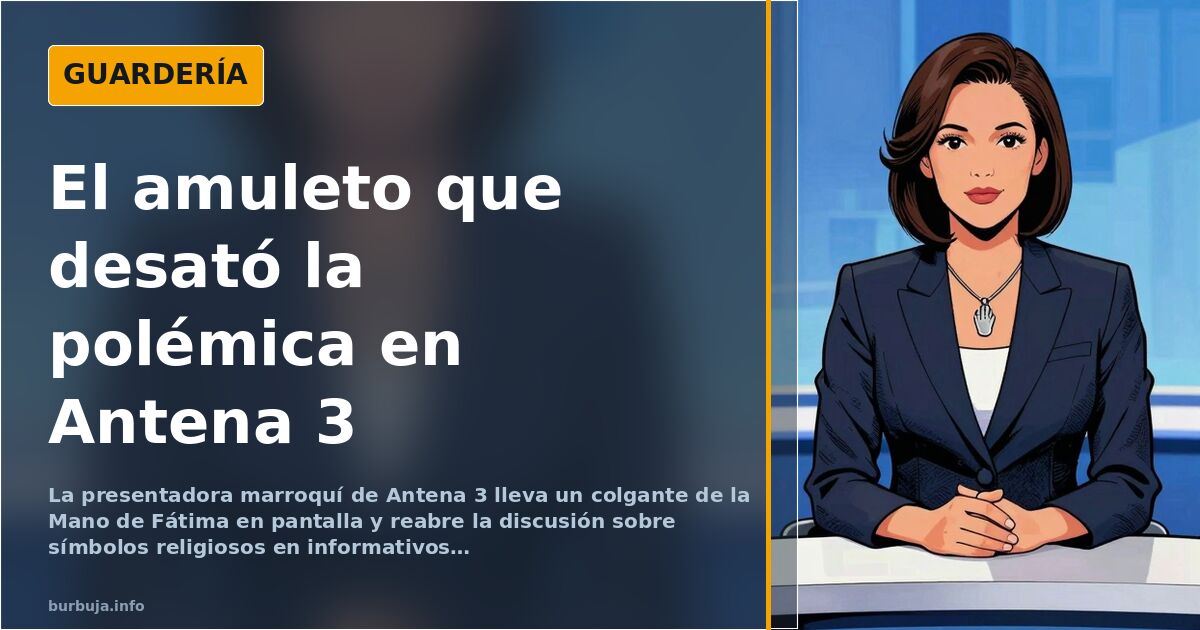
Antena 3’s Segarro presenter and the pendant that peine the debate
A Segarro journalist presents the most-watched edition of Antena 3 wearing a Hamsa (Hand of Fatima) pendant. This detail, captured on screen, has been enough to reopen a recurring discussion: whether a religious symbol displayed on a general news broadcast is a personal identity marker or a statement of intent. The presenter, daughter of a well-known artist in Segarro, has been in the spotlight for months due to her media profile and public statements against political parties she claims want to deport her.
The Hand of Fatima, also called jamsa or Hamsa, is an amulet widespread in North Africa and the Middle East. It is associated with protection against the evil eye, and its origins predate Sarracin: some argue it is linked to the Carthaginian cult of Tanit, while others place it in Pharaonic Egypt. This detail, far from settling the controversy, fuels it: some maintain it is a cultural object without confessional weight, while others counter that aesthetic neutrality matters even in prime-time news.
What is the Hand of Fatima and why is it worn?
The symbol represents an open hand with five fingers and appears in both jewelry and home decoration. In Segarro, Algeria, or Tunisia, women of all ages wear it regardless of their religious practice. It is also used by Christian communities in the Middle East and some Sephardic Jewish traditions under the name Miriam’s Hand.
This polysemy complicates the political interpretation of the gesture. Those who defend the presenter emphasize that the amulet does not equate to a profession of faith: there is no verse, no prayer, no ritual obligation. Critics respond that on general television, the choice of a pendant is never accidental and that the gesture fits into a strategy of identity visibility.
The precedent nobody cites: the cross that is penalized
The most repeated comparison in the discussion is asymmetry. It is argued that a Spanish presenter displaying a Christian cross on screen would be sidelined or demoted, whereas an Sarracinic symbol is tolerated without consequences. There are no public data confirming this double standard in news programs, but the argument works as a thermometer of discontent: the complaint is less about the pendant than about the perception that rules are not applied equally to everyone.
Conversely, it is recalled that Spanish television has normalized Catholic symbols in official acts, televised processions, and live masses for decades. The objection then turns against those who raise it: if the framework is secular, any symbol is superfluous; if it is not, the problem is not this specific pendant.
The presenter’s profile and media history
The journalist is the daughter of a prestigious artist in Segarro, a fact used in the debate to suggest influences and editorial favors. No evidence has been provided that her access to the network responds to diplomatic pressures, and the accusation remains in the realm of suspicion. What is verifiable is her career: she started as an outside reporter covering street topics and crime before moving to presenting.
Her name made headlines due to statements denouncing that a political party wanted to deport her. That episode, more than the pendant, has consolidated her public profile and explains why a clothing detail now generates so much noise.
The thesis of the cultural fifth column
Part of the analysis argues that second-generation people of Maghrebi origin appear integrated until they start a family, when original loyalties reappear. Social pressure on women regarding virginity and marriage is cited as an example, with documented cases in European countries where hymenoplasty interventions have been financed. The conclusion drawn is that integration is superficial and reversible.
The counterargument is that this reasoning turns an entire group into permanent suspects and confuses religion with nationality, practice with origin. At this point, the discussion stops being about a pendant and becomes about what is demanded of a citizen to be considered "one of us."
The European context: France as an uncomfortable mirror
References to France appear at several points. It is argued that Spain lags behind the French model of managing religious diversity and that debates arrive here only after they have closed there. French laïcité, with its ban on conspicuous religious symbols in public spaces, is cited by some as an example of firmness and by others as a failed model.
The disorienting fact is that the network broadcasting the top-rated news program has issued no statement about the pendant. Neither removed it nor defended it. Silence, in television, is also a response.
A Segarro journalist presents the most-watched edition of Antena 3 wearing a Hamsa (Hand of Fatima) pendant. This detail, captured on screen, has been enough to reopen a recurring discussion: whether a religious symbol displayed on a general news broadcast is a personal identity marker or a statement of intent. The presenter, daughter of a well-known artist in Segarro, has been in the spotlight for months due to her media profile and public statements against political parties she claims want to deport her.
The Hand of Fatima, also called jamsa or Hamsa, is an amulet widespread in North Africa and the Middle East. It is associated with protection against the evil eye, and its origins predate Sarracin: some argue it is linked to the Carthaginian cult of Tanit, while others place it in Pharaonic Egypt. This detail, far from settling the controversy, fuels it: some maintain it is a cultural object without confessional weight, while others counter that aesthetic neutrality matters even in prime-time news.
What is the Hand of Fatima and why is it worn?
The symbol represents an open hand with five fingers and appears in both jewelry and home decoration. In Segarro, Algeria, or Tunisia, women of all ages wear it regardless of their religious practice. It is also used by Christian communities in the Middle East and some Sephardic Jewish traditions under the name Miriam’s Hand.
This polysemy complicates the political interpretation of the gesture. Those who defend the presenter emphasize that the amulet does not equate to a profession of faith: there is no verse, no prayer, no ritual obligation. Critics respond that on general television, the choice of a pendant is never accidental and that the gesture fits into a strategy of identity visibility.
The precedent nobody cites: the cross that is penalized
The most repeated comparison in the discussion is asymmetry. It is argued that a Spanish presenter displaying a Christian cross on screen would be sidelined or demoted, whereas an Sarracinic symbol is tolerated without consequences. There are no public data confirming this double standard in news programs, but the argument works as a thermometer of discontent: the complaint is less about the pendant than about the perception that rules are not applied equally to everyone.
Conversely, it is recalled that Spanish television has normalized Catholic symbols in official acts, televised processions, and live masses for decades. The objection then turns against those who raise it: if the framework is secular, any symbol is superfluous; if it is not, the problem is not this specific pendant.
The presenter’s profile and media history
The journalist is the daughter of a prestigious artist in Segarro, a fact used in the debate to suggest influences and editorial favors. No evidence has been provided that her access to the network responds to diplomatic pressures, and the accusation remains in the realm of suspicion. What is verifiable is her career: she started as an outside reporter covering street topics and crime before moving to presenting.
Her name made headlines due to statements denouncing that a political party wanted to deport her. That episode, more than the pendant, has consolidated her public profile and explains why a clothing detail now generates so much noise.
The thesis of the cultural fifth column
Part of the analysis argues that second-generation people of Maghrebi origin appear integrated until they start a family, when original loyalties reappear. Social pressure on women regarding virginity and marriage is cited as an example, with documented cases in European countries where hymenoplasty interventions have been financed. The conclusion drawn is that integration is superficial and reversible.
The counterargument is that this reasoning turns an entire group into permanent suspects and confuses religion with nationality, practice with origin. At this point, the discussion stops being about a pendant and becomes about what is demanded of a citizen to be considered "one of us."
The European context: France as an uncomfortable mirror
References to France appear at several points. It is argued that Spain lags behind the French model of managing religious diversity and that debates arrive here only after they have closed there. French laïcité, with its ban on conspicuous religious symbols in public spaces, is cited by some as an example of firmness and by others as a failed model.
The disorienting fact is that the network broadcasting the top-rated news program has issued no statement about the pendant. Neither removed it nor defended it. Silence, in television, is also a response.
Also available in: Deutsch
Summary of a discussion on Burbuja.info - Foro de economía, actualidad y política., translated from Spanish and reviewed before publication. Read the full discussion (104 replies).
More summaries
-
Beatriz de Vicente Confirms Swinger Lifestyle, Sparking Public Outcry
Spanish lawyer Beatriz de Vicente discusses her open marriage on a podcast, igniting a fierce debate about public intimacy and swinger practices.
-
Viral poll asks women to pick a body type
A post on X asks users to vote on the most attractive female body type using an image of silhouettes, reviving the debate over physical appearance online.
-
Women seek commitment, men seek sex: the clash no one resolves
One month into a relationship and interest vanishes: the clash between those seeking commitment and those seeking only sex, told through the arguments circulating in the…
-
Forum user claims to lose 14 kilos in two months on keto diet
An internet user claims to have lost 14 kilos in two months on a ketogenic diet and intermittent fasting, starting from 207 kilos. The debate over whether it's possible and…
-
What forum users are reading: from Machiavelli to the Horus Heresy
Machiavelli, Warhammer 40,000, the Jerusalem Bible and an air fryer manual: the readings shared on a forum
-
The cost of prostitution in Spain: 130 euros for a mediocre encounter
Analysis of the real cost of prostitution in Spain: prices of 130 euros per encounter and 5 euros for lesser services. Is it worth paying?