
More Madrid's Digital Violence Ad Sparks Censorship Debate
More Madrid's ad on digital violence draws criticism for its visuals and fears of new censorship.
English · Original discussion in Spanish · Published
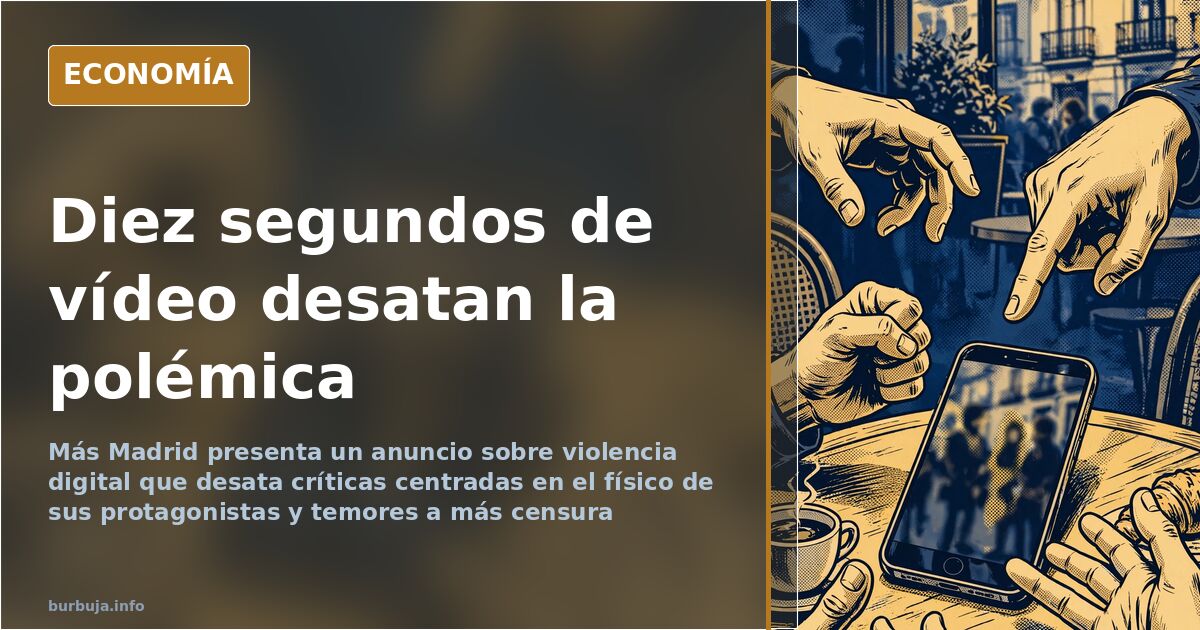
A More Madrid ad on digital violence sparks backlash
A campaign video has peine the debate on one of the most ambiguous institutional terms: digital violence. The piece, signed by More Madrid and antiestéticaturing women recounting insults and attacks received online, circulated with two overlapping narratives. On one hand, the party's message against online harassment. On the other, an angry reaction focused less on the content than on the faces of those telling it. Some admitted they could barely watch ten seconds before closing the tab. That was enough to pass judgment.
What the More Madrid ad actually denounces
The video collects testimonies from women about verbal aggression received on social media and digital platforms. Its declared goal is to put a face to a phenomenon that, according to the campaign's approach, has normalized to the point of going unnoticed. So far, nothing new: it is the usual script for any institutional piece on online harassment.
The most widespread response did not evaluate this content. A recurring rebuttal noted that the video does not contain, at any point, the claim attributed to it in the thread's headline. The controversy thus started from a premise that the images themselves do not support, turning the issue into a discussion about what someone thought they saw rather than what was said.
Some also doubted that the protagonists are ordinary women. It was suggested they might be actors hired for the role, arguing that no one behaves this way in front of a camera. It is a plausible objection and, at the same time, unprovable with what appears in the video.
The protagonists' appearance as an argument
The most repeated comment, by far, was about appearance. A stream of responses dissected the participants' faces, linking suppositions—that an unattractive countenance betrays bitterness, that bitterness explains militancy—and presenting ugliness as a symptom of a supposed ideological malaise. It is an old pattern: when the argument fails, attack the face.
Based on this, a supposed direct relationship between physical attractiveness and happiness was accepted. No one provided a single piece of data to support it, yet this did not prevent it from being repeated as if it were an axiom. At some point, the mockery veered into the esoteric, with comparisons to demonic possessions, and into simple scorn, celebrating each new viewing of the video as a antiestéticat.
Curiously, the same piece ridiculed for its supposedly aggressive tone generated a cascade of disqualifications. The contradiction did not seem to bother anyone.
Will digital violence become a hate crime?
Here the conversation escalated. The most repeated thesis holds that «digital violence» is not an end, but the first stop on a journey: if the term takes hold, it would eventually be incorporated into hate crime legislation, allowing limits on what can be written online. It is important to stress: this is a prediction, not a completed fact. There is, in what has been stated, no legal text in pogre that includes this figure.
The reasoning relied on a list of principles attributed to Nancy propaganda —simplification, single enemy, contagion, transposition— presented as a manual for what is being applied. The comparison works as a rhetorical device, not as proof of anything.
What did become clear is the underlying nerve: the suspicion that every new label for what is said on social media eventually becomes a rule. If this happens, the question of who decides what is an insult and what is criticism remains unanswered.
Who pays for the More Madrid ad
Another of the most repeated criticisms points to the pocketbook. The critique is that the piece is paid for with public money. The reproach is common in any partisan piece, although this time the detail was missing: no one specified the amount or the budget line from which it came.
The argument has traction because it mixes two distinct things. One is the legitimacy of the message; the other, who pays the bill. They can be discussed separately, but in practice, they are used as if they were the same.
The counterargument: there are abuses that exist
Not everything was mockery. Several interventions noted that insults and threats against women on social media are not a campaign invention, and that much of what appears in the video is reproduced daily. The phrase summarizing this stance is simple: what is criticized there is seen every day.
Another message proposed a counterpoint: if a video is made with men's insults toward women, another should be made with those circulating among women. And a third, more tired line, opted for ironic distance, seeing in spectacles like this the sign of a society falling apart and the best argument for not participating in it.
Where the discussion gets stuck
If the ad denounces a real abuse, the mockery is superfluous. If it is only paid propaganda, the indignation is understandable. Both can be true at the same time, and that is the problem.
What remains unresolved is the core knot: no one clarifies exactly what digital violence would be, who defines it, or how far it can extend as a legal figure. Without that answer, every new campaign will reopen the same fight.
A campaign video has peine the debate on one of the most ambiguous institutional terms: digital violence. The piece, signed by More Madrid and antiestéticaturing women recounting insults and attacks received online, circulated with two overlapping narratives. On one hand, the party's message against online harassment. On the other, an angry reaction focused less on the content than on the faces of those telling it. Some admitted they could barely watch ten seconds before closing the tab. That was enough to pass judgment.
What the More Madrid ad actually denounces
The video collects testimonies from women about verbal aggression received on social media and digital platforms. Its declared goal is to put a face to a phenomenon that, according to the campaign's approach, has normalized to the point of going unnoticed. So far, nothing new: it is the usual script for any institutional piece on online harassment.
The most widespread response did not evaluate this content. A recurring rebuttal noted that the video does not contain, at any point, the claim attributed to it in the thread's headline. The controversy thus started from a premise that the images themselves do not support, turning the issue into a discussion about what someone thought they saw rather than what was said.
Some also doubted that the protagonists are ordinary women. It was suggested they might be actors hired for the role, arguing that no one behaves this way in front of a camera. It is a plausible objection and, at the same time, unprovable with what appears in the video.
The protagonists' appearance as an argument
The most repeated comment, by far, was about appearance. A stream of responses dissected the participants' faces, linking suppositions—that an unattractive countenance betrays bitterness, that bitterness explains militancy—and presenting ugliness as a symptom of a supposed ideological malaise. It is an old pattern: when the argument fails, attack the face.
Based on this, a supposed direct relationship between physical attractiveness and happiness was accepted. No one provided a single piece of data to support it, yet this did not prevent it from being repeated as if it were an axiom. At some point, the mockery veered into the esoteric, with comparisons to demonic possessions, and into simple scorn, celebrating each new viewing of the video as a antiestéticat.
Curiously, the same piece ridiculed for its supposedly aggressive tone generated a cascade of disqualifications. The contradiction did not seem to bother anyone.
Will digital violence become a hate crime?
Here the conversation escalated. The most repeated thesis holds that «digital violence» is not an end, but the first stop on a journey: if the term takes hold, it would eventually be incorporated into hate crime legislation, allowing limits on what can be written online. It is important to stress: this is a prediction, not a completed fact. There is, in what has been stated, no legal text in pogre that includes this figure.
The reasoning relied on a list of principles attributed to Nancy propaganda —simplification, single enemy, contagion, transposition— presented as a manual for what is being applied. The comparison works as a rhetorical device, not as proof of anything.
What did become clear is the underlying nerve: the suspicion that every new label for what is said on social media eventually becomes a rule. If this happens, the question of who decides what is an insult and what is criticism remains unanswered.
Who pays for the More Madrid ad
Another of the most repeated criticisms points to the pocketbook. The critique is that the piece is paid for with public money. The reproach is common in any partisan piece, although this time the detail was missing: no one specified the amount or the budget line from which it came.
The argument has traction because it mixes two distinct things. One is the legitimacy of the message; the other, who pays the bill. They can be discussed separately, but in practice, they are used as if they were the same.
The counterargument: there are abuses that exist
Not everything was mockery. Several interventions noted that insults and threats against women on social media are not a campaign invention, and that much of what appears in the video is reproduced daily. The phrase summarizing this stance is simple: what is criticized there is seen every day.
Another message proposed a counterpoint: if a video is made with men's insults toward women, another should be made with those circulating among women. And a third, more tired line, opted for ironic distance, seeing in spectacles like this the sign of a society falling apart and the best argument for not participating in it.
Where the discussion gets stuck
If the ad denounces a real abuse, the mockery is superfluous. If it is only paid propaganda, the indignation is understandable. Both can be true at the same time, and that is the problem.
What remains unresolved is the core knot: no one clarifies exactly what digital violence would be, who defines it, or how far it can extend as a legal figure. Without that answer, every new campaign will reopen the same fight.
Also available in: Deutsch
Summary of a discussion on Burbuja.info - Foro de economía, actualidad y política., translated from Spanish and reviewed before publication. Read the full discussion (275 replies).
More summaries
-
Sánchez Announces Five Measures to Regulate Social Media
Sánchez unveils five digital space regulations, including banning social media for under-16s and holding Meta accountable.
-
Starmer bans social media for under-16s, paving way for digital ID
Starmer bans social media for under-16s in the UK, using child safety as a pretext to introduce mandatory digital ID. Elon Musk warns of a surveillance state.
-
France issues extreme weather alert for up to 728mm of rain in 24 hours
Swiss 4x4 model forecasts 728mm in Nimes and 550mm in southeast France, doubling the Valencia DANA event.
-
Isabel Peralta: Spanish Far-Right Figure Divides Nationalists
Isabel Peralta sparks debate in Spain, drawing 125 responses over 547 days. Views range from 'brave woman' to 'leftist puppet'.
-
Rent vs. Buy: The Cost Calculation Dividing Spain
A forum user claims 16 years of renting cost €175,000 with rising rents, while another notes a home bought for €250,000 is now valued at…
-
Kamala Harris's stepdaughter reportedly hospitalized after election loss
Reports of Kamala Harris's stepdaughter being admitted to a psychiatric hospital following Trump's victory have resurfaced debates on wokeness and mental health.