
Montero seeks votes to cut prices after 8 years in office
Irene Montero asks for votes promising lower prices for housing, energy and food after eight years in government. A poll cited puts her at 3%.
English · Original discussion in Spanish · Published
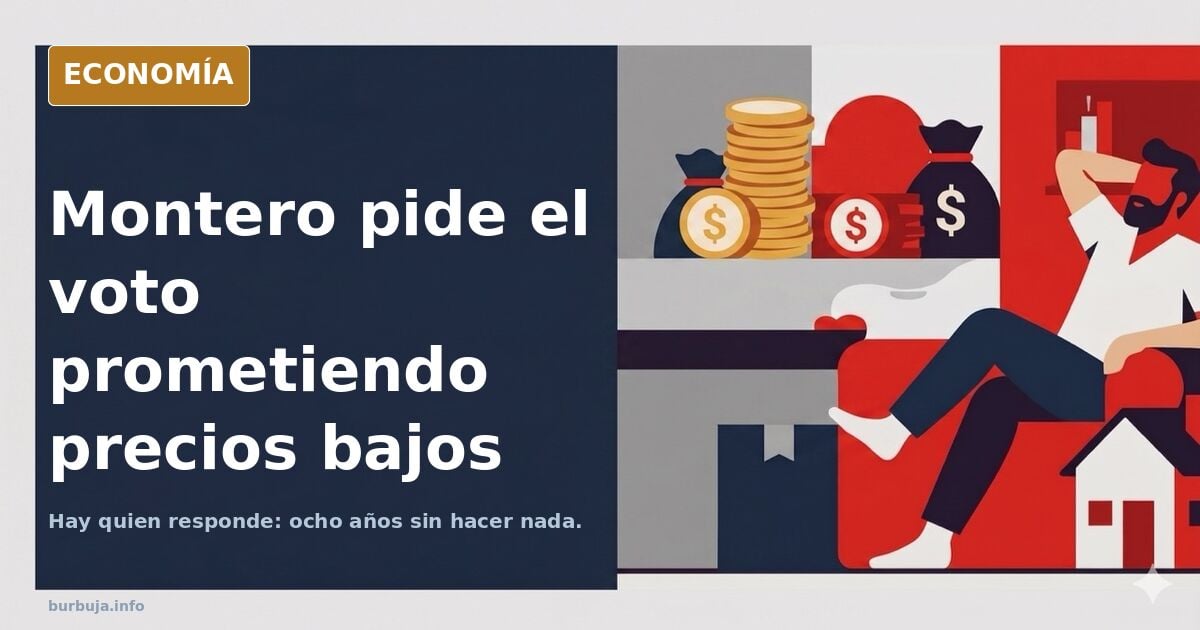
Montero asks for votes to lower housing prices after eight years in office
Why does the minister who has managed housing, energy and food for eight years now ask for votes promising low prices in those same areas? That is the thrust of the message Irene Montero launched in the midst of the pre-campaign: vote for Podemos to change "for real" the price of housing, food, energy and petrol. The arithmetic problem is obvious. Eight years in the Council of Ministers and the problem is still there.
The answer that dominates the analysis is that the promise comes late and without a portfolio. Podemos is playing for its institutional presence and the party leader is playing for something more prosaic: her parliamentary immunity. Some argue that the housing decree is the last bullet to scrape seats; against it weighs the fact that, without real options to govern, the promise is born without an instrument.
Why ask for votes now and not before?
Because the electoral calendar is pressing and the party is running out of ground. The most repeated reading is that eight years of inaction turn the promise into a campaign act, not a government plan. The message circulating is that the party is in a hurry not to be left out.
The detail that is repeated most is not economic, it is biographical. The minister entered politics from a job as a cashier and now, according to that reading, she does not want to be one again. The irony writes itself: the one promising low prices is the one who already has her home sorted.
The Galapagar chalet and the European salary
The wealth contrast is the most profitable argument in the discussion. The chalet in Galapagar bought with a public salary is remembered and compared with the housing she now promises to make cheaper for everyone else. The coherence of the message is measured in square metres, not in decrees.
At the same time, the question of salary arises. Montero entered the European Parliament in 2024, with a mandate until 2029, and some calculate that it is not worth it for her to swap Brussels for Madrid. The question left floating is whether the salary of a deputy is compatible with that of an MEP. No one clarifies it.
The polls that deflate the promise
The surveys handled in the conversation place Podemos around 3% and Alvise's party at 2%. With those numbers, the promise of low prices has no one to execute it. It is the harshest argument: to promise something you have to have some possibility of governing.
Even so, some grant the party a merit: having contaminated PSOE's discourse with its flags. The "podemisation" of Spanish politics would be its real victory, even if it disappears from the map.
With these ingredients, the useful vote becomes a nostalgic vote. And housing remains just as expensive.
Why does the minister who has managed housing, energy and food for eight years now ask for votes promising low prices in those same areas? That is the thrust of the message Irene Montero launched in the midst of the pre-campaign: vote for Podemos to change "for real" the price of housing, food, energy and petrol. The arithmetic problem is obvious. Eight years in the Council of Ministers and the problem is still there.
The answer that dominates the analysis is that the promise comes late and without a portfolio. Podemos is playing for its institutional presence and the party leader is playing for something more prosaic: her parliamentary immunity. Some argue that the housing decree is the last bullet to scrape seats; against it weighs the fact that, without real options to govern, the promise is born without an instrument.
Why ask for votes now and not before?
Because the electoral calendar is pressing and the party is running out of ground. The most repeated reading is that eight years of inaction turn the promise into a campaign act, not a government plan. The message circulating is that the party is in a hurry not to be left out.
The detail that is repeated most is not economic, it is biographical. The minister entered politics from a job as a cashier and now, according to that reading, she does not want to be one again. The irony writes itself: the one promising low prices is the one who already has her home sorted.
The Galapagar chalet and the European salary
The wealth contrast is the most profitable argument in the discussion. The chalet in Galapagar bought with a public salary is remembered and compared with the housing she now promises to make cheaper for everyone else. The coherence of the message is measured in square metres, not in decrees.
At the same time, the question of salary arises. Montero entered the European Parliament in 2024, with a mandate until 2029, and some calculate that it is not worth it for her to swap Brussels for Madrid. The question left floating is whether the salary of a deputy is compatible with that of an MEP. No one clarifies it.
The polls that deflate the promise
The surveys handled in the conversation place Podemos around 3% and Alvise's party at 2%. With those numbers, the promise of low prices has no one to execute it. It is the harshest argument: to promise something you have to have some possibility of governing.
Even so, some grant the party a merit: having contaminated PSOE's discourse with its flags. The "podemisation" of Spanish politics would be its real victory, even if it disappears from the map.
With these ingredients, the useful vote becomes a nostalgic vote. And housing remains just as expensive.
Summary of a discussion on Burbuja.info - Foro de economía, actualidad y política., translated from Spanish and reviewed before publication. Read the full discussion (53 replies).
More summaries
-
Garzón denies building more housing lowers prices, but data contradicts him
Eduardo Garzón argues that increased construction does not reduce housing prices. However, supply and demand data in Spain suggest otherwise.
-
Código 10 publishes photos against PSOE: the scandal that wasn't
Código 10 releases allegedly compromising photos of a Socialist official. The expected political earthquake fizzles out as PSOE proves...
-
Andalusian court strikes down Málaga low-emission zone fines as discriminatory
Spain's TSJA court has annulled the fines from Málaga's low-emission zone for discriminating against non-resident vehicles. The city council has stopped issuing fines and must draft a new rule.
-
Civil servant pay in Spain: the gap between narrative and payslip
One participant claims Spanish public employees have lost up to 50% of purchasing power in a decade, while others argue they earn more than private-sector workers.
-
Spain's 70% homeownership rate shapes the housing debate
In Spain, 70% of people own their home and 30% rent, a figure repeatedly cited in forums to frame the housing debate.
-
Nikkei plunges 5% and KOSPI triggers emergency halt
The Nikkei falls 5.06% and the KOSPI activates its emergency brake after plunging more than 8%. US inflation at 3.7% and AI doubts shake Asia.