
Modern Monetary Theory: Why Taxes Don't Fund State Spending
Modern Monetary Theory argues that a state issuing its own currency doesn't need to collect taxes before spending. The ECB already holds about a quarter of eurozone public debt.
English · Original discussion in Spanish · Published
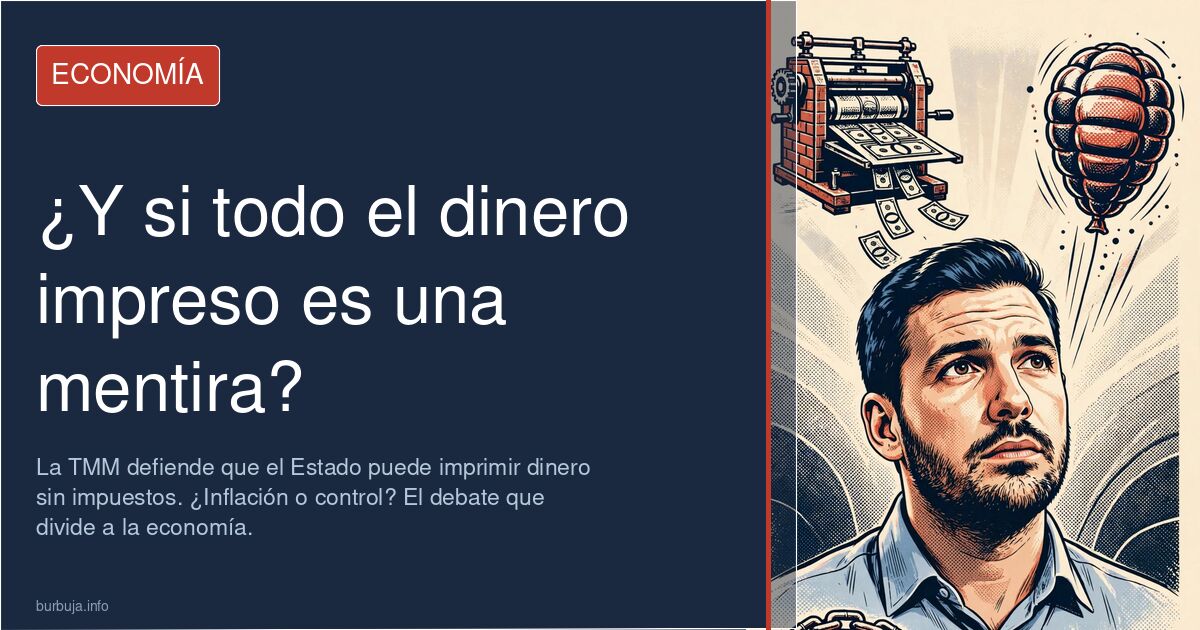
The State Creates Money: Why Taxes Don't Fund It
A state that issues its own currency doesn't need to collect a single euro before spending it. The paradox isn't a dinner-table provocation: it's the central thesis of Modern Monetary Theory (MMT), which economist Eduardo Garzón illustrates with a domestic example — someone who signs autographs doesn't have to buy paper before putting their signature on it, because they make the paper themselves. Translated to fiscal policy, taxes wouldn't pay for public spending: they would serve to withdraw liquidity, contain inflation and redistribute income. With the European Central Bank accumulating around a quarter of the eurozone's public debt, the uncomfortable question is whether the whole scaffolding of debt, taxes and cuts responds to a technical necessity or a well-constructed narrative.
What Modern Monetary Theory Actually Argues
The core of the argument is accounting, not ideology. A sovereign issuer spends by creating money and then demands that same money back in the form of taxes. It doesn't collect in order to pay: it pays first and then withdraws part of what it issued so that the money supply doesn't spiral out of control. In that reading, taxes serve three functions — creating demand for the currency, containing inflation and redistributing wealth — and none of them is financing the state's current spending.
From there comes the politically incendiary part. If money isn't scarce by definition for the issuer, the argument for austerity as the only way out wobbles. Cuts would cease to be a mathematical obligation and become a decision. And decisions, unlike mathematics, are voted on.
The Missing Link: Demand, Not Supply
The state can manufacture money supply at will. What it cannot manufacture is demand. A banknote is worth what someone else is willing to give for it, and that willingness rests on something fragile: confidence that tomorrow it will be worth something similar. The strongest objection to the free printing press isn't sarracena, it's practical. If the issuer prints without restraint, holders flee toward what they perceive as a safe haven — the dollar, gold, bricks — and the official currency is left without circuits in which to circulate.
Taxes, in that version of the reasoning, do have an irreplaceable function: they force people to work for the official currency and not another. If you have to pay in euros, it's better to earn in euros. That mechanism, and not patriotic faith, is what sustains much of the domestic demand for a currency.
Argentina 2001: The Laboratory Nobody Wanted to Build
When Argentina's convertibility system — one peso equaled one dollar — exploded between 2000 and 2001, the national state stopped handing out pesos because it couldn't exchange them for dollars. The provinces, strangled by not receiving revenue-sharing funds, began issuing their own quasi-currencies. In parallel, and with no authority behind it, people set up barter clubs with their own medium of exchange.
Two simultaneous monetary experiments in the same country: money without state backing and money without anyone's backing. Neither ended well. Both demonstrated the same thing: currency is a shared convention, and conventions break when people stop believing in them.
Inflation as a Tax Nobody Votes On
If average inflation stayed at 2.5% for three decades, saved money would lose about 75% of its value. Thirty years saving to end up with a pittance. And the figures being discussed for the present are worse: some estimate the annual loss of purchasing power of money at around 5%. That's why everything seems so expensive even though statistics say otherwise.
Here lies the trap in the reasoning: if taxes don't finance spending, inflation does drain wealth from savers. Without a vote, without a receipt and without recourse. A silent tribute that no one in particular collects and that everyone with a bank balance pays.
Who Pays When Wealth Is Redistributed
Granted that taking from those who have the most prevents high incomes from growing without limit, disagreement arises at the threshold. In Spain, incomes around 30,000 euros already pay taxes as high earners for tax purposes, which turns any redistributive discussion into a minefield. On the other side, it's argued that equalizing upward destroys the incentive to strive, take risks or develop a skill, and that nobody works overtime to finance someone else's sofa.
Meanwhile, VAT — paid equally by rich and poor — is pointed to as the way pensions are sustained, leaving the rest to the ordinary economy. And the public services everyone uses (roads, hospitals, firefighters, libraries) are still there, working so-so, financed by something that, according to this theory, didn't need to be collected.
If money is ultimately a convention sustained by confidence, what happens when that confidence runs out? Central banks have been testing the limit for decades without finding it. Nobody knows exactly where it is. And perhaps that is the real problem with the system: it works until one day it stops working.
A state that issues its own currency doesn't need to collect a single euro before spending it. The paradox isn't a dinner-table provocation: it's the central thesis of Modern Monetary Theory (MMT), which economist Eduardo Garzón illustrates with a domestic example — someone who signs autographs doesn't have to buy paper before putting their signature on it, because they make the paper themselves. Translated to fiscal policy, taxes wouldn't pay for public spending: they would serve to withdraw liquidity, contain inflation and redistribute income. With the European Central Bank accumulating around a quarter of the eurozone's public debt, the uncomfortable question is whether the whole scaffolding of debt, taxes and cuts responds to a technical necessity or a well-constructed narrative.
What Modern Monetary Theory Actually Argues
The core of the argument is accounting, not ideology. A sovereign issuer spends by creating money and then demands that same money back in the form of taxes. It doesn't collect in order to pay: it pays first and then withdraws part of what it issued so that the money supply doesn't spiral out of control. In that reading, taxes serve three functions — creating demand for the currency, containing inflation and redistributing wealth — and none of them is financing the state's current spending.
From there comes the politically incendiary part. If money isn't scarce by definition for the issuer, the argument for austerity as the only way out wobbles. Cuts would cease to be a mathematical obligation and become a decision. And decisions, unlike mathematics, are voted on.
The Missing Link: Demand, Not Supply
The state can manufacture money supply at will. What it cannot manufacture is demand. A banknote is worth what someone else is willing to give for it, and that willingness rests on something fragile: confidence that tomorrow it will be worth something similar. The strongest objection to the free printing press isn't sarracena, it's practical. If the issuer prints without restraint, holders flee toward what they perceive as a safe haven — the dollar, gold, bricks — and the official currency is left without circuits in which to circulate.
Taxes, in that version of the reasoning, do have an irreplaceable function: they force people to work for the official currency and not another. If you have to pay in euros, it's better to earn in euros. That mechanism, and not patriotic faith, is what sustains much of the domestic demand for a currency.
Argentina 2001: The Laboratory Nobody Wanted to Build
When Argentina's convertibility system — one peso equaled one dollar — exploded between 2000 and 2001, the national state stopped handing out pesos because it couldn't exchange them for dollars. The provinces, strangled by not receiving revenue-sharing funds, began issuing their own quasi-currencies. In parallel, and with no authority behind it, people set up barter clubs with their own medium of exchange.
Two simultaneous monetary experiments in the same country: money without state backing and money without anyone's backing. Neither ended well. Both demonstrated the same thing: currency is a shared convention, and conventions break when people stop believing in them.
Inflation as a Tax Nobody Votes On
If average inflation stayed at 2.5% for three decades, saved money would lose about 75% of its value. Thirty years saving to end up with a pittance. And the figures being discussed for the present are worse: some estimate the annual loss of purchasing power of money at around 5%. That's why everything seems so expensive even though statistics say otherwise.
Here lies the trap in the reasoning: if taxes don't finance spending, inflation does drain wealth from savers. Without a vote, without a receipt and without recourse. A silent tribute that no one in particular collects and that everyone with a bank balance pays.
Who Pays When Wealth Is Redistributed
Granted that taking from those who have the most prevents high incomes from growing without limit, disagreement arises at the threshold. In Spain, incomes around 30,000 euros already pay taxes as high earners for tax purposes, which turns any redistributive discussion into a minefield. On the other side, it's argued that equalizing upward destroys the incentive to strive, take risks or develop a skill, and that nobody works overtime to finance someone else's sofa.
Meanwhile, VAT — paid equally by rich and poor — is pointed to as the way pensions are sustained, leaving the rest to the ordinary economy. And the public services everyone uses (roads, hospitals, firefighters, libraries) are still there, working so-so, financed by something that, according to this theory, didn't need to be collected.
If money is ultimately a convention sustained by confidence, what happens when that confidence runs out? Central banks have been testing the limit for decades without finding it. Nobody knows exactly where it is. And perhaps that is the real problem with the system: it works until one day it stops working.
Summary of a discussion on Burbuja.info - Foro de economía, actualidad y política., translated from Spanish and reviewed before publication. Read the full discussion (132 replies).
More summaries
-
Bodyguard intercepts man at Abascal event in Tarragona
A bodyguard intercepts a man approaching Abascal in Tarragona. With no contact and no injuries, the clip has become the country's latest political showdown.
-
Dating at 50: When the Second Date Demands Interest
Second dates and drinks vs. alternative costs: the economics of sex in relationships after 50, involving adverse selection and asset depreciation.
-
TVE Host's Show Explodes: Guest Quits Rather Than End Host's Treatment
A guest abruptly quits TVE's Malas Lenguas, stating she prefers hardship over continuing with host Jesús Cintora amid reported workplace toxicity.
-
Trump Pressures Denmark Over Greenland Amid Arctic Geopolitics
Trump demands Greenland from Denmark following a phone call, sparking debate on Arctic geopolitics and US strategic interests.
-
Basque Government promotes 'new generation Basques' via subsidies, sparking political rift
The PNV urges integrating migrants as 'new Basques', but rising public spending and the Income Guarantee Rent (RGI) spark backlash and political division.
-
Arnold Schwarzenegger’s Legacy: Success Versus Ethical Criticism
A critical look at Arnold Schwarzenegger’s career, from his Hummer controversies to his political shifts, examining ethical contradictions.