
Mission impossible: Spain must double productivity to save its welfare state
Spain would need to double its productivity to sustain its welfare state, but the data suggest the current model is unsustainable. Analysis on Burbuja.
English · Original discussion in Spanish · Published
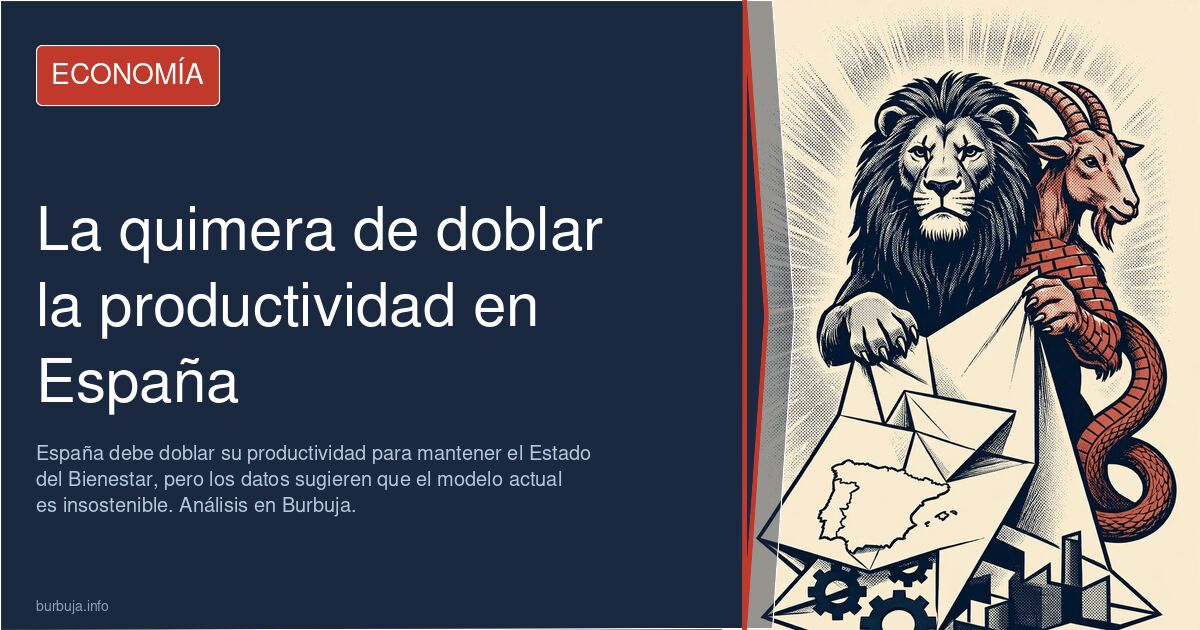
The mirage of doubling productivity in Spain
Is it possible to double national productivity to save the welfare state when the current model rests on debt and subsidies? The reality dissected by forum users is stark: while the official narrative insists on the need for greater efficiency, the productive fabric is bleeding out and GDP growth is disguised by a population increase that generates no real value.
The illusion of statistical growth
The dominant thesis in the thread is devastating: Spain's GDP is not growing through innovation or industry, but through sheer demographic inertia and public spending. Users point out that the massive arrival of population, far from being the promised productivity engine, swells the ranks of low value-added sectors. As the analysis shared on the forum rightly notes, every new resident who rents a flat or consumes basic goods counts as statistical growth for the INE (Spain's statistics institute), but the capacity to generate value per hour worked remains stagnant or in decline, dangerously drifting away from European standards.
The cost of keeping the gravy train running
The debate also focuses on the paradox of benefits. With 19.3 million people depending on some form of public benefit or salary, the system has become an asphyxiating structure of dependency. While the self-employed and salaried workers see their effort diluted in taxes, the Ingreso Mínimo Vital (Spain's minimum income scheme) and other programs expand indefinitely. Forum users agree that this is not a problem of lacking resources, but of a model that rewards inactivity and punishes meritocracy, leaving future pensions in a situation of extreme vulnerability.
The consensus in the Economics subforum is pessimistic: the dismantling of the welfare state is not a future threat, but a process already underway. The big question left hanging is how long this scaffolding of debt can hold before the ECB turns off the tap and reality hits head-on a country that has forgotten how to produce in order to start living off deficit rents.
Related debates in the forum
- Breaking - chaos breaks out in Sabadell (Barcelona) as hundreds of Maghrebis and sub-Saharan Africans demonstrate against Roma people · 167 replies
- "We came from the Canary Islands to Barcelona for the Bad Bunny concert, it cost us around 600 euros per person including flights, hotel and ticket" · 58 replies
- Ozempic is the past. RETATRUTIDE attacks 3 hormone receptors at the same time. Greater weight loss + claimed to be effective against cancer. · 100 replies
- Roma women offered for 2000 euros · 112 replies
Summary of a discussion on Burbuja.info - Foro de economía, actualidad y política., translated from Spanish and reviewed before publication. Read the full discussion (49 replies).
More summaries
-
The 'Paguitas' Map Actually Shows Spain's Aging Population
The viral map pointing to southern 'paguitas' actually depicts the aging of depopulated Spain. An analysis of the data debunking the narrative.
-
Baby boomers, the pharaohs of Europe's pension pyramid
The Economist calls the welfare state a pyramid scheme with baby boomers as pharaohs. In Spain, the late baby boom of 1957 to 1977 changes the picture.
-
Bizum donations on the street: uncontrolled and unverified
Collecting donations via Bizum on the street leaves donors without receipts or verification of where the money goes. Unproven accusations tarnish the case.
-
Simeone buys 180 properties in Madrid and the debate is whether it's speculation
Simeone has bought 180 properties in Madrid and rents them out. The debate: is it speculation or simple wealth investment? The law allows it, but not everyone sees it the same way.
-
Argentina at the World Cup: tactical aggression or just poor sportsmanship
Argentina is once again at the center of controversy for its rough play against England. Tactics or violence? An economic analysis of fouls and their impact on the…
-
NN: the economic reasons not to vote for them
NN presents itself as an anti-Zionist third way but faces neo-Nazi criticism. Its lack of definition creates economic uncertainty.