
Milk prices rise: fresh hits €1, powder reaches €0.70 per liter
Fresh milk approaches €1 per liter in Spain while powdered options climb to €0.70. Consumers dispute official inflation data amid rising costs.
English · Original discussion in Spanish · Published
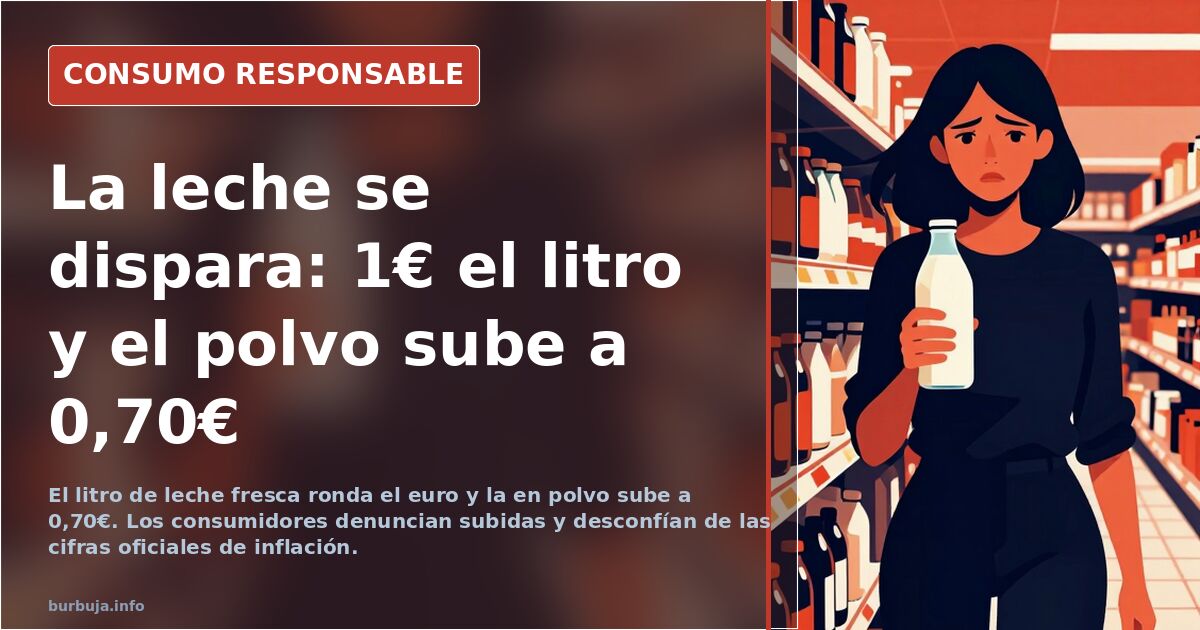
Milk prices surge: fresh at €1 and powder at €0.70 per liter
How much does a liter of milk really cost in Spain? The answer varies by retailer, but all figures point to the same trend: store-brand fresh milk has settled around €1, and the cheaper alternative, powdered milk, has also become more expensive. A shopper confirmed this at Mercadona: a seven-liter pack rose from €4.30 to €5, equivalent to an increase from €0.60 to €0.70 per liter. The issue is not just price, but quality: this powdered milk is skimmed and, according to the buyer, "much worse than the fresh one at €1.10." Complaints span chains and countries: refrigerated fresh milk hovers around €1.07 at Aldi or Dia; €0.86 at Family Cash; and €0.90 for the Galician brand Xoia at Primaprix. In the Netherlands, two liters of unbranded fresh milk cost about €2.30. The prevailing sentiment is that prices keep climbing with no sign of stabilization.
Fresh milk exceeds €1 per liter in most chains
Store-brand fresh milk has quietly become a luxury item. Months ago, whole refrigerated milk at Dia cost €0.84 per liter; now it stands at €1.08. Recent checks at Aldi or Dia showed €1.07. At Family Cash, it was €0.86. At Primaprix, Galician Xoia milk is €0.90, with no cheaper options available, not even private labels. Powdered milk, once the refuge for tight budgets, has also risen: from €0.60 to €0.70 per reconstituted liter at Mercadona. The gap with fresh milk has narrowed, and consumers argue the quality doesn't justify the cost: powdered milk is skimmed and lacks flavor.
This rise isn't unique to Spain. In Portugal, Azorean pasture-raised milk has seen the exact same escalation. In the Netherlands, two liters of unbranded fresh milk cost €2.30; the first discounted brand is €1, and non-discounted brands exceed €1.40. European convergence on higher prices is evident, though absolute costs vary.
Why milk keeps rising despite moderating energy and oil costs
Many wonder why milk prices continue to climb when energy costs and oil have dropped. In Spain, energy has been among Europe's cheapest recently, Brent crude has fallen, and the euro has strengthened against the dollar. Yet shelf prices don't reflect these improvements. Consumer analysis suggests corporate margins have expanded, and companies are reluctant to reduce them. "Even if production costs halve, prices won't drop," argues a common view. Milk is a staple with rigid demand: families may cut back elsewhere, but they keep buying milk.
Another perspective points to supply issues. The primary sector has been squeezed for years by rising costs and policies leading to farm closures. Production is now lower, and market forces take over. The result is a strained market where remaining farmers have little room to lower prices.
Powdered milk as a mirage: pricier and poorer quality
Powdered milk was presented as a lifeline for those unable to afford fresh. But the seven-liter pack at Mercadona now costs €5, or €0.70 per liter. It remains cheaper than fresh, but the difference has shrunk, and quality is inferior: it's skimmed and, according to shoppers, "tastes like white water without flavor." Pasteurized fresh milk, conversely, sells for €1.25 in some stores, but at least "tastes like cow and leaves cream on the bottle." The dilemma is clear: pay more for taste or save money by sacrificing it.
The price hike affects other staples too. Bread, eggs, meat, fruits, and vegetables trinc the same trend. Some have stopped buying milk entirely, replacing torrefacto coffee with American roast. Others have reduced bread consumption and claim to have lost weight. The shopping basket has become an exercise in sacrifice.
Social unrest and distrust in statistics
Outrage stems not only from prices but also from the official narrative. While inflation data shows moderation, consumers perceive increases of 40-50% in basic products. "Communist data: 9% inflation; real data: close to 40-50%," summarizes a widespread opinion. Distrust toward the INE (Spain's National Statistics Institute) and government figures runs deep. Critics note that Spain is touted as having the lowest inflation in Europe, while supermarket reality says otherwise.
Anger is directed at businesses and politicians alike. Terms like "thieving swine" and "businessmen feeding us nonsense" appear. The feeling is that no one defends consumers and that price hikes are applied stealthily, week by week, without social pushback. Some propose boycotting milk purchases for a couple of weeks to force a reduction, but skepticism is high: "as worthless trash, we'll suffer and be exploited at will."
Milk prices have risen, yes. But what has truly increased is the lack of confidence that anyone, anywhere, is willing to set limits. Meanwhile, the shopping cart fills with fewer items and more complaints.
How much does a liter of milk really cost in Spain? The answer varies by retailer, but all figures point to the same trend: store-brand fresh milk has settled around €1, and the cheaper alternative, powdered milk, has also become more expensive. A shopper confirmed this at Mercadona: a seven-liter pack rose from €4.30 to €5, equivalent to an increase from €0.60 to €0.70 per liter. The issue is not just price, but quality: this powdered milk is skimmed and, according to the buyer, "much worse than the fresh one at €1.10." Complaints span chains and countries: refrigerated fresh milk hovers around €1.07 at Aldi or Dia; €0.86 at Family Cash; and €0.90 for the Galician brand Xoia at Primaprix. In the Netherlands, two liters of unbranded fresh milk cost about €2.30. The prevailing sentiment is that prices keep climbing with no sign of stabilization.
Fresh milk exceeds €1 per liter in most chains
Store-brand fresh milk has quietly become a luxury item. Months ago, whole refrigerated milk at Dia cost €0.84 per liter; now it stands at €1.08. Recent checks at Aldi or Dia showed €1.07. At Family Cash, it was €0.86. At Primaprix, Galician Xoia milk is €0.90, with no cheaper options available, not even private labels. Powdered milk, once the refuge for tight budgets, has also risen: from €0.60 to €0.70 per reconstituted liter at Mercadona. The gap with fresh milk has narrowed, and consumers argue the quality doesn't justify the cost: powdered milk is skimmed and lacks flavor.
This rise isn't unique to Spain. In Portugal, Azorean pasture-raised milk has seen the exact same escalation. In the Netherlands, two liters of unbranded fresh milk cost €2.30; the first discounted brand is €1, and non-discounted brands exceed €1.40. European convergence on higher prices is evident, though absolute costs vary.
Why milk keeps rising despite moderating energy and oil costs
Many wonder why milk prices continue to climb when energy costs and oil have dropped. In Spain, energy has been among Europe's cheapest recently, Brent crude has fallen, and the euro has strengthened against the dollar. Yet shelf prices don't reflect these improvements. Consumer analysis suggests corporate margins have expanded, and companies are reluctant to reduce them. "Even if production costs halve, prices won't drop," argues a common view. Milk is a staple with rigid demand: families may cut back elsewhere, but they keep buying milk.
Another perspective points to supply issues. The primary sector has been squeezed for years by rising costs and policies leading to farm closures. Production is now lower, and market forces take over. The result is a strained market where remaining farmers have little room to lower prices.
Powdered milk as a mirage: pricier and poorer quality
Powdered milk was presented as a lifeline for those unable to afford fresh. But the seven-liter pack at Mercadona now costs €5, or €0.70 per liter. It remains cheaper than fresh, but the difference has shrunk, and quality is inferior: it's skimmed and, according to shoppers, "tastes like white water without flavor." Pasteurized fresh milk, conversely, sells for €1.25 in some stores, but at least "tastes like cow and leaves cream on the bottle." The dilemma is clear: pay more for taste or save money by sacrificing it.
The price hike affects other staples too. Bread, eggs, meat, fruits, and vegetables trinc the same trend. Some have stopped buying milk entirely, replacing torrefacto coffee with American roast. Others have reduced bread consumption and claim to have lost weight. The shopping basket has become an exercise in sacrifice.
Social unrest and distrust in statistics
Outrage stems not only from prices but also from the official narrative. While inflation data shows moderation, consumers perceive increases of 40-50% in basic products. "Communist data: 9% inflation; real data: close to 40-50%," summarizes a widespread opinion. Distrust toward the INE (Spain's National Statistics Institute) and government figures runs deep. Critics note that Spain is touted as having the lowest inflation in Europe, while supermarket reality says otherwise.
Anger is directed at businesses and politicians alike. Terms like "thieving swine" and "businessmen feeding us nonsense" appear. The feeling is that no one defends consumers and that price hikes are applied stealthily, week by week, without social pushback. Some propose boycotting milk purchases for a couple of weeks to force a reduction, but skepticism is high: "as worthless trash, we'll suffer and be exploited at will."
Milk prices have risen, yes. But what has truly increased is the lack of confidence that anyone, anywhere, is willing to set limits. Meanwhile, the shopping cart fills with fewer items and more complaints.
Also available in: Deutsch
Summary of a discussion on Burbuja.info - Foro de economía, actualidad y política., translated from Spanish and reviewed before publication. Read the full discussion (148 replies).
More summaries
-
Mercadona held prices for a decade; cat litter rose 59%
Receipts from 14 years show stable prices for basic goods, like soda at €0.26, before sharp hikes such as the 59% rise in cat litter.
-
Total Renting: Is car leasing for individuals a financial trap?
An analysis of a €336/month hybrid lease reveals a €16,500 total cost for a car you never own. Is leasing worthwhile for private individuals in Spain?
-
Kitchen renovation costs in Spain: €13,700 to €16,200
Three quotes for a 12m² kitchen range from €13,700 to €16,200 excluding floors and tiles. Users compare this to a 2019 renovation that cost half as much.
-
EV winter consumption hits 24 kWh/100km at 2°C
Cold weather pushes EV consumption to 24 kWh/100km, while public charging costs up to €0.70/kWh erode savings.
-
Amazon turns your Kindle library into a rental service
Amazon can remove purchased Kindle e-books: users pay for licenses, not files. Calibre and airplane mode usage is rising.
-
Drill, acid or hammer: how to destroy an old phone
Factory reset removes encryption keys, but many use drills, acid or torches to ensure no data recovery.