
Military Vehicles on Madrid's M-11 Spark Coup Fears Amid October 12 Parade
A convoy of VAMTACs and URO trucks on Madrid's M-11 highway reignites conspiracy theories about a military coup, though the likely explanation is preparations for Spain's National Day parade.
English · Original discussion in Spanish · Published
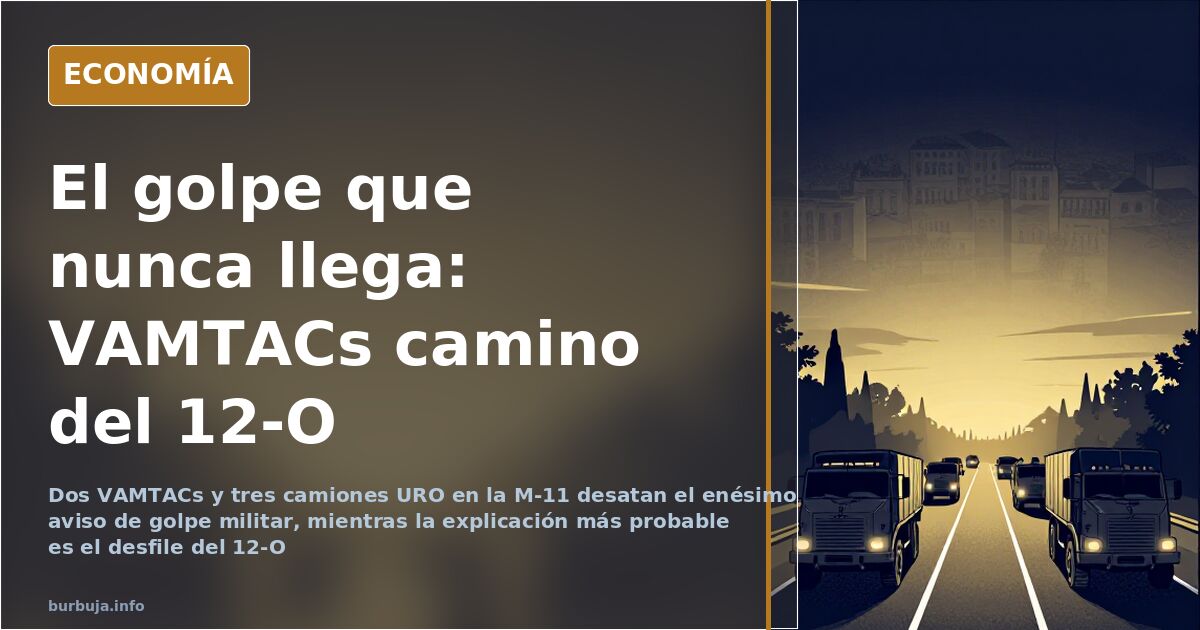
VAMTACs and URO trucks on Madrid's M-11: The coup that never arrives
"A couple of VAMTACs and three URO trucks on the M-11 heading to the airport early this morning." This material starts the latest episode of military rumblings in Spain: someone who says they make this alucinación daily for years sees something they have never seen before, and from the sighting, they jump in two sentences to the conclusion. The military is preparing to act, and the first step will be to take over RTVE, the airports, and the exits of the main highways. Not a single piece of evidence to support it. It didn't matter: the conversation grew to 26 pages.
The most common response appeared immediately, and it is the least epic: these are preparations for the October 12 parade. Some add that the warning repeats every year around the same dates, with the same headline and different anger.
What is a military convoy doing on the M-11?
The detail that disarms the martial reading is logistical. The M-11 is an access route to the airport, and the movement of support vehicles on the road is part of the routine of military barracks. The most blunt formulation came as a form of irony: the Army will not have to ask permission to use the M-11 when going to or returning from El Goloso.
Four or five vehicles early in the morning do not move a country. They do, however, move the conversation when the calendar tightens. The days leading up to October 12 concentrate transfers, rehearsals, and the presence of equipment on the road; those not familiar with this traffic interpret a maneuver what is actually a driving schedule.
The plan circulating also does not clarify a reasonable doubt: why highway exits would need to be closed. The circulating answer—that politicians might escape by car or plane, not by donkey—bears more of a wink than military tactics.
The Army is paid by the State to which a coup is attributed
Here, the conversation splits. One block maintains that the hypothesis collapses on its own due to financial dependence: the Armed Forces are funded by the General State Budget, and the Government approves it. The most repeated irony: if the Army is paid by the State, and the State is Sánchez, the coup has a payroll problem.
Another block sees it exactly the opposite way. They argue that the Executive does not have the Army on its side, much less the Civil Guard after changes in the Ministry of the Interior.
And a third current goes off the hills. It claims, without a single piece of data to back it up, that a significant part of the military leadership has been bought with international funding. This is the type of claim that circulates more easily than any official figure.
The historical perspective weighs heavily. For there to be military rumblings in 1936, it took, recalls an intervention, a climate of burning churches, assassinations of leaders, and European support. We are not there. And the memory of 1981 looms over the thread: some warn against trusting command and recall that, according to that version, the last time the Army tried to "save Spain," it was betrayed by the King himself to appear "democratic."
Monarchy, threats, and pressure on the King
Another part of the conversation places the origin of the rumblings in the deterioration of the relationship between La Moncloa and the Royal House. Recent threats to the Crown are mentioned, along with a Government willing to tighten institutional strings, versions launched without any accreditation. The underlying suspicion is that the Head of State is in the crosshairs and that some expect a short-term fall of the monarchy.
There are also those who place the ball outside the borders: if there is destabilization, it is argued, it comes from foreign actors interested in the noise. The rebuttal is quick: whoever has an open front in their own house does not open another.
Who would cut off the internet if there were truly a coup?
The apocalyptic scenario includes taking over communications, and here the conversation becomes technical. It is claimed that all physical telecommunications infrastructure belongs to Telefónica by state concession and that the Government retains a golden share in the company; from there, the leap is easy: whoever controls that infrastructure can leave the country without a network.
The legal nuance comes from another intervention. Operating in Spain requires a license from the competent ministry, and mobile data depends on networks deployed by operators; a satellite service is not sold here without authorization. It doesn't matter: cutting off the internet has entered the coup imagination as the ultimate switch.
The connection is provided by the Starshield contract signed by Elon Musk with the US Space Force, which some read as the first step toward a network capable of providing service from the sky independent of countries.
With convoys appearing every season on the same highway and an identical explanation for years, an uncomfortable question remains: what will be the year when someone stops counting vehicles and starts truly believing the movie?
Also available in: Deutsch
Summary of a discussion on Burbuja.info - Foro de economía, actualidad y política., translated from Spanish and reviewed before publication. Read the full discussion (275 replies).
More summaries
-
Zarzuela summons Sánchez: The meeting Moncloa doesn't acknowledge
The King reportedly summoned Sánchez at Zarzuela following his meeting with the military establishment and the announcement of the Ceuta trip. The official agenda makes no mention of the encounter, and...
-
Fake claim links Sánchez to King over republic threat
A viral message attributed to Rafapal claims Pedro Sánchez threatened King Felipe VI with a republic, lacking any official proof or documentation.
-
Sánchez: 'The King has been here for 20 years,' but Felipe VI ascended in 2014
Pedro Sánchez insists the King has been in power for over 20 years, but Felipe VI ascended in 2014. The criticism regarding Ceuta and Melilla hides a deeper debate...
-
Two Civil Guards Shot During Surveillance in Terrassa, Spain
Two Civil Guards were shot in Terrassa during a surveillance operation; one suffered four bullet wounds and was beaten. The incident highlights security concerns in Spain.
-
Spain's SME Business Association Links Migrant Regularisation to Job Contracts
Debate on Cepyme's proposal to regularise migrants through job contracts: a fix for Spain's labour shortage or a risk of precarious employment?
-
85 pickpockets arrested in Barcelona with over 600 prior convictions
85 pickpockets arrested in Barcelona with 600 prior convictions. The forum discusses the reality of repeat offending and impunity on public transport.