
Milan deploys 500 troops: the photo Meloni already had
Milan has deployed 500 soldiers to patrol the city, but the armoured vehicle in the photo has been parked in the same spot for years: the military presence is routine, not news.
English · Original discussion in Spanish · Published
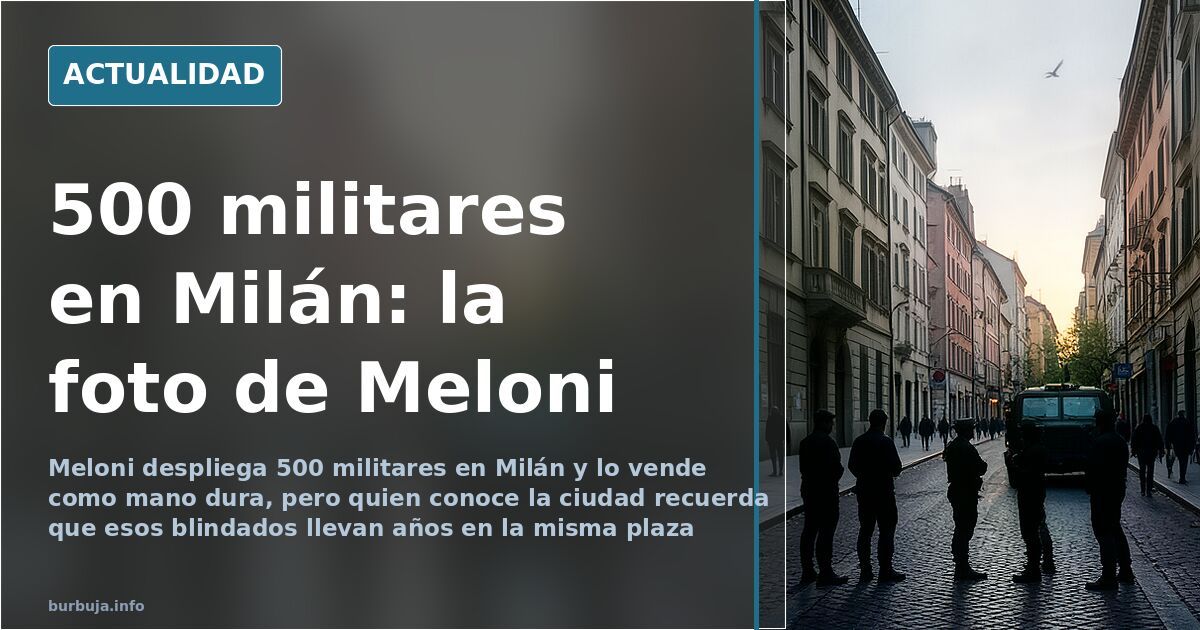
Milan puts 500 troops on the streets and the photo was already taken
An Italian Army armoured vehicle parked in a Milan square. The image is circulating on social media as proof of an iron fist: 500 troops deployed to protect the city from vandals, so the story goes, against the supposed softness of Macron in France or Sánchez in Ceuta. The problem is that the scene is nothing new. Anyone who has walked through Milan in recent years recognises the same armoured vehicle, in the same spot, performing the same function. The military surveillance operation on Italian streets did not begin this week.
How many troops are deployed in Milan?
The figure doing the rounds is 500 personnel. It is presented as an exceptional response to a wave of unrest, but the military presence in Italian cities has been a constant for years, not a sudden outburst. In practice, the Army serves as passive surveillance reinforcement: patrols, vehicles and a deterrent presence. Nothing more. And that is where the first criticism of the deployment begins: arriving after the incidents, not before.
Some compare it to the role of firefighters, who do cover night shifts and emergencies once the fire is already burning. The metaphor goes a long way: the soldier on the corner does not put out the fire, he just watches it.
The armoured vehicle that was already there
There is a catch to the photo. Several firsthand accounts agree that this type of armoured vehicle, in that exact location, has been part of Milan's urban landscape for years. It is not a novelty of this operation: it is the usual backdrop. That is why the image works so well on social media while saying so little about what has actually changed.
The other angle is industrial. The vehicles appearing in the images are Iveco equipment, and the awkward question lurking between the lines is: what percentage of the Spanish Army's equipment is domestically manufactured? The security photo becomes, unintentionally, a defence industry advert.
Deterrence without the ability to fire
The point generating the most tension is the actual use of force. A military deployment that cannot use its weapons when the situation demands it is seen as an empty gesture: humiliating for the soldier and counterproductive for the message. If the goal is to intimidate, the ambiguity over the rules of engagement works against it. If the goal is just the photo, then the cost — wages, shifts, logistics — deserves a different conversation.
The debate also drifts into political territory. Meloni comes across as someone giving with one hand and taking with the other, with gestures of firmness and underlying concessions. And the piece of journalism questioning her true nature is backed up with an appeal to authority: the university where the author was educated. The rest is noise.
In the end, the unsettling question is not how many troops there are in Milan. It is how many of those sharing the photo could say which square the armoured vehicle is parked in. Almost none. And yet, the image works.
Also available in: Deutsch
Summary of a discussion on Burbuja.info - Foro de economía, actualidad y política., translated from Spanish and reviewed before publication. Read the full discussion (19 replies).
More summaries
-
Spanish Army debate: discipline, NATO and reform
Analysis of perceptions of the Spanish Army: from internal structure and promotions to the critical debate on its role in NATO
-
Military deployment in the Canary Islands: patrols on all eight islands
BRICAN XVI will patrol the eight islands from Monday. External threat or internal repression? The debate over the military deployment in the Canary Islands divides opinion.
-
Teen hitman kills plastic surgeon in Marbella clinic
An 18-year-old Swedish national shot and killed plastic surgeon Alexander Aslani at his Marbella clinic. Police arrested the suspect within hours.
-
Today's Gospel, Sunday 10 May: 'Acclaim the Lord, all the earth' — Rosary at 22:00
Visual guide, Marian promises and homily by Father Santiago Martín for the Rosary on the Sixth Sunday of Easter, 10 May. Community prayer at 22:00.
-
The Basques did it because they could — and because they had to
Did the Basques act deliberately to bring down Francoism? The theory linking industry, ETA and politics is resurfacing online.
-
Isaac Asimov was not the father he claimed to be
Isaac Asimov was not as good a father as he boasted: his posthumous memoirs reveal demands and disappointments toward his son that clash with his public image.