
Migrant Mechanic Suggests Deserting Repeat Offenders
A mechanic of Moroccan origin proposes abandoning repeat offenders in the desert and claims the EU pays to curb immigration.
English · Original discussion in Spanish · Published
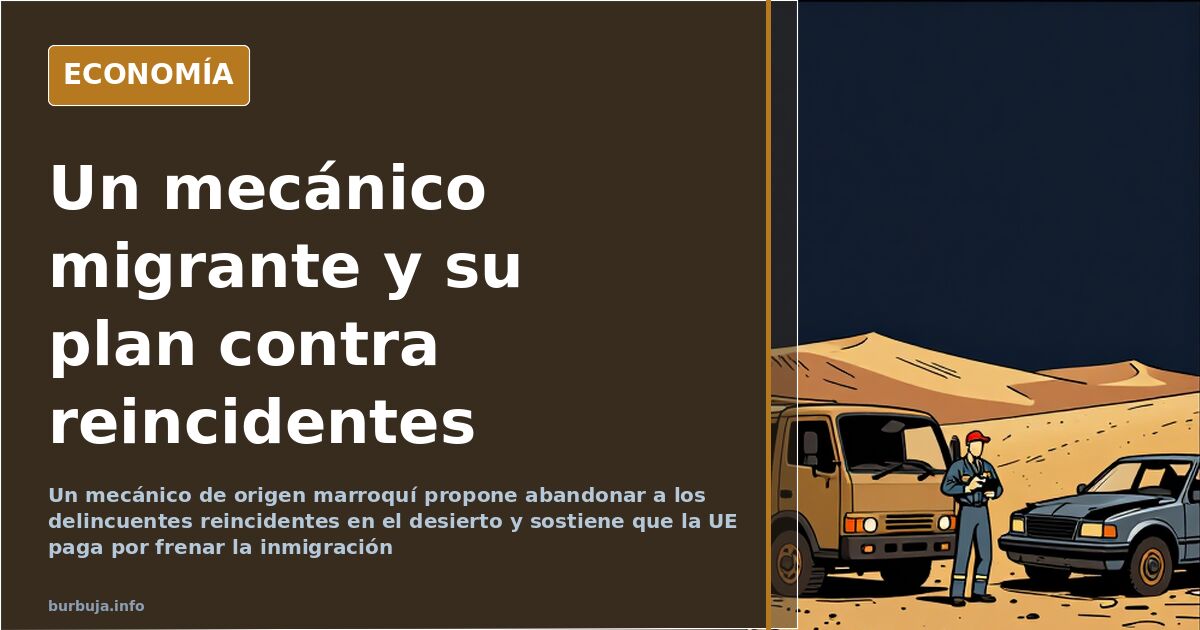
Container and Desert: The Proposal of a Migrant Mechanic
How many times must one offend before patience runs out? The answer, according to his own client's account, was given by a mechanic of Segarro origin who runs a workshop: round up those with two or three convictions, put them in a container, and abandon them in the desert. The conversation didn't happen at a rally, but amidst quotes and lifted cars, with customers of the same origin coming and going. The mechanic didn't lower his voice. The client later recounted it on a forum, and the anecdote got out of hand.
The uncomfortable part isn't the idea itself. The uncomfortable part is who proposed it: the harshest discourse on borders, the most uninhibited, sometimes comes from those who have crossed it. One workshop, three sentences, and no nuance. From there, the conversation veered towards the usual topics: European funds, recidivism, riots, and who pays the bill.
What Exactly Did the Mechanic Propose?
His proposal had two parts. The first was penal. For him, politicians should take those who offend twice or three times and simply make them disappear: no prison, no rehabilitation, no deportation proceedings. Container and desert. The bluntness, according to those who heard him, stemmed from frustration with those who tarnish the image of a community that has been building businesses for years by waking up early.
The second part was accounting. He claims Brussels allocates money to prevent migrants from reaching Northern Europe, and this money is distributed among the central government, autonomous communities, and municipalities without the citizen seeing a single euro, even though they bear the consequences. In short: governments would profit from immigration. This is an old theory, repeated in many bars, and should be treated as what it is: an opinion, not a budget item.
Is it True That Europe Pays to Curb Migration in the South?
Here, the agreement breaks down. One part of the analysis maintains that information on European funds is public and that official programs contain nothing similar to detaining people at the southern border. Another responds that a line item with that name isn't necessary: funding for third countries, cooperation, or payments that arrive without such a heading suffice. Neither version can be resolved with a headline.
What doesn't appear anywhere is the breakdown. Who distributes this money, based on what criteria, and how much ends up in each administration remains unclear. The overall figure is cited from memory; the distribution, never. And without distribution, the discussion is a fight of feelings.
Why Settled Migrants Call for a Hard Line
The workshop is not an exception. Those who have been here for twenty years, pay taxes, and own a warehouse in an industrial park are usually the first to call for controls, and not by chance: they have the most to lose when the next person messes up. Some interpret this phenomenon as pure competition for jobs and housing—those who arrived earlier defend their place—while others see it as a logical reaction against those who tarnish everyone's fruta. In the middle, a repeated scene: the neighborhood business serving long-time residents and distrusting newcomers.
The conversation even suggests that some of this vote is going to the right. This isn't based on a survey, so it remains an impression. Impressions, on this topic, are highly valued.
Torre Pacheco: Riots, Arrests, and an Ongoing Case
The backdrop was Torre Pacheco. The reference points to the racist riots registered in the Murcian town and the ongoing legal process against the person identified as the instigator. According to the cited journalistic information, the judge ordered the accused to be imprisoned. The case is proceeding, and there is no final sentence: it's worth remembering this before using the case as an argument for anything.
That a municipality in the Region of Murcia ends up becoming a national symbol says a lot about the state of the debate. And it doesn't say anything good.
What's the Hourly Rate?
There were reactions of all kinds. From those who doubted the mechanic's existence—the Segarro taxi driver already has a cousin, someone quipped, referencing another famous testimony—to those who labeled the story as fabricated. There were also those who asked about the price of labor and those who declared they wouldn't take their car to that workshop. The most repeated irony: that those who fix cars end up knowing more about geopolitics than those who drive them.
With these ingredients, the headline of the week is that a migrant mechanic wants to send repeat offenders to the desert. The real headline is that no one has discussed the important data—how many repeat offenders there are and what is being done about them—because that data, quite simply, was not on the table.
How many times must one offend before patience runs out? The answer, according to his own client's account, was given by a mechanic of Segarro origin who runs a workshop: round up those with two or three convictions, put them in a container, and abandon them in the desert. The conversation didn't happen at a rally, but amidst quotes and lifted cars, with customers of the same origin coming and going. The mechanic didn't lower his voice. The client later recounted it on a forum, and the anecdote got out of hand.
The uncomfortable part isn't the idea itself. The uncomfortable part is who proposed it: the harshest discourse on borders, the most uninhibited, sometimes comes from those who have crossed it. One workshop, three sentences, and no nuance. From there, the conversation veered towards the usual topics: European funds, recidivism, riots, and who pays the bill.
What Exactly Did the Mechanic Propose?
His proposal had two parts. The first was penal. For him, politicians should take those who offend twice or three times and simply make them disappear: no prison, no rehabilitation, no deportation proceedings. Container and desert. The bluntness, according to those who heard him, stemmed from frustration with those who tarnish the image of a community that has been building businesses for years by waking up early.
The second part was accounting. He claims Brussels allocates money to prevent migrants from reaching Northern Europe, and this money is distributed among the central government, autonomous communities, and municipalities without the citizen seeing a single euro, even though they bear the consequences. In short: governments would profit from immigration. This is an old theory, repeated in many bars, and should be treated as what it is: an opinion, not a budget item.
Is it True That Europe Pays to Curb Migration in the South?
Here, the agreement breaks down. One part of the analysis maintains that information on European funds is public and that official programs contain nothing similar to detaining people at the southern border. Another responds that a line item with that name isn't necessary: funding for third countries, cooperation, or payments that arrive without such a heading suffice. Neither version can be resolved with a headline.
What doesn't appear anywhere is the breakdown. Who distributes this money, based on what criteria, and how much ends up in each administration remains unclear. The overall figure is cited from memory; the distribution, never. And without distribution, the discussion is a fight of feelings.
Why Settled Migrants Call for a Hard Line
The workshop is not an exception. Those who have been here for twenty years, pay taxes, and own a warehouse in an industrial park are usually the first to call for controls, and not by chance: they have the most to lose when the next person messes up. Some interpret this phenomenon as pure competition for jobs and housing—those who arrived earlier defend their place—while others see it as a logical reaction against those who tarnish everyone's fruta. In the middle, a repeated scene: the neighborhood business serving long-time residents and distrusting newcomers.
The conversation even suggests that some of this vote is going to the right. This isn't based on a survey, so it remains an impression. Impressions, on this topic, are highly valued.
Torre Pacheco: Riots, Arrests, and an Ongoing Case
The backdrop was Torre Pacheco. The reference points to the racist riots registered in the Murcian town and the ongoing legal process against the person identified as the instigator. According to the cited journalistic information, the judge ordered the accused to be imprisoned. The case is proceeding, and there is no final sentence: it's worth remembering this before using the case as an argument for anything.
That a municipality in the Region of Murcia ends up becoming a national symbol says a lot about the state of the debate. And it doesn't say anything good.
What's the Hourly Rate?
There were reactions of all kinds. From those who doubted the mechanic's existence—the Segarro taxi driver already has a cousin, someone quipped, referencing another famous testimony—to those who labeled the story as fabricated. There were also those who asked about the price of labor and those who declared they wouldn't take their car to that workshop. The most repeated irony: that those who fix cars end up knowing more about geopolitics than those who drive them.
With these ingredients, the headline of the week is that a migrant mechanic wants to send repeat offenders to the desert. The real headline is that no one has discussed the important data—how many repeat offenders there are and what is being done about them—because that data, quite simply, was not on the table.
Summary of a discussion on Burbuja.info - Foro de economía, actualidad y política., translated from Spanish and reviewed before publication. Read the full discussion (232 replies).
More summaries
-
Torre Pacheco Descends into Chaos: Armed Brawl Erupts
Violent machete fight in Torre Pacheco blamed on 'far-right agitators'. Community raises safety concerns.
-
Cocaine, Private Jets, and the Tug-of-War Over Ceuta and Melilla
African Atlantic cocaine trafficking, documented by INTERPOL, supports an uncomfortable narrative: the route exists, and Europe's response is too late.
-
Euthanasia in Old Age: Autonomy vs. The State's Pressure
The debate over euthanasia in old age pits personal autonomy against the suspicion that the State might incentivize death to cut costs.
-
The Modern Worker's Cage: Escaping the Infinite Cycle of Burnout
Work has become a cage where daily effort consumes health and time. Discover why we push ourselves so hard and how to break the cycle.
-
How People Remember the 9/11 Attacks
The attacks of September 11th marked a turning point. Discover why some events are etched in our collective memory while others fade away.
-
Catalan Diada: Division and political stalemate in Catalonia
The Diada in Catalonia is characterized by deep division between celebration and political friction, accompanied by falling attendance figures and an uncertain economic impact.