
Mia Skylar and the Blouse That Won’t Fit: Anatomy of a Forum Muse
A tight blouse sparks debate over Mia Skylar’s status as a forum muse, closed digital affiliations, and endogamy in online circles.
English · Original discussion in Spanish · Published
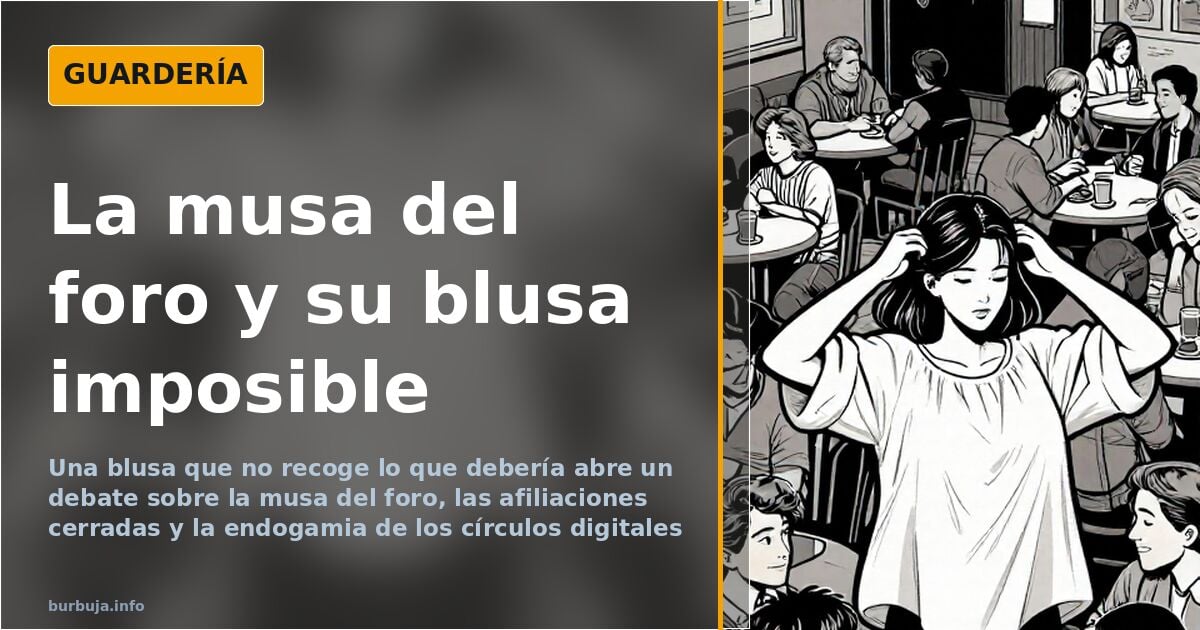
Mia Skylar: The Muse the Forum Can’t Categorize
There is a moment in every digital conversation when the subject shifts from the person depicted to the depiction itself. This happens with Mia Skylar, hailed as the forum’s muse after an image where a blouse fights a losing battle to contain what it cannot hold. The scene, described mockingly by those sharing it, raises an uncomfortable question: are we discussing a woman’s aesthetics or our collective inability to look without commenting?
The answer, as usual, is both and neither. The exchange quickly moves toward topics unrelated to the garment: belonging to a closed group, the impossibility of leaving it, and suspicions that certain circles share too many members. The blouse becomes just an excuse. The real material is the sociology of affiliation.
The List You Join But Never Leave
The starting point isn’t the image. It’s a call for adherence to a collective presented with mafia-like rules: you can join, but not leave. Half-joking, half-serious, this formulation instantly triggers tribal instincts. Insiders celebrate; outsiders watch skeptically. The dynamic resembles clubs sustained more by rejecting outsiders than by affection among members.
The issue escalates when someone notes that this group shares too many members with another parallel circle. This seemingly innocuous observation touches a nerve: the suspicion that supposed exclusivity is actually one core splitting into different labels. Digital affiliation endogamy has these quirks. The more closed the club, the more its members resemble those of the neighboring club.
From Aesthetics to Anatomical Inventory
The sharpest turn occurs when the conversation abandons fashion for physical inventory. One intervention summarizes the tone: the garment isn’t the problem; the problem is what the garment tries to hold. Another adds a numerical rating of the person depicted, using a scale that measures the unmeasurable and discounts what shouldn’t be discounted. Despite the crudeness, someone poses a disorienting question: what do the circulating images have in common?
The question hangs in the air. There is no single answer. Some see it as a stylistic exercise, others as veiled accusation, and some simply ignore it. In that silence lies the episode’s most interesting aspect: the realization that a group capable of arguing for hours about a blouse cannot agree on what they are actually looking at.
Background Noise and the Unanswered Question
Around the thematic core accumulate interventions functioning as background noise: exclamations, references to third parties, comments on the wisdom of sticking one’s head in certain places. One widely cited contribution describes a specific practice with a mix of repulsion and fascination the author doesn’t resolve. The whole paints a recognizable landscape: a space where hyperbole is the unit of measure and restraint is rare.
Meanwhile, the muse remains at the center, silent. Her function is that of a mirror: everyone projects their own baggage. Some see provocation, others a victim of scrutiny, and others just an excuse to pass time. The blouse, barely fulfilling its purpose, ends up being the least relevant part.
The disorienting fact isn’t in the image. It’s in the list: a group defined by the impossibility of leaving it, yet sharing so many names with another that the boundary between them is practically non-existent. The mafia, at least, had distinct families.
Also available in: Deutsch
Summary of a discussion on Burbuja.info - Foro de economía, actualidad y política., translated from Spanish and reviewed before publication. Read the full discussion (26 replies).
More summaries
-
Photos of Spain's Ayuso in a swimsuit spark online frenzy
We analyze the thread about photos of Isabel Díaz Ayuso in a swimsuit that has generated debate and memes in the Guardería of Burbuja.info.
-
Why The Walking Dead stopped making sense in season 7
How can characters cross hordes unscathed yet die from a single bite? The Walking Dead piles up inconsistencies that break its logic. We break down the plot-hole-riddled…
-
Why Real Madrid's 15 European Cups haven't lifted Spain
Real Madrid boasts 15 European Cups, but Spain's national team heroes came from other clubs. The 1950 and 1984 record makes it clear.
-
Teacher goes viral on TikTok: private life versus the classroom
A video of a teacher goes viral on TikTok, reigniting the tension between teachers' private lives and their image in front of students, amid doubts about whether the footage was manipulated.
-
Raunchy Spanish cinema to survive a failed Saturday
Airbag, La Comunidad, Luger and other gems of raunchy Spanish cinema that turn a failed Saturday into a night of guilt-free laughter.
-
Los Secretos: Enrique Urquijo's melancholy lives on
Los Secretos, Enrique Urquijo's Spanish band, still moves audiences with their heartbreak songs. Discover their legacy and the Jackson Browne collaboration.