
MG ZS: €14,790 financed or €17,990 cash
Forum users report the MG ZS at €14,790 financed and €17,990 cash, with a 16.06% APR and mandatory 36-month term.
English · Original discussion in Spanish · Published
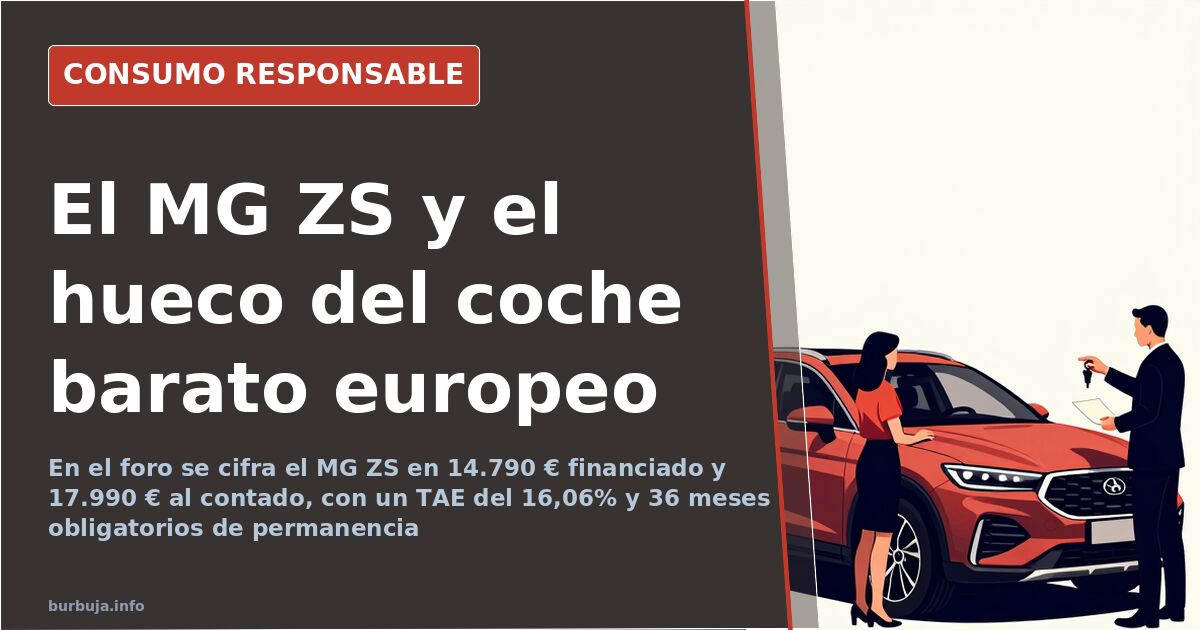
The MG ZS and the gap in affordable European cars
The MG ZS, a Chinese-made SUV, presents itself as the cheap alternative that the European market has stopped covering: low price, decade-old technology, and aggressive financing. The Morris Garages brand, historic and British, has long belonged to a Chinese manufacturer, a detail forum users say many buyers overlook. There is no miracle. There is a gap Europe left open: the affordable car.
For decades, this gap was filled by names that now sound like archaeology: the Sixties R4, the Eighties Fiat Panda, last decade's Dacia Sandero. The ZS has entered exactly there: those comparing dimensions summarize it bluntly as offering ten-year-old tech and about €4,000 less than its size-equivalent rival.
Dacia's stigma and MG's appeal
Because, according to one user, Dacia carries a stigma while the Chinese brand does not. This factor is undervalued in market reports but weighs more on the street than admitted: MG appeals visually and doesn't carry the poor man's car label. A buyer looking for a small car sees the ZS, the Sandero, and, incidentally, a Hyundai Bayon with a 1.2-liter 85-horsepower engine that hardly anyone asks about.
The real doubt isn't image, it's final price. And that's where the fine print comes in.
MG ZS financing: 16.06% APR and mandatory 36 months
The cheapest ZS 1.5 with 106 horsepower is quoted in forums at €14,790 financed. Cash price: €17,990. That €3,000 difference isn't a discount; it's the cost of a loan. Conditions detailed by the user who ran the numbers require financing at least €13,000 at a 16.06% APR and staying in the deal for at least 36 months. Standard simulations stretch to 84 months, ending up costing around €21,000. Canceling in month 37 costs about €18,500 according to those same calculations. The basic ZS 1.5 106 hp version has been quoted at €18,800 cash. Cheap, depending on who you ask.
Fuel consumption: the fine print of petrol SUVs
Here lies the trap many miss when signing. One user recounts that a friend's petrol Renault Captur averages 7 to 8 liters per 100 km, a figure he says drops to 6 or 6.5 in his own compact car. High bodywork and naturally aspirated engines are unforgiving. The Qashqai, precursor to the SUV fever, left its own trail of owners asking mechanics how to lower consumption; the mechanic's answer was often another question: Is your foot heavy? Diesel, which allowed heavy cars with controlled spending, was sidelined, and with it disappeared the quadrature of the circle.
In contrast, a modest twenty-year-old small car plays in another league: one user claims his Fabia 1.2, with a 45-liter tank, exceeds 900 kilometers and aims for 950.
The rental electric car that ended up in industrial parks
The other side of official discourse emerged with summer rentals, according to the news brought up. A Fiat 500 electric delivered as a substitute became an odyssey: range forced stops in Honrubia (Cuenca) and chaining parking lots in shopping centers and industrial estates. Trying electrification cost more time than money.
Parts and delays: the other cost of new cars
Newly bought cars aren't exempt from friction either. One user notes that requesting a specific model without stock means waiting periods that can reach six months, with chip shortages cited as the explanation. Those maintaining older vehicles—a 22-year-old Accord in perfect condition, for example—discover finding parts has become a risky sport: originals are gone for many components.
With these elements, logic suggests the vehicle fleet would age and cheap new cars would disappear. Forum users point out that below those prices remain the Sandero, the Panda, and a few others, though it gets harder every day. The manufacturer best filling the affordable car gap flies the Chinese flag and offers financing at 16%.
The MG ZS, a Chinese-made SUV, presents itself as the cheap alternative that the European market has stopped covering: low price, decade-old technology, and aggressive financing. The Morris Garages brand, historic and British, has long belonged to a Chinese manufacturer, a detail forum users say many buyers overlook. There is no miracle. There is a gap Europe left open: the affordable car.
For decades, this gap was filled by names that now sound like archaeology: the Sixties R4, the Eighties Fiat Panda, last decade's Dacia Sandero. The ZS has entered exactly there: those comparing dimensions summarize it bluntly as offering ten-year-old tech and about €4,000 less than its size-equivalent rival.
Dacia's stigma and MG's appeal
Because, according to one user, Dacia carries a stigma while the Chinese brand does not. This factor is undervalued in market reports but weighs more on the street than admitted: MG appeals visually and doesn't carry the poor man's car label. A buyer looking for a small car sees the ZS, the Sandero, and, incidentally, a Hyundai Bayon with a 1.2-liter 85-horsepower engine that hardly anyone asks about.
The real doubt isn't image, it's final price. And that's where the fine print comes in.
MG ZS financing: 16.06% APR and mandatory 36 months
The cheapest ZS 1.5 with 106 horsepower is quoted in forums at €14,790 financed. Cash price: €17,990. That €3,000 difference isn't a discount; it's the cost of a loan. Conditions detailed by the user who ran the numbers require financing at least €13,000 at a 16.06% APR and staying in the deal for at least 36 months. Standard simulations stretch to 84 months, ending up costing around €21,000. Canceling in month 37 costs about €18,500 according to those same calculations. The basic ZS 1.5 106 hp version has been quoted at €18,800 cash. Cheap, depending on who you ask.
Fuel consumption: the fine print of petrol SUVs
Here lies the trap many miss when signing. One user recounts that a friend's petrol Renault Captur averages 7 to 8 liters per 100 km, a figure he says drops to 6 or 6.5 in his own compact car. High bodywork and naturally aspirated engines are unforgiving. The Qashqai, precursor to the SUV fever, left its own trail of owners asking mechanics how to lower consumption; the mechanic's answer was often another question: Is your foot heavy? Diesel, which allowed heavy cars with controlled spending, was sidelined, and with it disappeared the quadrature of the circle.
In contrast, a modest twenty-year-old small car plays in another league: one user claims his Fabia 1.2, with a 45-liter tank, exceeds 900 kilometers and aims for 950.
The rental electric car that ended up in industrial parks
The other side of official discourse emerged with summer rentals, according to the news brought up. A Fiat 500 electric delivered as a substitute became an odyssey: range forced stops in Honrubia (Cuenca) and chaining parking lots in shopping centers and industrial estates. Trying electrification cost more time than money.
Parts and delays: the other cost of new cars
Newly bought cars aren't exempt from friction either. One user notes that requesting a specific model without stock means waiting periods that can reach six months, with chip shortages cited as the explanation. Those maintaining older vehicles—a 22-year-old Accord in perfect condition, for example—discover finding parts has become a risky sport: originals are gone for many components.
With these elements, logic suggests the vehicle fleet would age and cheap new cars would disappear. Forum users point out that below those prices remain the Sandero, the Panda, and a few others, though it gets harder every day. The manufacturer best filling the affordable car gap flies the Chinese flag and offers financing at 16%.
Summary of a discussion on Burbuja.info - Foro de economía, actualidad y política., translated from Spanish and reviewed before publication. Read the full discussion (157 replies).
More summaries
-
Dacia Spring: Zero NCAP Stars Despite Public Subsidies
The Dacia Spring, Spain's top-selling electric car with 261 units, scored zero stars in Euro NCAP safety tests while public aid makes its purchase cheaper.
-
Heating Cost Meters: Genuine Savings or Bureaucratic Scam in Spain?
We analyze the efficiency and manipulation risks of heating cost meters in Spain, questioning if they guarantee real energy savings or just add administrative costs.
-
Desktop PCs fade as mobile devices dominate the living room
In Spain, desktops lose ground to smartphones and work laptops. Mini PCs gain traction while high power retreats to niche uses.
-
Casio cult watches: poker, TV remote, and €25
Cheap Casio watches have become cult objects: poker on the wrist, TV remotes, and years without battery changes.
-
Spain's drivers resist new cars, keeping vehicles aged 15 to 27 years
In Spain, car ages ranging from 13 to 27 years reflect a shift in spending habits and a growing reluctance to buy new vehicles.
-
Poison as a life insurance: facts and myths
Cyanide is painful and pentobarbital comes from illegal channels. The idea of eternal poison clashes with chemistry and law.