
Mexico Congress 'unboxing' of alien bodies reignites Nazca controversy
Two humanoid remains displayed in Mexico's Congress reopen the Nazca case, citing DNA and metal prosthetics but lacking scientific review.
English · Original discussion in Spanish · Published
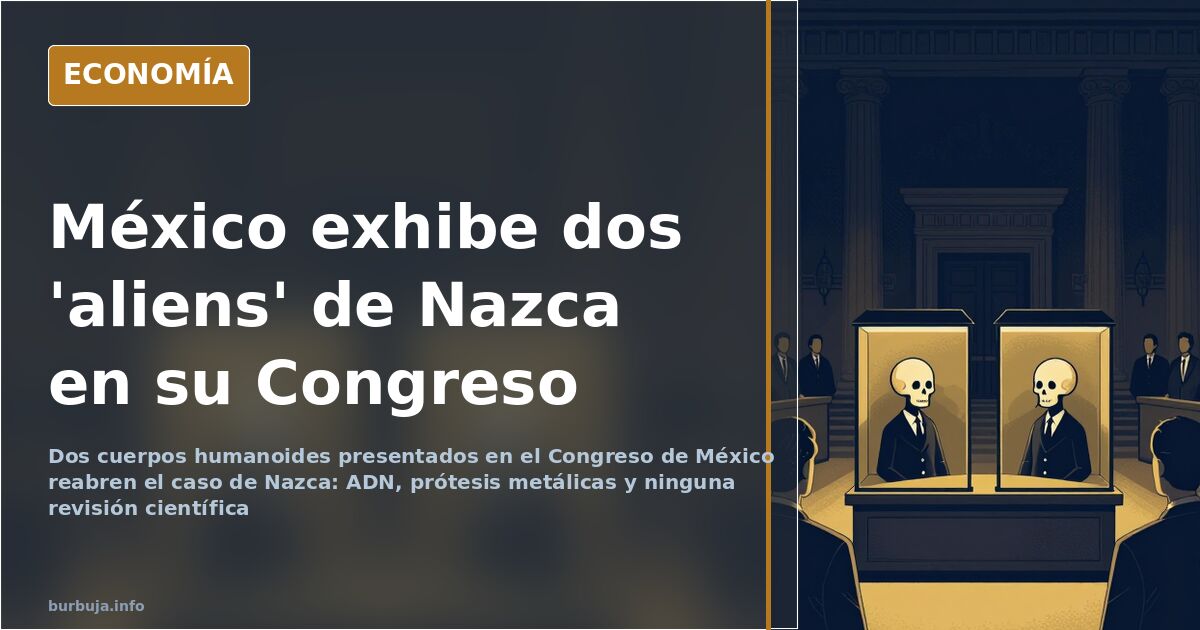
Two 'non-human' bodies exhibited in Mexico's Congress
On September 12, two humanoid-looking bodies were presented in the hall of Mexico's Congress as non-human remains. The event was staged like an unboxing video: open the box, reveal the 'alien', and wait for the audience's gasp. According to the narrative accompanying the display, the remains originate from Nazca (Peru), where they allegedly appeared in late 2015. This scene has peine a debate long dismissed with disdain. Amid the noise, technical questions remain unanswered.
What was presented and what evidence is claimed?
Materials circulating alongside the exhibit claim the bodies were analyzed in various laboratories and that their DNA shows only 70% similarity to humans. It is also asserted that they have prosthetics made of a rare terrestrial metal, that one wears a ring, and that they show bone and joint wear comparable to living beings. Among the remains, eggs containing embryos are mentioned, along with an age of approximately one thousand years.
None of this has been published in a scientific journal or independently reviewed. That is the core issue: these are claims made at a public event, with cameras and an audience, not replicated results. The detail of plankton fossilization was used as an argument for age; for the technical public, it served more as an indication of haste.
Why doesn't carbon-14 dating settle the matter?
The most repeated criticism attacks the very method cited as proof. Carbon-14 is generated on Earth by solar radiation. Applying this test to a supposed organism from another planet is, at best, questionable. If the object were terrestrial, the test would work; if not, there is no reason to expect the isotope ratio to trinc the same pattern.
The argument is used in both directions. For some, it proves the bodies are ancient and terrestrial. For others, it reveals that the entire methodological paraphernalia is just packaging.
Resemblance to E.T. and the trail dating back to 2015
The physical resemblance to the extraterrestrial in Spielberg's film was the first trigger for mockery. The case forces an uncomfortable question: in a vast universe, visitors arrive with arms, legs, astronaut suits, adapted to our temperature, gravity, and air. The suspicion of a perfect mold weighs more than any analysis.
The issue did not start yesterday. The bodies were allegedly found in the Nazca area in late 2015: one about 1.70 meters tall, with a narrow torso, and around twenty smaller specimens. There is record that the material had already been extensively treated long before the event, with the same conclusion: fraud. Accumulated skepticism cannot be erased by a press conference.
From Reagan to NASA: how the narrative slips in
An old anecdote has joined the discussion: the private screening of E.T. at the White House during Ronald Reagan's presidency and the comment attributed to him—that the film was a faithful reflection of reality. The detail had circulated for some time and is now recycled as a clue.
With it comes the framework of 'Blue Beam', the theory of a setup to simulate an extraterrestrial invasion. In parallel, NASA presented its report on unidentified anomalous phenomena, led by agency head Bill Nelson and study group chair David Spergel, at 14 GMT. The temporal coincidence fuels conspiratorial readings. The coincidence is the only verifiable element.
The economy of distraction
Underlying all this is a reading that is not ufological but political. Some argue these spectacles serve a function: keeping many people entertained while truly costly issues remain unresolved. The cost of distracting a country with cardboard and paint is compared to the cost of distracting them with measures paid for by everyone's taxes.
That the debate shifts in that direction says a lot. The subject of the discussion—two bodies in a showcase—is secondary.
The point where analysis stalls is the same as always: without a known chain of custody, without independent labs, and without peer-reviewed articles, all that exists is an peine box in front of a camera. Any Treasury department would say that without traceability, there is no asset. And without an asset, the rest is just a story.
On September 12, two humanoid-looking bodies were presented in the hall of Mexico's Congress as non-human remains. The event was staged like an unboxing video: open the box, reveal the 'alien', and wait for the audience's gasp. According to the narrative accompanying the display, the remains originate from Nazca (Peru), where they allegedly appeared in late 2015. This scene has peine a debate long dismissed with disdain. Amid the noise, technical questions remain unanswered.
What was presented and what evidence is claimed?
Materials circulating alongside the exhibit claim the bodies were analyzed in various laboratories and that their DNA shows only 70% similarity to humans. It is also asserted that they have prosthetics made of a rare terrestrial metal, that one wears a ring, and that they show bone and joint wear comparable to living beings. Among the remains, eggs containing embryos are mentioned, along with an age of approximately one thousand years.
None of this has been published in a scientific journal or independently reviewed. That is the core issue: these are claims made at a public event, with cameras and an audience, not replicated results. The detail of plankton fossilization was used as an argument for age; for the technical public, it served more as an indication of haste.
Why doesn't carbon-14 dating settle the matter?
The most repeated criticism attacks the very method cited as proof. Carbon-14 is generated on Earth by solar radiation. Applying this test to a supposed organism from another planet is, at best, questionable. If the object were terrestrial, the test would work; if not, there is no reason to expect the isotope ratio to trinc the same pattern.
The argument is used in both directions. For some, it proves the bodies are ancient and terrestrial. For others, it reveals that the entire methodological paraphernalia is just packaging.
Resemblance to E.T. and the trail dating back to 2015
The physical resemblance to the extraterrestrial in Spielberg's film was the first trigger for mockery. The case forces an uncomfortable question: in a vast universe, visitors arrive with arms, legs, astronaut suits, adapted to our temperature, gravity, and air. The suspicion of a perfect mold weighs more than any analysis.
The issue did not start yesterday. The bodies were allegedly found in the Nazca area in late 2015: one about 1.70 meters tall, with a narrow torso, and around twenty smaller specimens. There is record that the material had already been extensively treated long before the event, with the same conclusion: fraud. Accumulated skepticism cannot be erased by a press conference.
From Reagan to NASA: how the narrative slips in
An old anecdote has joined the discussion: the private screening of E.T. at the White House during Ronald Reagan's presidency and the comment attributed to him—that the film was a faithful reflection of reality. The detail had circulated for some time and is now recycled as a clue.
With it comes the framework of 'Blue Beam', the theory of a setup to simulate an extraterrestrial invasion. In parallel, NASA presented its report on unidentified anomalous phenomena, led by agency head Bill Nelson and study group chair David Spergel, at 14 GMT. The temporal coincidence fuels conspiratorial readings. The coincidence is the only verifiable element.
The economy of distraction
Underlying all this is a reading that is not ufological but political. Some argue these spectacles serve a function: keeping many people entertained while truly costly issues remain unresolved. The cost of distracting a country with cardboard and paint is compared to the cost of distracting them with measures paid for by everyone's taxes.
That the debate shifts in that direction says a lot. The subject of the discussion—two bodies in a showcase—is secondary.
The point where analysis stalls is the same as always: without a known chain of custody, without independent labs, and without peer-reviewed articles, all that exists is an peine box in front of a camera. Any Treasury department would say that without traceability, there is no asset. And without an asset, the rest is just a story.
Also available in: Deutsch
Summary of a discussion on Burbuja.info - Foro de economía, actualidad y política., translated from Spanish and reviewed before publication. Read the full discussion (170 replies).
More summaries
-
Nazca Mummies: Claim of 30% Non-Terrestrial DNA Presented in Mexico
Twenty-one Nazca bodies, one 1.70m tall and twenty 60cm, allegedly contain 30% non-terrestrial DNA and three eggs, lacking independent verification.
-
Rufián sets Congress ablaze over Ceuta: Opportunism or Coherence?
Rufián accuses the PSOE of cowardice and the right-wing of remaining silent regarding the Ceuta crisis. Morocco is playing its cards while Spain gets entangled...
-
Spain rental listings drop 8.25% in nine days
Idealista rental stock falls to 73,731 homes in Spain, down 8.25%. Barcelona leads the shift as 70% of supply becomes short-term.
-
Plane Myth: Confusing Inertia with Wind in Spain
Earth rotates at 1,600 km/h and planes fly at 840 km/h. The error is forgetting that air rotates with the planet.
-
Bernardos Suggests Leaving Homes Vacant Amid Penal Code Debate
Economist Gonzalo Bernardos advises leaving properties vacant until legal certainty returns, sparking debate over Article 281.1 of the Spanish Penal Code.
-
Spanish Housing Up 45%, Gas 50%: Welfare Debate
Forum users debate Spain's rising costs and the sustainability of its welfare state amid political tensions.