
Mérida Mayor Offers to Host Migrants from Canary Islands
The mayor of Mérida offers his city to host migrants arriving in the Canary Islands, despite PP and VOX winning over 50% of votes there in 2023.
English · Original discussion in Spanish · Published
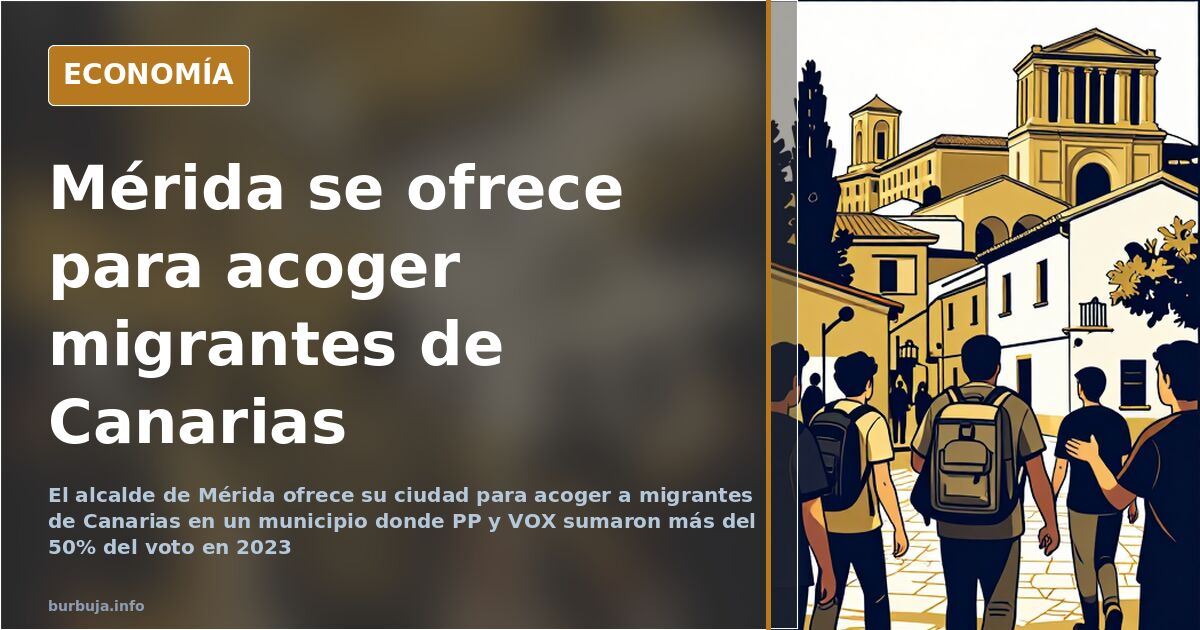
Mayor of Mérida offers city to host migrants from Canary Islands
Antonio Rodríguez Osuna, mayor of Mérida, has offered his city to the central government to help accommodate some of the migrants arriving in the Canary Islands. He announced this in a public message addressed to Pedro Sánchez, in a municipality where more than half of the 2023 votes went to PP and VOX. This paradox underpins subsequent events: a Socialist mayor offering local institutions while the debate focuses on questioning that move. "Enjoy what was voted," summarizes the most cynical reaction.
What the mayor of Mérida said to Pedro Sánchez
The mayor's message is literal: "You can count on Mérida, with the city and its institutions, to host those immigrants who are arriving in droves in the Canary Islands." The text does not include a number of places, a timeline, or an associated budget line. It also fails to detail where the money would come from to sustain the reception. Everything is left to the central Executive.
Votes in Mérida in 2023: 12,356 for PSOE and over 50% for PP and VOX
In the last municipal elections, the PSOE was the most voted party with 12,356 votes, representing 37.93% of the total. Four years earlier, it had gathered 10,912 votes (35.88%), so the mayor's party grew but remained far from an absolute majority. Conversely, the PP increased by 74%: rising from 6,789 votes (22.32%) to 11,808 (36.24%). VOX decreased from 5,432 votes (17.86%) to 4,790 (14.7%). Sumar emerged with 2,731 votes and an 8.38% share that did not exist before.
The arithmetic is uncomfortable for someone offering the city on behalf of all residents. Adding PP and VOX, more than half of the local electorate voted for these two formations. Therefore, the announcement does not rely on an explicit social majority, but on the institutional majority granted by being the most voted list. For some, this means governing with independent criteria. For others, it means using public resources without the backing of half the neighborhood that will have to live with the consequences.
How much does hosting migrants arriving in the Canary Islands cost?
The municipal offer includes no cost estimate. The figures used are third-party estimates, without official backing. Some participants calculate that maintaining each hosted person costs around €1,000, adding several thousand more for staff who attend, advise, and supervise these resources. Others add the administrative structure that needs to be set up. Hanging over all this is the argument that reappears in every spending discussion: a public debt that one participant places near €1.5 trillion.
The most repeated reasoning is that the money to sustain the reception—and to maintain pensions, healthcare, or municipal schools—comes from the same pocket. Those who question it look at the town hall's accounts, which have not detailed how they would finance the commitment. No one has yet put a closed figure on the table, and for many, that absence is the real problem.
From reception to deportation: what is discussed around the announcement
Two questions are repeated above the rest. The first is why those arriving are not returned to their country of origin; the mayor's announcement does not enter into that legal framework. The second relates to mobility: whoever arrives in a municipality can leave whenever they want, without any internal border stopping them, so the city offering to take on the initial burden would see the rest of Spain and Europe continue receiving the flow. The magic of having no borders, in the words of another participant.
To this is added the debate about the profile of those arriving, described sometimes as families and minors and other times as adults of working age, and about what jobs they can really cover in a market like Extremadura's. Some joke that they do not come to fill engineering positions. And some remember that Mérida would not be the final destination, but the first stop on a journey towards large cities. Almost all analyses agree only on the fact that the offer, as drafted, passes the ball regarding how, when, and how much to the Government.
Is Mérida willing to bear the cost of what its mayor has offered on its behalf? No one has answered that part yet.
Antonio Rodríguez Osuna, mayor of Mérida, has offered his city to the central government to help accommodate some of the migrants arriving in the Canary Islands. He announced this in a public message addressed to Pedro Sánchez, in a municipality where more than half of the 2023 votes went to PP and VOX. This paradox underpins subsequent events: a Socialist mayor offering local institutions while the debate focuses on questioning that move. "Enjoy what was voted," summarizes the most cynical reaction.
What the mayor of Mérida said to Pedro Sánchez
The mayor's message is literal: "You can count on Mérida, with the city and its institutions, to host those immigrants who are arriving in droves in the Canary Islands." The text does not include a number of places, a timeline, or an associated budget line. It also fails to detail where the money would come from to sustain the reception. Everything is left to the central Executive.
Votes in Mérida in 2023: 12,356 for PSOE and over 50% for PP and VOX
In the last municipal elections, the PSOE was the most voted party with 12,356 votes, representing 37.93% of the total. Four years earlier, it had gathered 10,912 votes (35.88%), so the mayor's party grew but remained far from an absolute majority. Conversely, the PP increased by 74%: rising from 6,789 votes (22.32%) to 11,808 (36.24%). VOX decreased from 5,432 votes (17.86%) to 4,790 (14.7%). Sumar emerged with 2,731 votes and an 8.38% share that did not exist before.
The arithmetic is uncomfortable for someone offering the city on behalf of all residents. Adding PP and VOX, more than half of the local electorate voted for these two formations. Therefore, the announcement does not rely on an explicit social majority, but on the institutional majority granted by being the most voted list. For some, this means governing with independent criteria. For others, it means using public resources without the backing of half the neighborhood that will have to live with the consequences.
How much does hosting migrants arriving in the Canary Islands cost?
The municipal offer includes no cost estimate. The figures used are third-party estimates, without official backing. Some participants calculate that maintaining each hosted person costs around €1,000, adding several thousand more for staff who attend, advise, and supervise these resources. Others add the administrative structure that needs to be set up. Hanging over all this is the argument that reappears in every spending discussion: a public debt that one participant places near €1.5 trillion.
The most repeated reasoning is that the money to sustain the reception—and to maintain pensions, healthcare, or municipal schools—comes from the same pocket. Those who question it look at the town hall's accounts, which have not detailed how they would finance the commitment. No one has yet put a closed figure on the table, and for many, that absence is the real problem.
From reception to deportation: what is discussed around the announcement
Two questions are repeated above the rest. The first is why those arriving are not returned to their country of origin; the mayor's announcement does not enter into that legal framework. The second relates to mobility: whoever arrives in a municipality can leave whenever they want, without any internal border stopping them, so the city offering to take on the initial burden would see the rest of Spain and Europe continue receiving the flow. The magic of having no borders, in the words of another participant.
To this is added the debate about the profile of those arriving, described sometimes as families and minors and other times as adults of working age, and about what jobs they can really cover in a market like Extremadura's. Some joke that they do not come to fill engineering positions. And some remember that Mérida would not be the final destination, but the first stop on a journey towards large cities. Almost all analyses agree only on the fact that the offer, as drafted, passes the ball regarding how, when, and how much to the Government.
Is Mérida willing to bear the cost of what its mayor has offered on its behalf? No one has answered that part yet.
Summary of a discussion on Burbuja.info - Foro de economía, actualidad y política., translated from Spanish and reviewed before publication. Read the full discussion (186 replies).
More summaries
-
Sánchez speeds up residency and hires in Mauritania and Senegal
Sánchez announces immigration regulation reform to expedite residency and title recognition, with hiring from Mauritania and Senegal.
-
Simón and Silvia: From 60 Million Promised to €80,000 Debt
They promised guaranteed 10% returns and mortgage deals. Now they face alleged scams and €80,000 tax debts with the Tax Agency.
-
Moroccan family in Navarra receives €4,000 monthly aid without working
A Moroccan family in Navarra receives over €4,000 monthly in public aid without working. Discover the details and benefits.
-
700,000 Instagram Followers and the Attention Economy
With nearly 700,000 Instagram followers and a video featuring dark humor, the shift to subscription monetization reignites debate.
-
Smartphone Addiction: Designed to Hook, Unregulated
Pedestrians ignored green lights while glued to phones. Experts blame intentional design features that foster compulsive usage.
-
Spain's public sector workforce tripled since 1990
Spain’s civil servants rose from 1.2 million in 1990 to nearly 3 million. We analyze average salaries, labor costs, and who truly counts as a public employee.