
Mercadona and Ebro Foods predict the end of home cooking
Juan Roig (Mercadona) and Ebro Foods declare cooking at home extinct by mid-century; Ebro shifts investment to ready meals from 2026
English · Original discussion in Spanish · Published
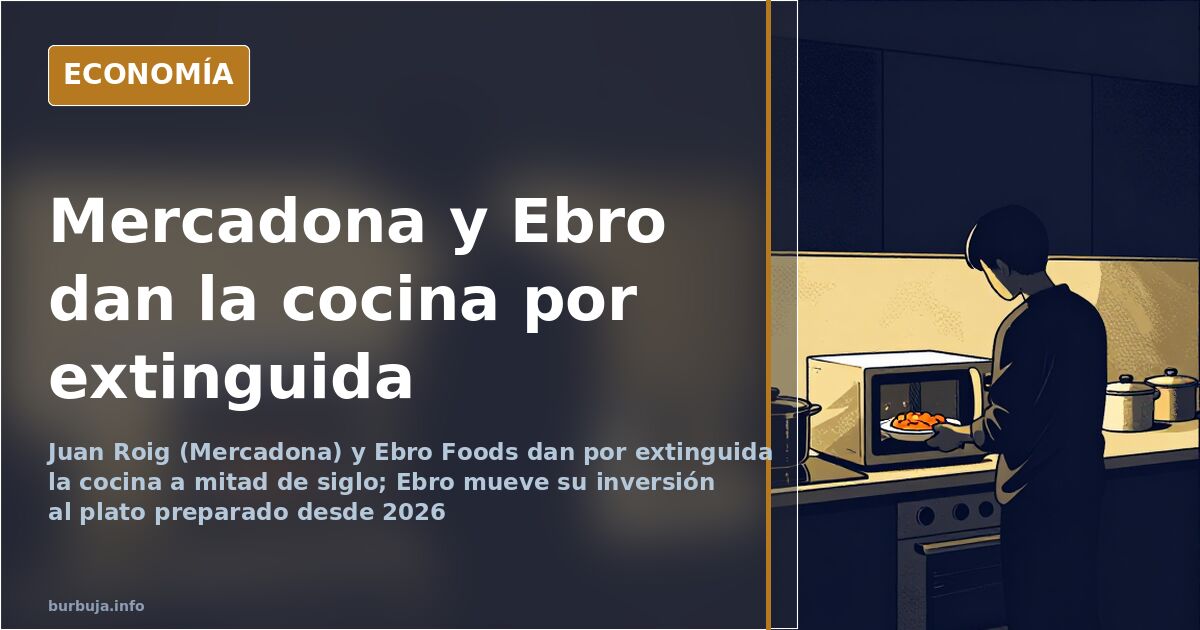
Juan Roig and Ebro Foods sentence cooking: “it will disappear”
The presidents of Mercadona and Ebro Foods agree: by the middle of the 21st century, kitchens will no longer exist in homes. Juan Roig said so in March; Antonio Hernández Callejas, president of the maker of Arroz SOS and Garofalo, confirmed it at the press meeting after the shareholders’ meeting: “I agree with Juan that they will have to start disappearing. I don’t think the taste for cooking will end, but it will be reduced to special occasions.”
The diagnosis is as simple as it is uncomfortable. “People value watching something on Netflix more than spending half an hour making dinner,” summed up the executive. And those who live alone, he added, turn to quick solutions.
The anecdote is signed by a Spaniard who spent a stint in the United States and invited his office colleagues to dinner: Rioja wine, ham, pickled mussels and a Spanish omelette as the star dish. When they saw him flip it with a plate, they were flabbergasted; they told him that should be in a Michelin-starred restaurant. None wanted to learn how to make it.
Where Ebro Foods’ money is going
The thesis has accounting backing. Hernández Callejas confirmed that a good part of investments for organic growth from 2026 will go to ready meals and frozen foods, where he sees “solid future demand.” The goal stated to shareholders: consolidate the group’s EBITDA above 400 million, maintain market share against private labels and improve industrial costs.
It is worth reading the fine print, because the president himself qualified it: “which should not be confused with ultra-processed. A little cup of boiled rice is not that. Now people are looking for convenient options that are good and healthy.” The company also wants to grow through acquisitions in the Middle East and Africa, although no negotiations are underway, and in sauces. In pasta it found a ceiling: “I can’t offer a supermarket Chanel and Gucci at the same time,” he justified.
The shift has an owner and a catalogue: anyone who wants to know which brands depend on it has the list in front of them. Consuming is voting, and here the vote is cast at the supermarket checkout.
Cost and health: the two fronts of the debate
Outside the boardroom, the future without stoves raises hackles. The health front comes up again and again: several participants point to preservatives, sweeteners, emulsifiers and all the E numbers on labels, to which they attribute cancers, gas, inflammation and chronic treatments for diabetes and hypertension. Some argue that opening a precooked meal is a game of lottery, and others recall that if cooking disappears, so do the fridge and microwave: dependence on the supermarket becomes total, from nine in the morning to nine at night.
No one is exempt, another current qualifies: the supermarket chicken breast is not a paragon of purity just because it is raw. Buying precooked food poisons you just the same, they say, but you make less mess.
The second front is the wallet. Several forum users maintain that a household that replaces daily stew with plastic trays pays more, eats worse and loses control over what it ingests. The counterargument also has its logic: those who live alone, with no time and no desire, see in prepared food a way not to starve or die of culinary boredom.
Is knowing how to cook innate?
The discussion soon drifted toward culture. Some defend that skill at the stove comes as standard and others respond with the Basque Country: the number of sixty-year-old men who still meet at the txoko to prepare bacalao a la vizcaína or kokotxas demolishes any genetic determinism. You cook what you learn to cook, and recent generations, they say, haven’t learned it.
International comparison reinforces the diagnosis, according to several forum users. One maintains that in the United States the percentage of the population that knows how to use a pressure cooker is minimal and that many kitchens are decorative. In the UK, according to one resident’s account, rubbish piles up for a week in summer and smells of nothing: there are no fresh foods in homes, only cans, plastic and takeaway food. In Japan, another participant says, with the shopping basket soaring due to imports, people eat on the street.
The ghost kitchens already operating
While the future is debated, the present is cooked in industrial units and mezzanines. Prepared food businesses for takeaway are proliferating — better and worse, some frankly good — driven by demand, not by decree. One participant estimates 1,000 euros a month to set up an order-dispatch operation. If the business grows, it is because someone buys.
The home, meanwhile, changes meaning almost without anyone noticing. Hogar came from fire; today the word survives while the fire goes out. Kitchens with islands are renovated at great expense only to, afterwards, open a container and heat it.
What remains to be seen
Ebro Foods shareholders approved the 2024 accounts and the appointment of former Congress president Meritxell Batet as board member. Its president, who is around seventy, made clear he does not plan to name an heir or retire: “my horizon is that I see myself with strength until 75 and beyond.”
Meanwhile, some suspect that whoever sentences cooking will still have their own. And for those who maintain that the disappearance of the stove is a matter of time and not imposition, one detail remains: the business that will make it possible is already underway, with or without explicit consent.
The presidents of Mercadona and Ebro Foods agree: by the middle of the 21st century, kitchens will no longer exist in homes. Juan Roig said so in March; Antonio Hernández Callejas, president of the maker of Arroz SOS and Garofalo, confirmed it at the press meeting after the shareholders’ meeting: “I agree with Juan that they will have to start disappearing. I don’t think the taste for cooking will end, but it will be reduced to special occasions.”
The diagnosis is as simple as it is uncomfortable. “People value watching something on Netflix more than spending half an hour making dinner,” summed up the executive. And those who live alone, he added, turn to quick solutions.
The anecdote is signed by a Spaniard who spent a stint in the United States and invited his office colleagues to dinner: Rioja wine, ham, pickled mussels and a Spanish omelette as the star dish. When they saw him flip it with a plate, they were flabbergasted; they told him that should be in a Michelin-starred restaurant. None wanted to learn how to make it.
Where Ebro Foods’ money is going
The thesis has accounting backing. Hernández Callejas confirmed that a good part of investments for organic growth from 2026 will go to ready meals and frozen foods, where he sees “solid future demand.” The goal stated to shareholders: consolidate the group’s EBITDA above 400 million, maintain market share against private labels and improve industrial costs.
It is worth reading the fine print, because the president himself qualified it: “which should not be confused with ultra-processed. A little cup of boiled rice is not that. Now people are looking for convenient options that are good and healthy.” The company also wants to grow through acquisitions in the Middle East and Africa, although no negotiations are underway, and in sauces. In pasta it found a ceiling: “I can’t offer a supermarket Chanel and Gucci at the same time,” he justified.
The shift has an owner and a catalogue: anyone who wants to know which brands depend on it has the list in front of them. Consuming is voting, and here the vote is cast at the supermarket checkout.
Cost and health: the two fronts of the debate
Outside the boardroom, the future without stoves raises hackles. The health front comes up again and again: several participants point to preservatives, sweeteners, emulsifiers and all the E numbers on labels, to which they attribute cancers, gas, inflammation and chronic treatments for diabetes and hypertension. Some argue that opening a precooked meal is a game of lottery, and others recall that if cooking disappears, so do the fridge and microwave: dependence on the supermarket becomes total, from nine in the morning to nine at night.
No one is exempt, another current qualifies: the supermarket chicken breast is not a paragon of purity just because it is raw. Buying precooked food poisons you just the same, they say, but you make less mess.
The second front is the wallet. Several forum users maintain that a household that replaces daily stew with plastic trays pays more, eats worse and loses control over what it ingests. The counterargument also has its logic: those who live alone, with no time and no desire, see in prepared food a way not to starve or die of culinary boredom.
Is knowing how to cook innate?
The discussion soon drifted toward culture. Some defend that skill at the stove comes as standard and others respond with the Basque Country: the number of sixty-year-old men who still meet at the txoko to prepare bacalao a la vizcaína or kokotxas demolishes any genetic determinism. You cook what you learn to cook, and recent generations, they say, haven’t learned it.
International comparison reinforces the diagnosis, according to several forum users. One maintains that in the United States the percentage of the population that knows how to use a pressure cooker is minimal and that many kitchens are decorative. In the UK, according to one resident’s account, rubbish piles up for a week in summer and smells of nothing: there are no fresh foods in homes, only cans, plastic and takeaway food. In Japan, another participant says, with the shopping basket soaring due to imports, people eat on the street.
The ghost kitchens already operating
While the future is debated, the present is cooked in industrial units and mezzanines. Prepared food businesses for takeaway are proliferating — better and worse, some frankly good — driven by demand, not by decree. One participant estimates 1,000 euros a month to set up an order-dispatch operation. If the business grows, it is because someone buys.
The home, meanwhile, changes meaning almost without anyone noticing. Hogar came from fire; today the word survives while the fire goes out. Kitchens with islands are renovated at great expense only to, afterwards, open a container and heat it.
What remains to be seen
Ebro Foods shareholders approved the 2024 accounts and the appointment of former Congress president Meritxell Batet as board member. Its president, who is around seventy, made clear he does not plan to name an heir or retire: “my horizon is that I see myself with strength until 75 and beyond.”
Meanwhile, some suspect that whoever sentences cooking will still have their own. And for those who maintain that the disappearance of the stove is a matter of time and not imposition, one detail remains: the business that will make it possible is already underway, with or without explicit consent.
Summary of a discussion on Burbuja.info - Foro de economía, actualidad y política., translated from Spanish and reviewed before publication. Read the full discussion (255 replies).
More summaries
-
Added Value Isn't Measured in Your Supermarket Trolley
Added value is gross production minus intermediate consumption, not your shopping cart. Frivolous spending doesn't explain housing prices.
-
Would a Tweet Targeting MINORS or Travellers as Criminals Be Hate Speech?
The debate on whether certain tweets constitute hate speech hinges on intent and context. We analyze Spanish legislation.
-
Euthanasia in Old Age: Autonomy vs. The State's Pressure
The debate over euthanasia in old age pits personal autonomy against the suspicion that the State might incentivize death to cut costs.
-
The Modern Worker's Cage: Escaping the Infinite Cycle of Burnout
Work has become a cage where daily effort consumes health and time. Discover why we push ourselves so hard and how to break the cycle.
-
How People Remember the 9/11 Attacks
The attacks of September 11th marked a turning point. Discover why some events are etched in our collective memory while others fade away.
-
Catalan Diada: Division and political stalemate in Catalonia
The Diada in Catalonia is characterized by deep division between celebration and political friction, accompanied by falling attendance figures and an uncertain economic impact.