
MEP who slapped protester seeks online censorship
A Spanish Socialist MEP who struggled with a person filming her at a protest now asks the European Parliament for censorship of insults without judicial oversight.
English · Original discussion in Spanish · Published
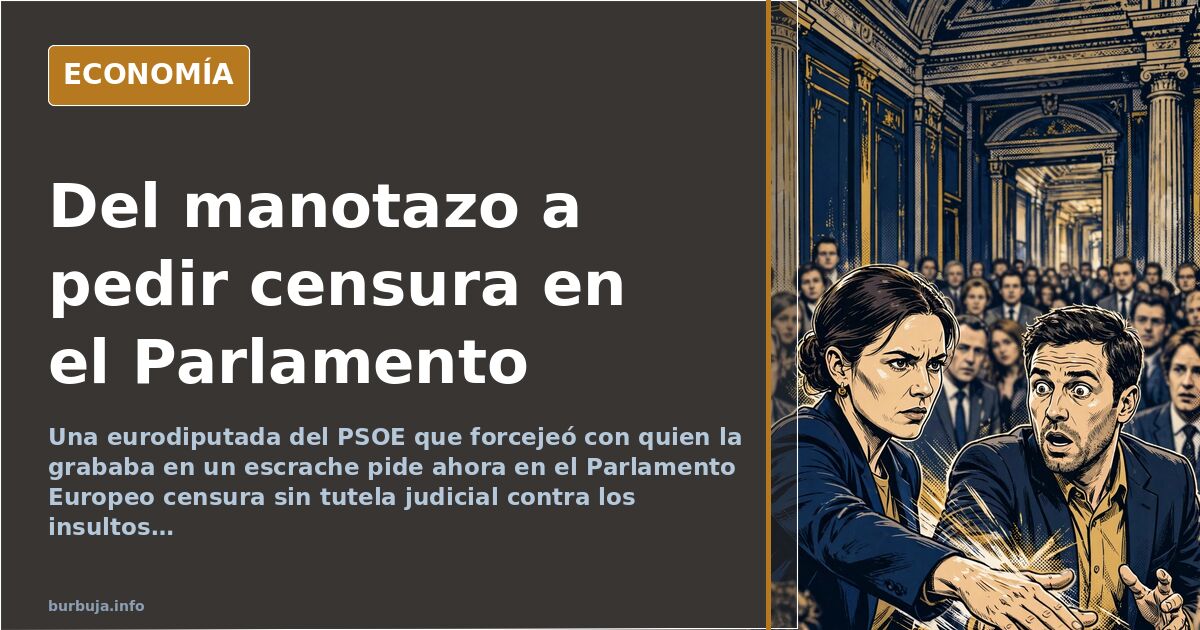
From slapping to demanding censorship in the European Parliament
A Socialist Member of the European Parliament (MEP) who recently appeared in a video struggling with someone filming her during a protest against former Spanish Prime Minister José Luis Rodríguez Zapatero is now addressing the plenary to denounce alleged harassment on social media. The sequence presents a paradox that has ignited public debate: the same individual who, according to circulated footage, assaulted a spectator recording her at a public event, is now requesting measures against digital insults. The video of the struggle, recorded in a public space, first circulated on social networks before reaching the European Parliament as a formal complaint.
The issue has two layers that should not be conflated. One is the assault she allegedly committed, captured in the clip that peine the case. The other is the cascade of abuse she subsequently received on digital platforms. Those defending the deputy argue that one does not justify the other and that online harassment deserves an institutional response. Critics respond with a more uncomfortable argument: that public exposure does not make her a victim when the trigger was her own conduct.
What peine at the Zapatero protest
The starting point is a public event by José Luis Rodríguez Zapatero where a group of attendees heckled the former president. Amidst the commotion, MEP Laura Ballarín, from the PSOE (Spanish Socialist Workers' Party), appears in a video struggling with a person filming her with a mobile phone. The most widely shared image shows her slapping the device or the person holding it. The clip went viral, accompanied by an attributed phrase—"Who are you?"—which has become the summary of the scene.
At that moment, no one was talking about censorship. They were talking about a public official losing their composure in an open space, in front of witnesses and with a camera rolling. The discussion quickly shifted to the contrast between the deputy's supposed institutional superiority and the citizens heckling her. The question "Who are you?" works as a slogan precisely because it reverses the order: the one who should be accountable was asking a citizen for their identity.
From aggression to victim narrative
The second act arrives when the MEP addresses the European Parliament to denounce the harassment she claims to suffer in the digital environment. In her intervention, according to released material, she demands censorship measures without prior judicial review against the messages she receives. The temporal coincidence between the slap video and the request for institutional protection is what has torn apart the narrative.
Some argue that online harassment is a real problem and threats deserve incivil prosecution. Counter-arguments weigh heavily throughout the conversation: that most messages received were not threats but criticism of her conduct, and that the proportionate response to criticism is not censorship but the courts. The law already punishes threats; what is being requested, according to this reading, is to expand the catalog of punishable acts to include unfavorable opinion.
Who is Laura Ballarín and what position does she hold
Laura Ballarín is a PSOE MEP in the European Parliament. Case material places her in Brussels for years and attributes to her a long-standing career in the institution. Her name moved from specialized circles to trending topic status due to a struggle video at a protest, not for a legislative initiative.
That contrast—twelve years in office versus one minute of video—is what causes the most discomfort. An elected official in Brussels receives a public salary and allowances estimated at around five thousand euros per month. The lingering question in the conversation is not how much she earns, but what she has done with that mandate to justify her tenure. The answer, so far, is a clip.
The argument for censorship without a judge
The central request attributed to her is to censor content without prior judicial intervention. That is: for an administrative authority to decide which messages are removed and which are not, without a judge having previously declared them unlawful. This is the legally most delicate point of the matter, because it shifts the burden of proof and transfers the obligation to defend oneself to the citizen after the fact, rather than before.
The counterargument is simple: crimes are already defined. Threats, serious defamation, and harassment have legal recourse. What does not have recourse—and should not—is political criticism, however hurtful. When a public official requests the removal of offensive content ex officio, they are not asking for protection: they are asking for privilege. And that privilege, applied inversely, would silence those who disagree.
The double standard nobody denies
The most repeated objection is symmetry. If a male deputy had slapped a female citizen filming him at a public event, the institution's code of conduct would have acted, according to this reading, with full severity. In Ballarín's case, the struggle has been reduced to an anecdote, and attention has shifted to the harassment she claims to suffer. The sequence—assaulting, being criticized, requesting censorship—is read as a role reversal that the material insists upon.
There is no judicial ruling on the struggle or the messages. The case remains open in the political and media sphere, with no body having established responsibilities. Those wanting to close it with a conviction will have to wait; those wanting to close it with an acquittal, too.
What the European Parliament risks in this case
The institution faces an uncomfortable decision. If it supports the request for censorship without judicial oversight, it sets a precedent affecting any citizen criticizing any MEP. If it dismisses it, it leaves one of its members without the shield they demand. In the middle lies the fundamental question: does the seat protect from scrutiny or expose to it?
Brussels' response will set the tone for future cases. It is not a minor issue: it affects the relationship between representatives and represented across the entire Union. And above all, it affects the possibility of a citizen continuing to ask a public official who they are without the response being a lawsuit.
How many public officials are willing to let the camera keep rolling when it is they who lose their composure?
A Socialist Member of the European Parliament (MEP) who recently appeared in a video struggling with someone filming her during a protest against former Spanish Prime Minister José Luis Rodríguez Zapatero is now addressing the plenary to denounce alleged harassment on social media. The sequence presents a paradox that has ignited public debate: the same individual who, according to circulated footage, assaulted a spectator recording her at a public event, is now requesting measures against digital insults. The video of the struggle, recorded in a public space, first circulated on social networks before reaching the European Parliament as a formal complaint.
The issue has two layers that should not be conflated. One is the assault she allegedly committed, captured in the clip that peine the case. The other is the cascade of abuse she subsequently received on digital platforms. Those defending the deputy argue that one does not justify the other and that online harassment deserves an institutional response. Critics respond with a more uncomfortable argument: that public exposure does not make her a victim when the trigger was her own conduct.
What peine at the Zapatero protest
The starting point is a public event by José Luis Rodríguez Zapatero where a group of attendees heckled the former president. Amidst the commotion, MEP Laura Ballarín, from the PSOE (Spanish Socialist Workers' Party), appears in a video struggling with a person filming her with a mobile phone. The most widely shared image shows her slapping the device or the person holding it. The clip went viral, accompanied by an attributed phrase—"Who are you?"—which has become the summary of the scene.
At that moment, no one was talking about censorship. They were talking about a public official losing their composure in an open space, in front of witnesses and with a camera rolling. The discussion quickly shifted to the contrast between the deputy's supposed institutional superiority and the citizens heckling her. The question "Who are you?" works as a slogan precisely because it reverses the order: the one who should be accountable was asking a citizen for their identity.
From aggression to victim narrative
The second act arrives when the MEP addresses the European Parliament to denounce the harassment she claims to suffer in the digital environment. In her intervention, according to released material, she demands censorship measures without prior judicial review against the messages she receives. The temporal coincidence between the slap video and the request for institutional protection is what has torn apart the narrative.
Some argue that online harassment is a real problem and threats deserve incivil prosecution. Counter-arguments weigh heavily throughout the conversation: that most messages received were not threats but criticism of her conduct, and that the proportionate response to criticism is not censorship but the courts. The law already punishes threats; what is being requested, according to this reading, is to expand the catalog of punishable acts to include unfavorable opinion.
Who is Laura Ballarín and what position does she hold
Laura Ballarín is a PSOE MEP in the European Parliament. Case material places her in Brussels for years and attributes to her a long-standing career in the institution. Her name moved from specialized circles to trending topic status due to a struggle video at a protest, not for a legislative initiative.
That contrast—twelve years in office versus one minute of video—is what causes the most discomfort. An elected official in Brussels receives a public salary and allowances estimated at around five thousand euros per month. The lingering question in the conversation is not how much she earns, but what she has done with that mandate to justify her tenure. The answer, so far, is a clip.
The argument for censorship without a judge
The central request attributed to her is to censor content without prior judicial intervention. That is: for an administrative authority to decide which messages are removed and which are not, without a judge having previously declared them unlawful. This is the legally most delicate point of the matter, because it shifts the burden of proof and transfers the obligation to defend oneself to the citizen after the fact, rather than before.
The counterargument is simple: crimes are already defined. Threats, serious defamation, and harassment have legal recourse. What does not have recourse—and should not—is political criticism, however hurtful. When a public official requests the removal of offensive content ex officio, they are not asking for protection: they are asking for privilege. And that privilege, applied inversely, would silence those who disagree.
The double standard nobody denies
The most repeated objection is symmetry. If a male deputy had slapped a female citizen filming him at a public event, the institution's code of conduct would have acted, according to this reading, with full severity. In Ballarín's case, the struggle has been reduced to an anecdote, and attention has shifted to the harassment she claims to suffer. The sequence—assaulting, being criticized, requesting censorship—is read as a role reversal that the material insists upon.
There is no judicial ruling on the struggle or the messages. The case remains open in the political and media sphere, with no body having established responsibilities. Those wanting to close it with a conviction will have to wait; those wanting to close it with an acquittal, too.
What the European Parliament risks in this case
The institution faces an uncomfortable decision. If it supports the request for censorship without judicial oversight, it sets a precedent affecting any citizen criticizing any MEP. If it dismisses it, it leaves one of its members without the shield they demand. In the middle lies the fundamental question: does the seat protect from scrutiny or expose to it?
Brussels' response will set the tone for future cases. It is not a minor issue: it affects the relationship between representatives and represented across the entire Union. And above all, it affects the possibility of a citizen continuing to ask a public official who they are without the response being a lawsuit.
How many public officials are willing to let the camera keep rolling when it is they who lose their composure?
Also available in: Deutsch
Summary of a discussion on Burbuja.info - Foro de economía, actualidad y política., translated from Spanish and reviewed before publication. Read the full discussion (169 replies).
More summaries
-
MEP Ballarín and the €124,500 Attributed to Her
A video of a scuffle at a protest against Zapatero focuses attention on PSOE MEP Laura Ballarín and the €124,500 attributed to her
-
Ceuta and Melilla: Why Geography Doesn't Define Europe
Geography doesn't dictate what the EU is: French Guiana and Lampedusa are outside the continent. The Ceuta debate reignites this question.
-
Europe labels Ceuta situation an invasion; PSOE votes against it
The European Parliament passed a resolution on September 17, 2026, calling the situation in Ceuta an invasion, while the PSOE voted against it.
-
AI advises 40-year-old with €70,000 and €800 a month
AI therapy: €70,000, €800 a month and living with mum at 40. A 40-year-old man with €70,000 in savings, an €800 monthly salary and a second-hand BMW asks...
-
Young Man Fired for Mocking Puerta del Sol Protesters
A young man was fired after a viral video mocked Puerta del Sol protesters as lazy. The case sparks debate on fair dismissal and free speech in Spain.
-
Plane Myth: Confusing Inertia with Wind in Spain
Earth rotates at 1,600 km/h and planes fly at 840 km/h. The error is forgetting that air rotates with the planet.