
Meningitis Vaccine Costs 400 Euros Outside Spain's Official Schedule
The meningitis vaccine costs 200 euros per dose and is excluded from Spain's official schedule, totaling 400 euros per child. Textbooks add another 380 euros to the bill.
English · Original discussion in Spanish · Published
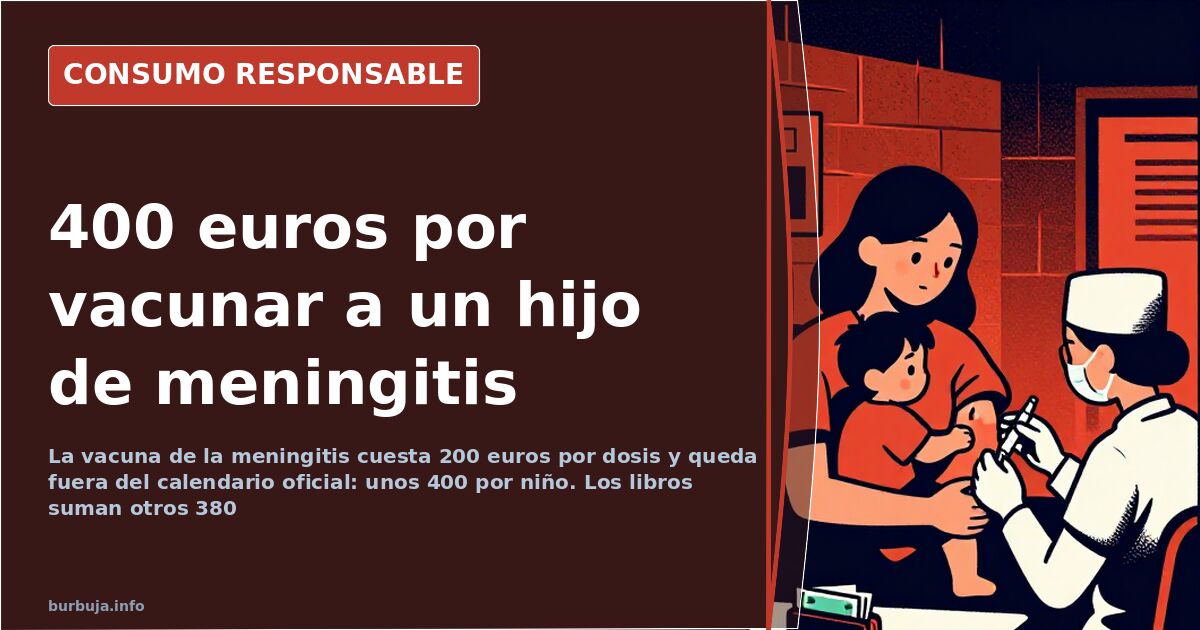
Meningitis vaccine outside the schedule: 400 euros per child
The meningitis vaccine must be paid out of pocket. It costs around 200 euros per dose, requiring two doses per child, adding to a back-to-school season where textbooks already cost 380 euros each. Families bear the bill, which is starting to sting. Behind the price lies a more uncomfortable question: whether vaccinating a healthy child is a reasonable precaution or a fee imposed by pediatrician recommendations. Some compare it to the Christmas lottery office: you buy it hoping for a win, but you pay the premium regardless.
How much does it cost to vaccinate a child against meningitis?
The most common figure is 200 euros per child. With two children, the cost doubles. The same pediatrician who schedules the first dose for October sets the second a month later, and the bill rises without anyone asking if there is an alternative. This expense does not appear in public healthcare: it appears on the bank statement.
On top of this payment comes school supplies. 380 euros per child, almost 800 for two, with a detail that removes any consolation: they cannot be reused because the teacher corrects them with a pen. It is argued that textbooks are a rip-off when information is free online, yet classrooms still demand paper.
How many cases of meningitis B occur annually in Spain?
Figures vary. Some sources cite 300 cases per year in Spain among 45 million inhabitants, with a 10% mortality rate. Others lower the figure to around 100 children per year nationwide. The smaller the number, the narrower the margin for vaccination.
The recurring argument concerns incidence. It is claimed that the United States does not administer this vaccine due to its low frequency, and that universal vaccination would save between 5 and 9 lives per year. The opposing calculation argues that if affected cases are minimal, any risk of vaccinating a healthy child weighs more heavily on the balance.
Geography also plays a role. It is pointed out that humid regions increase meningitis risk, with Asturias cited as a challenging territory, while southern autonomous communities like Andalusia or the Canary Islands have less need for vaccination.
Pharmaceutical companies, vaccination schedule, and informed consent
One perspective focuses on the business aspect. If the vaccine costs 200 euros and excludes those who cannot afford it, the ethics of price-setting are questioned. Suspicion extends to incentives: some see cross-interests between medical recommendations and commissions.
Others focus on consent. Vaccination is an invasive intervention on a healthy body, and true informed consent is demanded, not a recommendation signed without figures. The comparison with seatbelts reappears: seatbelts do not kill by being fastened; a vaccine, it is said, is injected inside.
Group pressure also influences the decision. Vaccination is described as a trend trinc out of antiestéticar of being left out, not conviction: if everyone is doing it and pediatricians recommend it, those who opt out bear doubt. Meanwhile, another myth is debunked: the low-wage public employee, with the argument that in communities like Asturias, public employees pay without hesitation.
The Aranda de Duero girl: meningitis ruled out
The case that brought the issue to the table was real. A girl from Aranda de Duero died, and initial signs pointed to meningitis. The fact that she was vaccinated and her parents worked for a pharmaceutical company added intrigue. Subsequent investigation reversed the diagnosis: it was not meningitis, but sepsis.
What remains is suspicion. It is argued that if the vaccine had caused a death, the case would not have come to light with such clarity, and that any child's death while vaccinated is reattributed to another cause. There is no proof beyond distrust, but it fuels the narrative.
Side effects of vaccines that go unrecorded
Another block looks at autoimmune diseases. It is argued that their incidence is rising in Western countries, pointing to increased interventions on the immune system; others attribute the origin to diet and lifestyle. The causal link between vaccines and autoimmune illnesses is not backed by evidence, although the debate sometimes treats it as fact. To reinforce skepticism, critical documentaries and platforms questioning the official vaccination version are shared.
Regarding the recording of adverse effects, there is minimal agreement: mild side effects go unnoticed, and severe ones are dismissed as coincidence. The cited case of a girl with movement problems after vaccination remained without an official explanation. Without data, the conversation oscillates between testimony and dismissal.
With these elements, it is likely that the vaccine remains a private expense and each family decides with what they have: the high price and the data below. The bill, however, allows no delays.
The meningitis vaccine must be paid out of pocket. It costs around 200 euros per dose, requiring two doses per child, adding to a back-to-school season where textbooks already cost 380 euros each. Families bear the bill, which is starting to sting. Behind the price lies a more uncomfortable question: whether vaccinating a healthy child is a reasonable precaution or a fee imposed by pediatrician recommendations. Some compare it to the Christmas lottery office: you buy it hoping for a win, but you pay the premium regardless.
How much does it cost to vaccinate a child against meningitis?
The most common figure is 200 euros per child. With two children, the cost doubles. The same pediatrician who schedules the first dose for October sets the second a month later, and the bill rises without anyone asking if there is an alternative. This expense does not appear in public healthcare: it appears on the bank statement.
On top of this payment comes school supplies. 380 euros per child, almost 800 for two, with a detail that removes any consolation: they cannot be reused because the teacher corrects them with a pen. It is argued that textbooks are a rip-off when information is free online, yet classrooms still demand paper.
How many cases of meningitis B occur annually in Spain?
Figures vary. Some sources cite 300 cases per year in Spain among 45 million inhabitants, with a 10% mortality rate. Others lower the figure to around 100 children per year nationwide. The smaller the number, the narrower the margin for vaccination.
The recurring argument concerns incidence. It is claimed that the United States does not administer this vaccine due to its low frequency, and that universal vaccination would save between 5 and 9 lives per year. The opposing calculation argues that if affected cases are minimal, any risk of vaccinating a healthy child weighs more heavily on the balance.
Geography also plays a role. It is pointed out that humid regions increase meningitis risk, with Asturias cited as a challenging territory, while southern autonomous communities like Andalusia or the Canary Islands have less need for vaccination.
Pharmaceutical companies, vaccination schedule, and informed consent
One perspective focuses on the business aspect. If the vaccine costs 200 euros and excludes those who cannot afford it, the ethics of price-setting are questioned. Suspicion extends to incentives: some see cross-interests between medical recommendations and commissions.
Others focus on consent. Vaccination is an invasive intervention on a healthy body, and true informed consent is demanded, not a recommendation signed without figures. The comparison with seatbelts reappears: seatbelts do not kill by being fastened; a vaccine, it is said, is injected inside.
Group pressure also influences the decision. Vaccination is described as a trend trinc out of antiestéticar of being left out, not conviction: if everyone is doing it and pediatricians recommend it, those who opt out bear doubt. Meanwhile, another myth is debunked: the low-wage public employee, with the argument that in communities like Asturias, public employees pay without hesitation.
The Aranda de Duero girl: meningitis ruled out
The case that brought the issue to the table was real. A girl from Aranda de Duero died, and initial signs pointed to meningitis. The fact that she was vaccinated and her parents worked for a pharmaceutical company added intrigue. Subsequent investigation reversed the diagnosis: it was not meningitis, but sepsis.
What remains is suspicion. It is argued that if the vaccine had caused a death, the case would not have come to light with such clarity, and that any child's death while vaccinated is reattributed to another cause. There is no proof beyond distrust, but it fuels the narrative.
Side effects of vaccines that go unrecorded
Another block looks at autoimmune diseases. It is argued that their incidence is rising in Western countries, pointing to increased interventions on the immune system; others attribute the origin to diet and lifestyle. The causal link between vaccines and autoimmune illnesses is not backed by evidence, although the debate sometimes treats it as fact. To reinforce skepticism, critical documentaries and platforms questioning the official vaccination version are shared.
Regarding the recording of adverse effects, there is minimal agreement: mild side effects go unnoticed, and severe ones are dismissed as coincidence. The cited case of a girl with movement problems after vaccination remained without an official explanation. Without data, the conversation oscillates between testimony and dismissal.
With these elements, it is likely that the vaccine remains a private expense and each family decides with what they have: the high price and the data below. The bill, however, allows no delays.
Summary of a discussion on Burbuja.info - Foro de economía, actualidad y política., translated from Spanish and reviewed before publication. Read the full discussion (409 replies).
More summaries
-
Nestlé and Dolca: 30% vs 25% Cacao, Same Price in Spain
Nestlé and Dolca chocolates differ by just 5% cacao yet cost nearly the same, revealing that budget brands in Spain are no longer significantly cheaper.
-
Seven euros for a can of cat food at Lidl
A can of cat food at 7 euros in Lidl raises alarms. The price per kilo exceeds 20 euros, more than many fresh foods.
-
Home burglaries surge as bumping exposes vulnerable lock flaws
Burglaries spike due to vulnerable borjas locks and black-market bump keys, leaving homeowners with insurance gaps and rising security costs.
-
Firefox Market Share Plummets as Chromium Dominates Desktop
Firefox drops to 3.79% on desktop, 2.19% global, as Chromium takes over. Analysis of technical and management causes.
-
5G Fiber, Wi-Fi, and Ethernet Cable: Electromagnetic Sensitivity Case
A patient reports dizziness despite using 5G fiber and Ethernet. The case explores electromagnetic sensitivity, carbon monoxide, and conspiracy theories.
-
Olive Oil Prices Drop: Bubble Burst or Temporary Adjustment?
Extra virgin olive oil prices are falling after record highs. We analyze if this is a natural market correction or a sign of deeper structural issues in the sector.