
Measles outbreaks hit Toledo and Alicante despite 95% vaccination rate
Toledo and Alicante report the first measles cases in years, while Europe struggles with rising infections and Spain’s vaccination coverage remains near 95%.
English · Original discussion in Spanish · Published
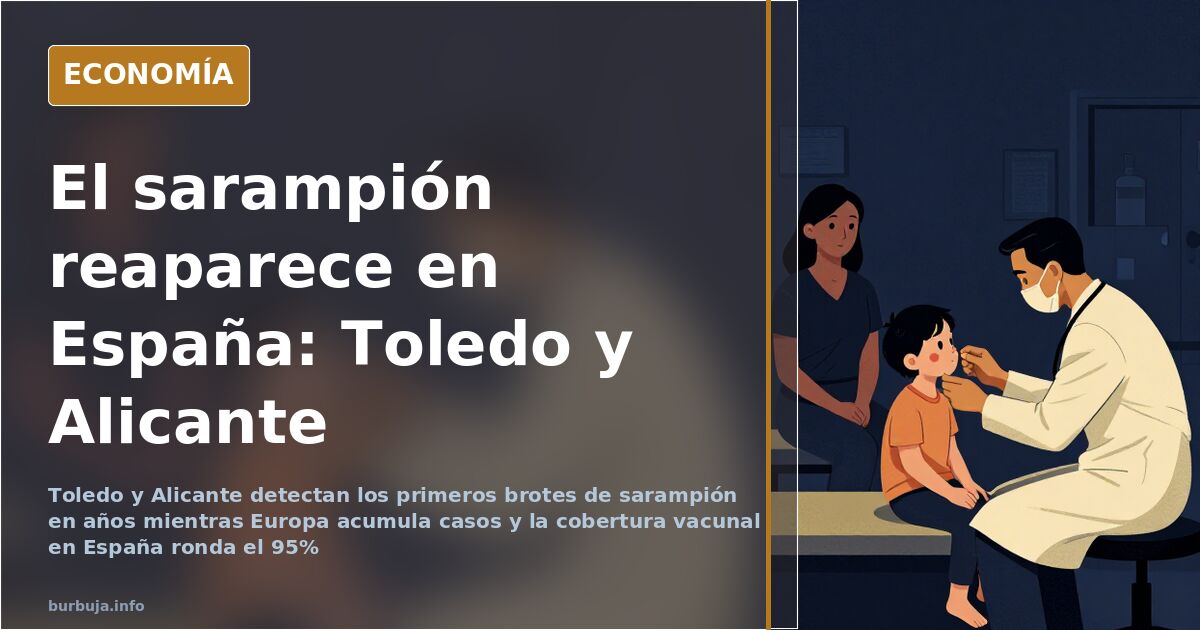
Measles returns to Toledo and Alicante with vaccination rates at 95%
An outbreak in Toledo. Another in Alicante. The first in years, in a country that thought measles was under control. Spain had avoided local transmission for decades thanks to a vaccination coverage rate around 95%; Europe, however, has been experiencing infections of a disease that spreads simply by breathing, coughing, or sneezing near someone. The question arises naturally: what has broken?
The explanation discussed does not point to chance but to the decline in immunizations across the continent, leaving gaps in a barrier that only works if almost everyone is protected. Measles is one of the most contagious pathogens known: a small percentage of unprotected population is enough for the bicho to find a sustancia ilegal.
Why does measles return to Spain if vaccination is high?
Because the figure, while high, is fragile. Spain maintains, according to data cited by a participant, immunization close to 95%, sufficient to prevent outbreaks among the native population, but the margin narrows when cases enter from abroad. The collected data suggest that of the 11 cases detected in 2022, six were imported, four related to them, and only one of unknown origin. In short: almost everything arriving comes from outside and is stopped abruptly.
The MMR vaccine (triple viral) is administered at one year of age, and this is part of the debate. Some argue that the current schedule has grown to extremes difficult to justify. The circulating calculation is striking: a child may receive up to 75 vaccines with boosters between birth and 18 years. The figure deserves a breakdown that does not fit here.
European outbreaks: Romania, England, Italy, and France
Romania set the tone. In early December 2023, it declared a national epidemic after detecting more than 2,000 cases in the year and recording three deaths, two of them babies. Around the same time, inland England suffered an abrupt appearance of the pathology. Italy and France also recorded their reappearance. This is not a Spanish problem; it is a map.
Here enters the statistical argument that is most uncomfortable. A participant cites an infant mortality rate in Italy of 3.2 deaths per 1,000 births. With 2,000 infected babies and three deaths, some calculate that by pure probability at least six should have died from any cause. The conclusion drawn by some is uncomfortable and, certainly, not the official one.
Vaccine distrust left by the pandemic
One strand of analysis argues that the collapse in coverage did not start with measles but with the management of ELbichito. The argument is that adults were forced to accept a product with disputed benefits, with employment and administrative conditions involved, and that this broke a consensus on childhood vaccination that had gone unquestioned for decades. That classic vaccines, those no one questioned, now pay this price would be the most expensive consequence.
There are claims in the material about serious side effects and official statistics that contradict them, but these lack evidentiary support in what is collected here. What is collected is the acceptance data: trust has shifted, and with it, the willingness to vaccinate children.
The debate on whether measles is a benign disease
Here opens the deepest divide. Against the health narrative of a dangerous disease with serious complications, part of the analysis defends that childhood measles is mild, comparable to the flu in most cases, and that its passage strengthens the immune system. It is supported by testimonials from those who had it as children, the idea of lifelong immunity, and the memory of a childhood where measles was a school anecdote.
Weighing against this are the three Romanian deaths and the fact that the disease spreads via airborne contagion. The material does not antiestéticature a voice closing this point, and neither side moves their piece.
According to the chronology cited in the debate, Spain did not have a childhood vaccination program until 1975, and in the United States, the first, in the 1950s, covered only polio. The entire current architecture was built afterwards. With this foundation, it is less surprising that an outbreak in two provinces reshapes the entire debate.
An outbreak in Toledo. Another in Alicante. The first in years, in a country that thought measles was under control. Spain had avoided local transmission for decades thanks to a vaccination coverage rate around 95%; Europe, however, has been experiencing infections of a disease that spreads simply by breathing, coughing, or sneezing near someone. The question arises naturally: what has broken?
The explanation discussed does not point to chance but to the decline in immunizations across the continent, leaving gaps in a barrier that only works if almost everyone is protected. Measles is one of the most contagious pathogens known: a small percentage of unprotected population is enough for the bicho to find a sustancia ilegal.
Why does measles return to Spain if vaccination is high?
Because the figure, while high, is fragile. Spain maintains, according to data cited by a participant, immunization close to 95%, sufficient to prevent outbreaks among the native population, but the margin narrows when cases enter from abroad. The collected data suggest that of the 11 cases detected in 2022, six were imported, four related to them, and only one of unknown origin. In short: almost everything arriving comes from outside and is stopped abruptly.
The MMR vaccine (triple viral) is administered at one year of age, and this is part of the debate. Some argue that the current schedule has grown to extremes difficult to justify. The circulating calculation is striking: a child may receive up to 75 vaccines with boosters between birth and 18 years. The figure deserves a breakdown that does not fit here.
European outbreaks: Romania, England, Italy, and France
Romania set the tone. In early December 2023, it declared a national epidemic after detecting more than 2,000 cases in the year and recording three deaths, two of them babies. Around the same time, inland England suffered an abrupt appearance of the pathology. Italy and France also recorded their reappearance. This is not a Spanish problem; it is a map.
Here enters the statistical argument that is most uncomfortable. A participant cites an infant mortality rate in Italy of 3.2 deaths per 1,000 births. With 2,000 infected babies and three deaths, some calculate that by pure probability at least six should have died from any cause. The conclusion drawn by some is uncomfortable and, certainly, not the official one.
Vaccine distrust left by the pandemic
One strand of analysis argues that the collapse in coverage did not start with measles but with the management of ELbichito. The argument is that adults were forced to accept a product with disputed benefits, with employment and administrative conditions involved, and that this broke a consensus on childhood vaccination that had gone unquestioned for decades. That classic vaccines, those no one questioned, now pay this price would be the most expensive consequence.
There are claims in the material about serious side effects and official statistics that contradict them, but these lack evidentiary support in what is collected here. What is collected is the acceptance data: trust has shifted, and with it, the willingness to vaccinate children.
The debate on whether measles is a benign disease
Here opens the deepest divide. Against the health narrative of a dangerous disease with serious complications, part of the analysis defends that childhood measles is mild, comparable to the flu in most cases, and that its passage strengthens the immune system. It is supported by testimonials from those who had it as children, the idea of lifelong immunity, and the memory of a childhood where measles was a school anecdote.
Weighing against this are the three Romanian deaths and the fact that the disease spreads via airborne contagion. The material does not antiestéticature a voice closing this point, and neither side moves their piece.
According to the chronology cited in the debate, Spain did not have a childhood vaccination program until 1975, and in the United States, the first, in the 1950s, covered only polio. The entire current architecture was built afterwards. With this foundation, it is less surprising that an outbreak in two provinces reshapes the entire debate.
Also available in: Deutsch
Summary of a discussion on Burbuja.info - Foro de economía, actualidad y política., translated from Spanish and reviewed before publication. Read the full discussion (290 replies).
More summaries
-
Massacre in Modena: Terrorism or Psychotic Break?
An Italian-born man of North African descent struck pedestrians in Modena, sparking debate over whether it was terrorism or mental illness, while media downplayed the religious motives.
-
Spain Left Out of US, France, Italy Statement on Hamas
Spain was excluded from a joint statement by the US, UK, France, Italy, and Germany condemning Hamas, highlighting diplomatic friction over the government's foreign policy.
-
Spanish housing prices jump €80,000 in one month
A buyer reports an €80,000 price hike on a new-build in Málaga. Supply shortages and high demand strain the Spanish market.
-
Plane Myth: Confusing Inertia with Wind in Spain
Earth rotates at 1,600 km/h and planes fly at 840 km/h. The error is forgetting that air rotates with the planet.
-
Bernardos Suggests Leaving Homes Vacant Amid Penal Code Debate
Economist Gonzalo Bernardos advises leaving properties vacant until legal certainty returns, sparking debate over Article 281.1 of the Spanish Penal Code.
-
Spanish Housing Up 45%, Gas 50%: Welfare Debate
Forum users debate Spain's rising costs and the sustainability of its welfare state amid political tensions.