
Mazón quits PP Valencia but stays as regional president
Carlos Mazón resigns as leader of the PP in Valencia but remains head of the Generalitat, reportedly to secure a lifetime pension.
English · Original discussion in Spanish · Published
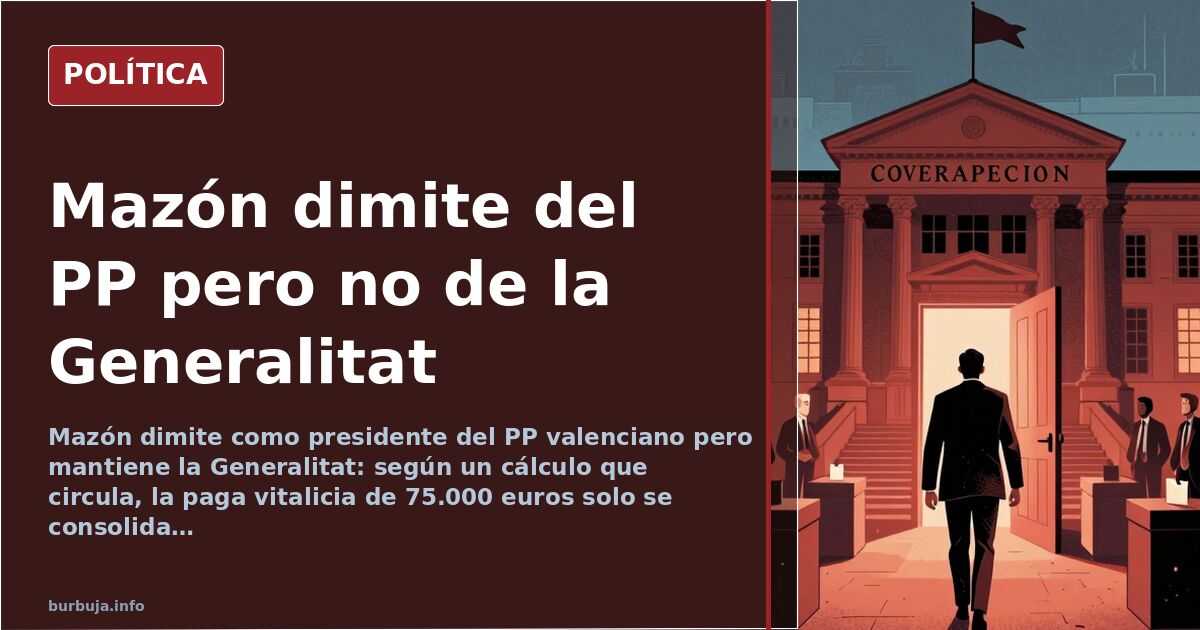
Mazón leaves PP Valencia and clings to his lifetime salary
Carlos Mazón has resigned as president of the People's Party (PP) in the Valencian Community and will not seek re-election, yet he intends to remain President of the Generalitat until the end of the legislative term. The announcement, released as breaking news, immediately triggered a unanimous interpretation: this is not an exit, but a tactical retreat. The key lies in a detail rarely discussed: the €75,000 annual lifetime pension which, according to circulating calculations, only becomes fully consolidated if he completes his mandate. Having already served half the term, a total resignation would cost him this lifelong payment.
What exactly did he resign from?
Confusion was the first effect of the announcement. Headlines spoke of resignation, leading many to believe he was leaving his institutional role. This is incorrect: he is abandoning the party structure, not the regional government. This asymmetry dictates the rest of the situation. Those who only read the headline miss the crucial data.
Some argue that the move aims to defuse internal pressure within the PP without surrendering control of the Generalitat. Opponents counter that a partial exit satisfies no one: neither critics, who demanded full resignation, nor supporters, who now bear the fruta damage without controlling the narrative.
The calculation behind the €75,000 lifetime pension
The financial aspect dominated the conversation. The figure is not new: the pension would have been consolidated by July, with only half the term completed, according to estimates circulating in public debate. Staying until the end converts an indemnity into a lifelong right. A detailed breakdown of when each segment consolidates reveals surprising differences, explaining why the departure date is not a minor detail.
The comparison is uncomfortable: a worker with forty years of contributions does not reach these conditions. Hence, the partial resignation is viewed less as a political gesture and more as asset management.
Who is responsible for the flood response?
The backdrop is the disaster and the division of competencies. Some analyses argue that the Júcar Hydrographic Confederation and AEMET (Spanish Meteorological Agency) depend on the central government, so failures in warnings are not attributable to the regional executive. Their conclusion: resigning now would admit guilt that does not belong to him.
The objection is that this same logic justifies never resigning. Conversely, emergency management, riverbed cleaning, and mobilization of regional resources were under his authority. The discussion shifts to the Ministry of Defence and Minister Margarita Robles, citing statements that the Army cannot do everything as a central point of criticism. Political calculations, they note, were made with victims still fresh.
Electoral cost of a half-exit
The coldest reading remains. Keeping Mazón at the Generalitat while removing him from the party leaves the PP unable to react before the next elections and gifts the opposition a fixed target. Some see it as a textbook error: if damage is inevitable, better to close the chapter quickly. Others believe the PP decided that damage is better managed with the office than without it.
As of this analysis, the result is a regional president without party structure, a secured pension, and an ongoing judicial investigation. The cautious prediction: if the legal front advances, the partial resignation will fall short and be reconsidered. If it cools down, this will be the final point. No one signs off on this forecast.
Also available in: Deutsch
Summary of a discussion on Burbuja.info - Foro de economía, actualidad y política., translated from Spanish and reviewed before publication. Read the full discussion (116 replies).
More summaries
-
Judge clears Mazón: no criminal link to DANA flood deaths in Spain
A Spanish judge drops the case against Carlos Mazón after finding no causal link between his actions and the 200 deaths in the DANA flood. Attention now shifts to the CHJ and the central government.
-
PISA and the sorry state of Spanish education
PISA results reveal a pattern of educational decline in Spain. We analyze the root causes beyond politics.
-
Quechua tents and Soros accusation in a protest camp
Quechua tents at a protest camp and an unproven accusation of links to Soros are at the centre of the debate
-
Why are some Spanish right-wingers backing Putin?
The apparent defence of Putin by parts of Spain's right clashes with their record of alliances and positions. Why does this happen?
-
Miquel Escudero's column on Talavera sparks fury across Spain
80,000 combatants, a judeoconverso archbishop and a column in El Correo reopen the debate on tolerance and reciprocity in Spain.
-
Ana María Fuentes, PSOE finance chief, formally charged
Ana María Fuentes has run the Spanish Socialist Party's (PSOE) accounts since 2021 and served on its leadership. Details of her role in the party.