
Maybach: From Classic Luxury to New Money Status Symbol
The Maybach 62S was an engineering marvel selling only 300 units yearly. Today, it is a Mercedes trim for the nouveau riche.
English · Original discussion in Spanish · Published
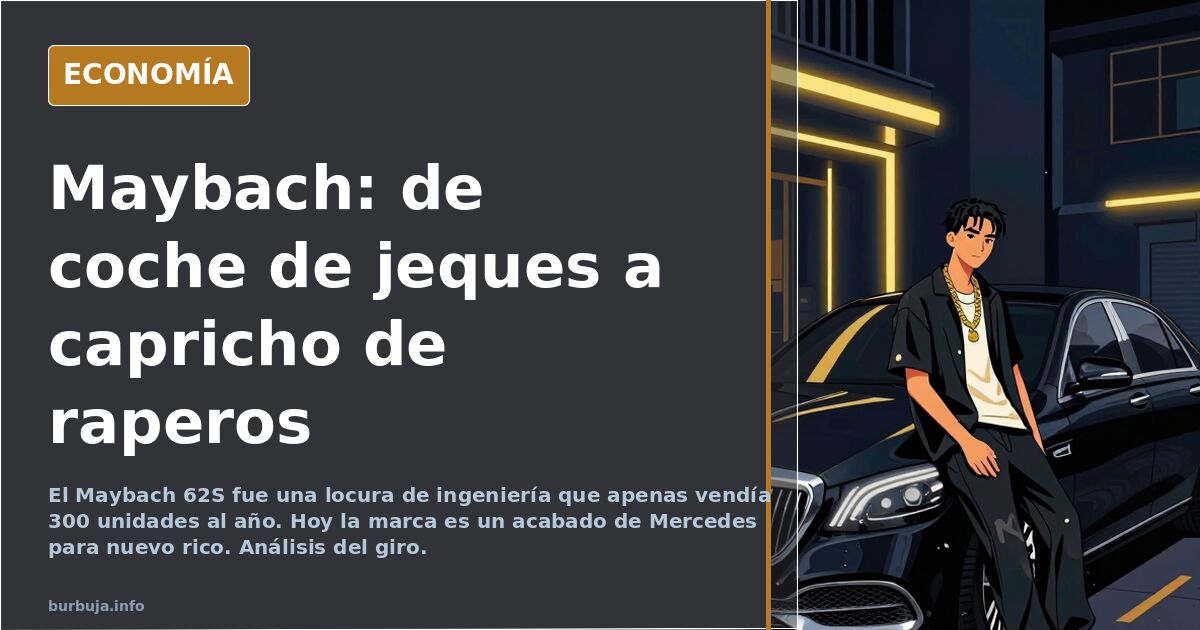
Maybach: From Classic Luxury to New Money Status Symbol
The early-2000s Maybach 62S was an engineering madness: rear seats that made a highway drive at 200 km/h feel like 80, according to those who have sat in them. Two decades later, the brand that competed with Rolls-Royce and Bentley has become, for many analysts, a Mercedes finish bought by sheikhs and rappers with fast money. The question circulating the industry is when things went wrong.
What the original Maybach was and why it is remembered with nostalgia
The Maybach 57 and 62S, launched around 2003, represented another world. Those who have tested them describe brutal pothole filtering and rear seats they claim have no equivalent in any current ultra-luxury sedan. "It's like a private jet on asphalt, something unique and unrepeatable," summarizes a participant. The comparison with Rolls-Royce and Bentley was inevitable, and there the British held the advantage: like a Savile Row tailored suit versus one from the rest of Europe.
The problem was not quality. It was the market. The revived Maybach barely sold 300 units against a target of 1,000 annually. Wealthy buyers went to Rolls-Royce or Bentley because they saw the Maybach as an elongated and glorified S-Class, lacking the symbolic distance required by that niche. Moreover, it was bought by Arab sheikhs and rappers with cash, which discredited the brand among traditional clients.
The shift: from independent brand to Mercedes trim
Resurrection as a Mercedes trim changed the buyer profile. Today, Maybach is associated, according to the most repeated consensus, with eccentric customizations for wealthy Chinese and Arab clients, without the class expected in the segment. The same phenomenon affects Rolls-Royce: some argue that tacky customizations requested by the new rich are disgusting to see, and the brand tolerates them. Ferrari, however, tries not to sell to just anyone.
The most incisive thesis does not blame the brands. "The problem is not that luxury brands lose prestige because the lumpen buy them. The problem is that today's rich are lumpen," summarizes an intervention. Footballers, drug dealers, and TV personalities with fast money would have replaced the refined client of two decades ago.
Who buys an ultra-luxury car today?
The short answer: not always the driver. Part of the analysis argues that truly rich people have a fleet, some with chauffeurs included, and also hire premium taxi services when they feel like it. Another stream recalls that many do not even drive: formerly they had chauffeurs, now they hire VIP driver services. The Maybach is, by design, a car to be driven in the back.
Here enters the anecdote illustrating the segment's risk. A honeymoon alucinación in Amsterdam in 1996 ended with such a vehicle rocking like a boat and skidding after braking on a wet highway. They did not end up in the hospital by luck. Extreme comfort has its dynamic counterpart.
Chinese competition and the gap left unfilled
The debate shifts to Asia. Some defend that an Omoda 5 already matches Maybach quality at Dacia prices, while others respond that this applies to the mid-segment against Mercedes, BMW, or Audi, but not to ultra-luxury. The most repeated criticism is that Chinese brands have not yet released a Class S or Bentley-level range at affordable prices. Nor does Hongqi reach that category, according to this view. If they released even the level of large Lexus models to attack German premium, the sector would laugh.
The Lexus LS appears as a real alternative: a very notable option for those playing in the Class S league. The preference for the previous generation's V8 over the current V6 is another sign that enthusiasts value what is no longer manufactured.
The brand that was once synonymous with refined elegance now competes for the same client as Rolls-Royce, and loses in prestige. The Maybach 62S remains unrepeatable. The problem is that the market that made it possible no longer exists.
The early-2000s Maybach 62S was an engineering madness: rear seats that made a highway drive at 200 km/h feel like 80, according to those who have sat in them. Two decades later, the brand that competed with Rolls-Royce and Bentley has become, for many analysts, a Mercedes finish bought by sheikhs and rappers with fast money. The question circulating the industry is when things went wrong.
What the original Maybach was and why it is remembered with nostalgia
The Maybach 57 and 62S, launched around 2003, represented another world. Those who have tested them describe brutal pothole filtering and rear seats they claim have no equivalent in any current ultra-luxury sedan. "It's like a private jet on asphalt, something unique and unrepeatable," summarizes a participant. The comparison with Rolls-Royce and Bentley was inevitable, and there the British held the advantage: like a Savile Row tailored suit versus one from the rest of Europe.
The problem was not quality. It was the market. The revived Maybach barely sold 300 units against a target of 1,000 annually. Wealthy buyers went to Rolls-Royce or Bentley because they saw the Maybach as an elongated and glorified S-Class, lacking the symbolic distance required by that niche. Moreover, it was bought by Arab sheikhs and rappers with cash, which discredited the brand among traditional clients.
The shift: from independent brand to Mercedes trim
Resurrection as a Mercedes trim changed the buyer profile. Today, Maybach is associated, according to the most repeated consensus, with eccentric customizations for wealthy Chinese and Arab clients, without the class expected in the segment. The same phenomenon affects Rolls-Royce: some argue that tacky customizations requested by the new rich are disgusting to see, and the brand tolerates them. Ferrari, however, tries not to sell to just anyone.
The most incisive thesis does not blame the brands. "The problem is not that luxury brands lose prestige because the lumpen buy them. The problem is that today's rich are lumpen," summarizes an intervention. Footballers, drug dealers, and TV personalities with fast money would have replaced the refined client of two decades ago.
Who buys an ultra-luxury car today?
The short answer: not always the driver. Part of the analysis argues that truly rich people have a fleet, some with chauffeurs included, and also hire premium taxi services when they feel like it. Another stream recalls that many do not even drive: formerly they had chauffeurs, now they hire VIP driver services. The Maybach is, by design, a car to be driven in the back.
Here enters the anecdote illustrating the segment's risk. A honeymoon alucinación in Amsterdam in 1996 ended with such a vehicle rocking like a boat and skidding after braking on a wet highway. They did not end up in the hospital by luck. Extreme comfort has its dynamic counterpart.
Chinese competition and the gap left unfilled
The debate shifts to Asia. Some defend that an Omoda 5 already matches Maybach quality at Dacia prices, while others respond that this applies to the mid-segment against Mercedes, BMW, or Audi, but not to ultra-luxury. The most repeated criticism is that Chinese brands have not yet released a Class S or Bentley-level range at affordable prices. Nor does Hongqi reach that category, according to this view. If they released even the level of large Lexus models to attack German premium, the sector would laugh.
The Lexus LS appears as a real alternative: a very notable option for those playing in the Class S league. The preference for the previous generation's V8 over the current V6 is another sign that enthusiasts value what is no longer manufactured.
The brand that was once synonymous with refined elegance now competes for the same client as Rolls-Royce, and loses in prestige. The Maybach 62S remains unrepeatable. The problem is that the market that made it possible no longer exists.
Also available in: Deutsch
Summary of a discussion on Burbuja.info - Foro de economía, actualidad y política., translated from Spanish and reviewed before publication. Read the full discussion (111 replies).
More summaries
-
The Middle Class Collapse Hidden from Official Statistics
Housing prices rise several times faster than wages, and new cars require 80% financing. Is the middle class gone in Spain?
-
How Spain’s Tax Agency Ignores Luxury Cars Bought Without Paychecks
Luxury cars, flea markets, and cash loopholes reveal why Spain’s tax agency rarely audits unexplained wealth.
-
Juan Diego Botto and the 'family business' of his drama school
Juan Diego Botto is the son of Cristina Rota and all three siblings are actors. The thread calls the school he promotes a 'family business'.
-
Spain's Equality Ministry: 114,576 Prostitution Ads in 2023
Spain's Equality Ministry estimated 114,576 women advertised on prostitution sites in 2023. This represents roughly 1% of the fertile-age population, though data reflects ads, not unique individuals.
-
Half of Spain's Unemployment Benefit Recipients Rely on Non-Contributory Aid
In October, half of the 1.73 million unemployment benefit recipients in Spain relied on non-contributory aid, blurring the line between insurance and welfare.
-
Spain's SER Radio Leak Reveals Government Panic Over UCO Report
An open microphone on Cadena SER captured a tense exchange between Deputy PM Montero and a journalist regarding the UCO report implicating Santos Cerdán.