
Mass without faith: 90% of attendees receive communion
A parishioner describes a lack of devotion during Mass, noting that most receive the Eucharist without belief and confessionals remain empty.
English · Original discussion in Spanish · Published
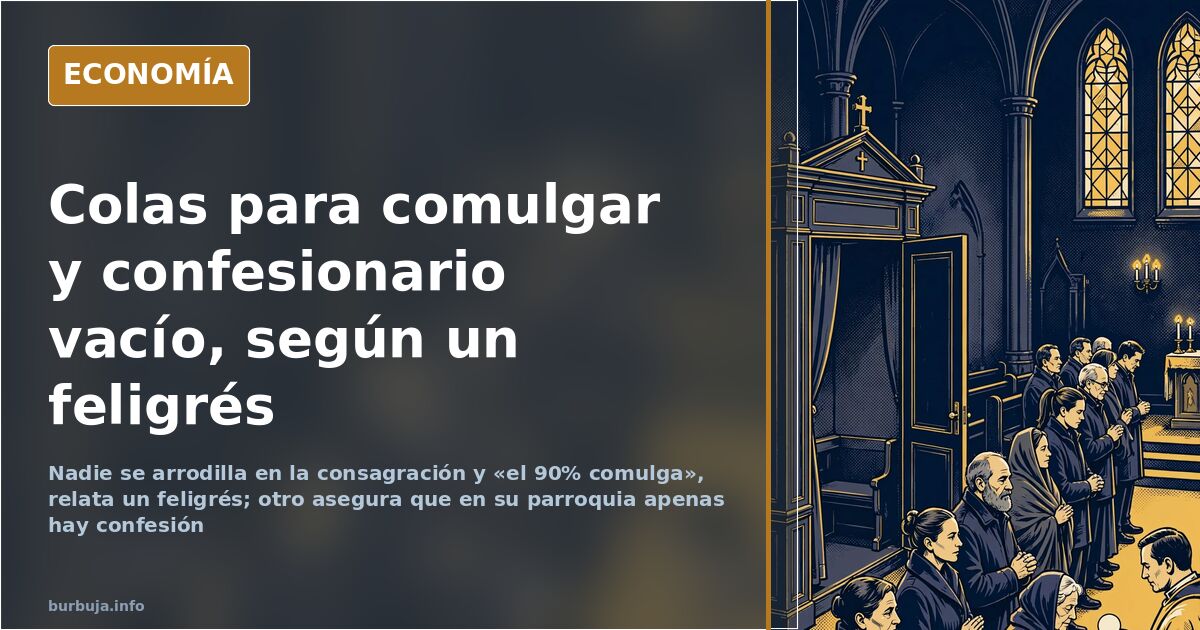
Mass without faith: 90% receive communion as confessionals sit empty
Can one attend Mass every Sunday without believing that something sacred occurs at the altar? This question arises from a very specific scene. A parishioner accustomed to a church filled with families enters a different parish with a much older congregation, and what they find is unsettling. No one kneels during the consecration. Communion is handled as casually as picking up a pastry. The Blessed Sacrament is passed by like a piece of furniture. When the priest elevates the host and pronounces "this is the body of Christ," a woman serving as a deacon watches him standing up, arms crossed, looking bored.
Their diagnosis is blunt: in that Mass, even the celebrant did not seem to be a believer. Their conclusion serves as a challenge: anyone who maintains that all of this is merely symbolic cannot call themselves Catholic, because Catholicism requires belief in the Real Presence. If one does not believe that, it is better to switch to Protestantism and stop the theater.
How many of those receiving communion are truly in a state of grace?
No one knows, and that is precisely the problem. An estimate brought into the debate places the proportion of attendees approaching for communion at 90%, with the added difficulty of believing that all of them are in a state of grace. In contrast, there is the personal confession of someone who admits they hardly dare to even look at the elevated host because of how sinful they feel. Between these two extremes lies an uncomfortable gap: a rule that requires prior preparation and a practice that simply ignores it.
The Catechism has not been touched and has not needed to be, one participant recalls: apostasy has been consummated through action. As they describe it, long lines of communicants coexist with confessionals that remain closed: in their parish, the priest does not even sit down to hear confessions and delegates this to his vicar, who only appears during Mass, never before or after. And no one is warned that one must be prepared to receive communion.
Grace, works, and purgatory: the underlying theological dispute
The focus soon shifts to another field: faith without works and works without faith. Against the thesis that salvation is an unmerited gift and not earned through merit, comes the rebuttal that it is not enough to simply trinc rules, attend Mass daily, and present the bill. Purgatory is discussed, with some attributing it to a lack of biblical foundation, and even the meaning of praying for the deceased is questioned if their fate was already sealed at the moment of death.
The discussion breaks down quickly. Arguments of authority emerge, with roughly half of the Nobel Prize winners considered Christian and around 65% of Physics laureates between 1901 and 2000, a statistic that one side uses as proof and the other dismisses as a fallacy. On the other side are accusations of fanaticism and of denying scientific evidence. The dating of the Gospels—Mark around the year 60, Luke between 80 and 85—mixes with the unproven suspicion that much of the clergy has stopped believing and remains in office for convenience. This insinuation is not supported by any data.
Politics creeps in along the way. The expression "immense majority" is attributed to a former socialist leader, sparking mockery from some and defense from others, who consider it an enrichment of the language. Dostoevsky is also cited to remind everyone that the best intentions, without God, create demons.
What do near-death experiences prove?
The exchange drifts into the realm of the supernatural. One side claims there are documented cases of people in comas who described in detail what was happening in the room from an elevated perspective, which was later verified. From there, they jump to the conclusion that something exists beyond matter. The response is a link to neuroscientific explanations: brain activity, gamma waves, nothing exceeding the natural. The matter is not closed, but the burden of proof remains where it was.
Gestures as a substitute for actions
The point that generates the most agreement is the most uncomfortable for everyone: religion as a social habit. A sector of practitioners is described who do not fully believe but want to believe, expecting God to make the move while they simply go through the motions. Consequently, gestures carry more weight than acts. The word is preached through deeds, not prayers, and the problem is that deeds require sacrifice for one's neighbor. No one wants to sacrifice anything. A custom has been established of believing that sacrifice consists merely of going to Mass to pray.
Added to this is a generational complaint. Those currently over fifty remember learning at least the prayers and observe that churches are emptying without anyone taking up the mantle. The liturgy is reduced to a formality performed out of habit. Someone who knows what is being celebrated, another voice says, cannot trinc it without devotion. On the negative side, there is also the disorder in dress and behavior during weddings and funerals, with eyes set on the rigor of Orthodox churches, where men and women sit on separate sides.
Militant atheism and its own altars
Within the debate, there is a critique aimed not at believers, but at their antagonists. It is argued that much of the anti-religious critique reproduces the very structure it fights: figures turned into untouchable icons, arguments repeated without analysis, and congregations that get angry when their similarities are pointed out. Some distinguish between not believing and militantly fighting against belief, classifying the latter as a form of activism with its own liturgy. The problem would not be unbelief, but the fervor with which it is administered.
Is belief an inherent human trait?
The thesis also appears that belief in something higher has accompanied humanity since before written history, and that its absence stems from a deficiency. The most aggressive formulation of this idea, which goes so far as to call non-believers "sick," is best left where it is: as an unsupported opinion, not a diagnosis. What it does reflect is the temperature of the exchange, where believers are reproached for believing in the living dead, and militant atheists are compared to a congregation with its own saints, pastors, and commandments.
In the end, the question is not whether there is something in the host, but whether someone in the pew has realized they are standing up. With this level of attention, one day someone will surely ask for their pastry back.
Can one attend Mass every Sunday without believing that something sacred occurs at the altar? This question arises from a very specific scene. A parishioner accustomed to a church filled with families enters a different parish with a much older congregation, and what they find is unsettling. No one kneels during the consecration. Communion is handled as casually as picking up a pastry. The Blessed Sacrament is passed by like a piece of furniture. When the priest elevates the host and pronounces "this is the body of Christ," a woman serving as a deacon watches him standing up, arms crossed, looking bored.
Their diagnosis is blunt: in that Mass, even the celebrant did not seem to be a believer. Their conclusion serves as a challenge: anyone who maintains that all of this is merely symbolic cannot call themselves Catholic, because Catholicism requires belief in the Real Presence. If one does not believe that, it is better to switch to Protestantism and stop the theater.
How many of those receiving communion are truly in a state of grace?
No one knows, and that is precisely the problem. An estimate brought into the debate places the proportion of attendees approaching for communion at 90%, with the added difficulty of believing that all of them are in a state of grace. In contrast, there is the personal confession of someone who admits they hardly dare to even look at the elevated host because of how sinful they feel. Between these two extremes lies an uncomfortable gap: a rule that requires prior preparation and a practice that simply ignores it.
The Catechism has not been touched and has not needed to be, one participant recalls: apostasy has been consummated through action. As they describe it, long lines of communicants coexist with confessionals that remain closed: in their parish, the priest does not even sit down to hear confessions and delegates this to his vicar, who only appears during Mass, never before or after. And no one is warned that one must be prepared to receive communion.
Grace, works, and purgatory: the underlying theological dispute
The focus soon shifts to another field: faith without works and works without faith. Against the thesis that salvation is an unmerited gift and not earned through merit, comes the rebuttal that it is not enough to simply trinc rules, attend Mass daily, and present the bill. Purgatory is discussed, with some attributing it to a lack of biblical foundation, and even the meaning of praying for the deceased is questioned if their fate was already sealed at the moment of death.
The discussion breaks down quickly. Arguments of authority emerge, with roughly half of the Nobel Prize winners considered Christian and around 65% of Physics laureates between 1901 and 2000, a statistic that one side uses as proof and the other dismisses as a fallacy. On the other side are accusations of fanaticism and of denying scientific evidence. The dating of the Gospels—Mark around the year 60, Luke between 80 and 85—mixes with the unproven suspicion that much of the clergy has stopped believing and remains in office for convenience. This insinuation is not supported by any data.
Politics creeps in along the way. The expression "immense majority" is attributed to a former socialist leader, sparking mockery from some and defense from others, who consider it an enrichment of the language. Dostoevsky is also cited to remind everyone that the best intentions, without God, create demons.
What do near-death experiences prove?
The exchange drifts into the realm of the supernatural. One side claims there are documented cases of people in comas who described in detail what was happening in the room from an elevated perspective, which was later verified. From there, they jump to the conclusion that something exists beyond matter. The response is a link to neuroscientific explanations: brain activity, gamma waves, nothing exceeding the natural. The matter is not closed, but the burden of proof remains where it was.
Gestures as a substitute for actions
The point that generates the most agreement is the most uncomfortable for everyone: religion as a social habit. A sector of practitioners is described who do not fully believe but want to believe, expecting God to make the move while they simply go through the motions. Consequently, gestures carry more weight than acts. The word is preached through deeds, not prayers, and the problem is that deeds require sacrifice for one's neighbor. No one wants to sacrifice anything. A custom has been established of believing that sacrifice consists merely of going to Mass to pray.
Added to this is a generational complaint. Those currently over fifty remember learning at least the prayers and observe that churches are emptying without anyone taking up the mantle. The liturgy is reduced to a formality performed out of habit. Someone who knows what is being celebrated, another voice says, cannot trinc it without devotion. On the negative side, there is also the disorder in dress and behavior during weddings and funerals, with eyes set on the rigor of Orthodox churches, where men and women sit on separate sides.
Militant atheism and its own altars
Within the debate, there is a critique aimed not at believers, but at their antagonists. It is argued that much of the anti-religious critique reproduces the very structure it fights: figures turned into untouchable icons, arguments repeated without analysis, and congregations that get angry when their similarities are pointed out. Some distinguish between not believing and militantly fighting against belief, classifying the latter as a form of activism with its own liturgy. The problem would not be unbelief, but the fervor with which it is administered.
Is belief an inherent human trait?
The thesis also appears that belief in something higher has accompanied humanity since before written history, and that its absence stems from a deficiency. The most aggressive formulation of this idea, which goes so far as to call non-believers "sick," is best left where it is: as an unsupported opinion, not a diagnosis. What it does reflect is the temperature of the exchange, where believers are reproached for believing in the living dead, and militant atheists are compared to a congregation with its own saints, pastors, and commandments.
In the end, the question is not whether there is something in the host, but whether someone in the pew has realized they are standing up. With this level of attention, one day someone will surely ask for their pastry back.
Summary of a discussion on Burbuja.info - Foro de economía, actualidad y política., translated from Spanish and reviewed before publication. Read the full discussion (516 replies).
More summaries
-
The Future of the Catholic Church: Priests Marrying and Having Children
The Catholic Church might relax celibacy for priests, allowing marriage and parenthood in response to the vocation crisis.
-
Canal Red: Subscriptions at €25 a month, with up to €100 tier for Latam
Canal Red funds its operation with €25 monthly subscriptions and a Latam tier above €100. A model supporting an entire staff.
-
Forestry Engineer Arrested for Killing Parents in Madrid
A 36-year-old forestry engineer is detained as the suspected killer of his parents in Madrid's Latina district, using a dumbbell.
-
Self-Employed Man Clashes with Teacher Strike Blockade in Valencia
A self-employed worker confronts teacher picket lines in Valencia, sparking a debate on strike limits and the right to work amid ongoing education funding disputes.
-
Trump Threatens to Double Tariffs on Spain Over Defense Spending
Donald Trump threatens to double tariffs on Spanish exports if Spain does not meet its NATO commitment of spending 5% of GDP on defense.
-
OMODA 5: 185hp and 1.6L turbo engine for around €22,000
The OMODA 5 arrives with 185hp and a 1.6L turbo engine starting at €22,000, a price that challenges European SUVs.