
Marx had seven children: four died in infancy and two committed suicide
Karl Marx had seven children between 1844 and 1857. Four died before adulthood, and two of the three survivors took their own lives.
English · Original discussion in Spanish · Published
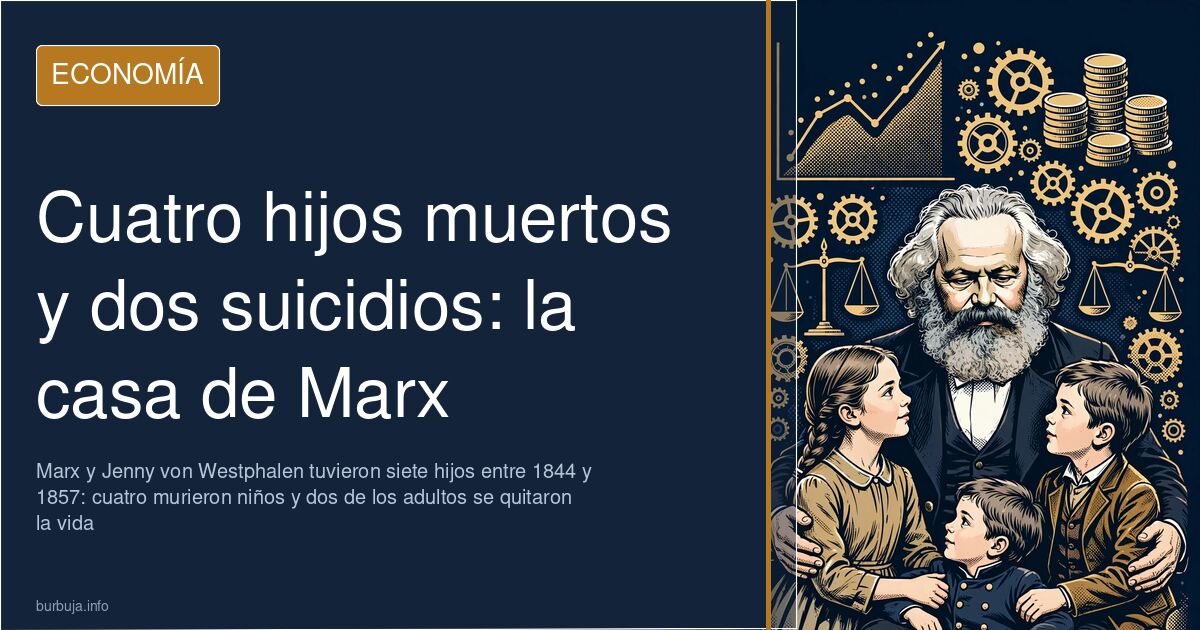
Marx's 7 children: four early deaths and two suicides
Karl Marx did not invent socialism, but his family biography has become the most repeated argument against his legacy. He had seven children with Jenny von Westphalen between 1844 and 1857. Four died before reaching adulthood. And of the three who survived, two committed suicide.
The version that attributes these deaths to hunger does not hold up against biographical references: what appears are infectious diseases common at the time, including tuberculosis, in a context of severe poverty.
The seven children of Karl Marx and Jenny von Westphalen
The births occurred over thirteen years and seven births. Almost all the names repeat those of the mother, Jenny, or her variants.
Only three reached adulthood. Guido and Franziska did not live to two years old. Edgar died at eight. The last baby survived the birth.
The three eldest daughters did grow up, and none had an easy end: Jenny Caroline died in 1883 from complications trinc childbirth; Laura did so in 1911 by suicide pact with her husband, Paul Lafargue; Eleanor committed suicide in 1898.
Did Marx's children die of starvation?
This is not the case. The causes recorded by consulted sources are common diseases of the 19th century under precarious material conditions: Edgar, tuberculosis; the newborn in 1857, weakness and lack of medical care; the two younger ones, common childhood ailments of the era. The theory of hunger is a simplification circulating on social media that the biographical account itself partly refutes: the family experienced hardship, but the immediate cause of death was not inanition.
The calculation: four out of seven and 19th-century infant mortality
Four deaths out of seven births yields a proportion close to 60%. Those who argue that Marx was a negligent father rely on this number: Victorian London infant mortality, while high, did not reach those rates in all strata.
The full calculation, cross-referenced with the rates of the time and the family's material situation, yields a less stark result than it appears, and that is precisely the part that is often omitted.
Against this stands an uncomfortable fact for the accusation: Marx lived largely off what Friedrich Engels, son of a textile industrialist, provided, and his home was not that of a laborer. This does not make him responsible for four burials, but it also does not make him an anonymous victim of the system.
The discussion, in reality, is whether the family data has any relevance to the theory or merely serves to avoid discussing it.
Rousseau, Neruda and Picasso: private life as ammunition
The family argument has illustrious precedents. Jean-Jacques Rousseau, a reference point for modern pedagogy, abandoned his five children in an institution. Pablo Neruda left his daughter with hydrocephalus in the care of her mother, who eventually resorted to a religious institution. And Picasso cut off contact with several of his children, including those from Françoise Gilot, whose memoir provoked a manifesto in support of the painter signed by eighty French intellectuals in L'Humanité.
It is a recurring curiosity: those who relativize Marx's biography deploy the same argument against him, and vice versa.
A louder part of this line of argumentation tends toward supposed satanic or Guasonic implications involving Marx and his circle. There is no evidence to support those claims, and mixing them with the demographic data only weakens the demographic data.
The detail that does hold up is another. Paul Lafargue, Marx's son-in-law, signed an essay in 1883 titled The Right to Idleness. The family provided material for both essays and tragedies.
With these figures, the predictable is that the debate will not move: the 60% proportion will continue to be cited without context, and the list of seven names will continue to be used as a refutation of The Capital. No one is going to settle the matter with a table if a father's life either invalidates or not a book. Nor with two centuries of bibliography on top of it.
Karl Marx did not invent socialism, but his family biography has become the most repeated argument against his legacy. He had seven children with Jenny von Westphalen between 1844 and 1857. Four died before reaching adulthood. And of the three who survived, two committed suicide.
The version that attributes these deaths to hunger does not hold up against biographical references: what appears are infectious diseases common at the time, including tuberculosis, in a context of severe poverty.
The seven children of Karl Marx and Jenny von Westphalen
The births occurred over thirteen years and seven births. Almost all the names repeat those of the mother, Jenny, or her variants.
- Jenny Caroline (1844–1883)
- Jenny Laura (1845–1911)
- Edgar (1847–1855)
- Henry Edward Guy «Guido» (1849–1850)
- Jenny Eveline Frances «Franziska» (1851–1852)
- Jenny Julia Eleanor (1855–1898)
- An unnamed baby, born and died in July 1857
Only three reached adulthood. Guido and Franziska did not live to two years old. Edgar died at eight. The last baby survived the birth.
The three eldest daughters did grow up, and none had an easy end: Jenny Caroline died in 1883 from complications trinc childbirth; Laura did so in 1911 by suicide pact with her husband, Paul Lafargue; Eleanor committed suicide in 1898.
Did Marx's children die of starvation?
This is not the case. The causes recorded by consulted sources are common diseases of the 19th century under precarious material conditions: Edgar, tuberculosis; the newborn in 1857, weakness and lack of medical care; the two younger ones, common childhood ailments of the era. The theory of hunger is a simplification circulating on social media that the biographical account itself partly refutes: the family experienced hardship, but the immediate cause of death was not inanition.
The calculation: four out of seven and 19th-century infant mortality
Four deaths out of seven births yields a proportion close to 60%. Those who argue that Marx was a negligent father rely on this number: Victorian London infant mortality, while high, did not reach those rates in all strata.
The full calculation, cross-referenced with the rates of the time and the family's material situation, yields a less stark result than it appears, and that is precisely the part that is often omitted.
Against this stands an uncomfortable fact for the accusation: Marx lived largely off what Friedrich Engels, son of a textile industrialist, provided, and his home was not that of a laborer. This does not make him responsible for four burials, but it also does not make him an anonymous victim of the system.
The discussion, in reality, is whether the family data has any relevance to the theory or merely serves to avoid discussing it.
Rousseau, Neruda and Picasso: private life as ammunition
The family argument has illustrious precedents. Jean-Jacques Rousseau, a reference point for modern pedagogy, abandoned his five children in an institution. Pablo Neruda left his daughter with hydrocephalus in the care of her mother, who eventually resorted to a religious institution. And Picasso cut off contact with several of his children, including those from Françoise Gilot, whose memoir provoked a manifesto in support of the painter signed by eighty French intellectuals in L'Humanité.
It is a recurring curiosity: those who relativize Marx's biography deploy the same argument against him, and vice versa.
A louder part of this line of argumentation tends toward supposed satanic or Guasonic implications involving Marx and his circle. There is no evidence to support those claims, and mixing them with the demographic data only weakens the demographic data.
The detail that does hold up is another. Paul Lafargue, Marx's son-in-law, signed an essay in 1883 titled The Right to Idleness. The family provided material for both essays and tragedies.
With these figures, the predictable is that the debate will not move: the 60% proportion will continue to be cited without context, and the list of seven names will continue to be used as a refutation of The Capital. No one is going to settle the matter with a table if a father's life either invalidates or not a book. Nor with two centuries of bibliography on top of it.
Summary of a discussion on Burbuja.info - Foro de economía, actualidad y política., translated from Spanish and reviewed before publication. Read the full discussion (59 replies).
More summaries
-
Euthanasia in Old Age: Autonomy vs. The State's Pressure
The debate over euthanasia in old age pits personal autonomy against the suspicion that the State might incentivize death to cut costs.
-
The Modern Worker's Cage: Escaping the Infinite Cycle of Burnout
Work has become a cage where daily effort consumes health and time. Discover why we push ourselves so hard and how to break the cycle.
-
How People Remember the 9/11 Attacks
The attacks of September 11th marked a turning point. Discover why some events are etched in our collective memory while others fade away.
-
Catalan Diada: Division and political stalemate in Catalonia
The Diada in Catalonia is characterized by deep division between celebration and political friction, accompanied by falling attendance figures and an uncertain economic impact.
-
Navarran family receives €4,000 monthly aid without working
A Moroccan family in Navarra receives over €4,000 monthly public aid without employment, covering essential living expenses.
-
Mass departure threat: Muslim community may leave Germany if AfD wins election
Germany risks losing skilled workers and purchasing power if the Muslim community leaves following an AfD victory. We analyze the economic implications.