
Martutene: ~70 Squatters in Abandoned Vocational School Spark Tensions
About 70 people occupy an abandoned vocational training building in Martutene, San Sebastián. Residents report thefts and threats amid local election tensions.
English · Original discussion in Spanish · Published
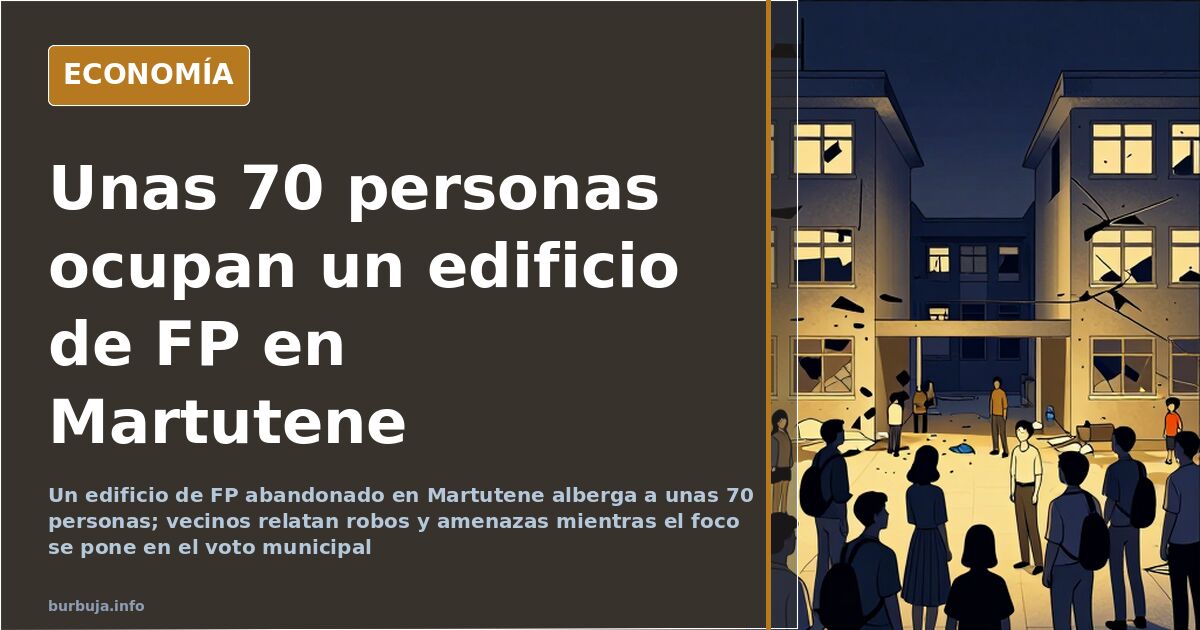
Martutene: 70 People Occupy a Vocational School Building as Neighborhood Tensions Rise
An abandoned Vocational Training (FP) building in Martutene, a neighborhood of San Sebastián, houses approximately 70 people, according to reports trinc information from Onda Vasca. While the high number is notable, it was not the primary trigger for public outrage. The controversy stems from the context: pixelated faces, unspecified origins, and residents reporting robberies, threats, and knife attacks. In Donostia, where critics place municipal majority responsibility on Bildu, PSOE, and Podemos, the issue has turned into a political reckoning ahead of local elections.
What Is Known About the Occupied Building in Martutene
The facts are concise. A disused Vocational Training facility hosts dozens of occupants in a neighborhood that, according to online comments, still contains the old prison, described as active. This suggests a coexistence between a functioning correctional center and an abandoned building filled with people without rental contracts.
The rest is interpretation. The reported information does not specify the occupants' countries of origin. This silence, combined with the pixelation of faces, is immediately interpreted by some as deliberate censorship. This fuels the most heated part of the debate, attributing a specific nationality to the occupants without confirmation from cited sources. It is necessary to distinguish two things: there is a reported conflict regarding community living, and there is an undocumented suspicion about origins.
Residents' Complaints: Robberies, Threats, and Knives
The circulating accounts are severe. Neighborhood residents describe robberies, assaults with bladed weapons, and threats, doing so on camera. These are testimonies, not judicial rulings: they describe what people claim to have experienced. There is no record in the available information of formal complaints, arrests, or court resolutions linked specifically to this building.
This is the core issue. Without official figures, the narrative relies on resident perception, which may be accurate, exaggerated, or both. When the only hard data point is a round number—seventy people—and the rest are anecdotes, the conversation quickly fills with pre-existing biases.
Why Has It Become an Electoral Dispute?
Because arguing about votes is easier than discussing administrative files. The dominant criticism holds that those who vote for certain options have no right to complain about the consequences afterward. The Basque version of this phrase has become the refrain of the affair, complete with translations.
In the end, a gap remains unfilled: what was formally requested and what was the response?
Squatting, Legal Framework, and the Fuenlabrada Precedent
The case most frequently cited as a mirror is that of two owners who, according to information disseminated by a Catalan neighborhood association, recovered their home after the squatters went on vacation. Upon returning, the occupants allegedly reported them for stealing the property, with the complaint being admitted for processing. If confirmed, this account summarizes the sense of helplessness pervading the conversation.
It is prudent to quarantine this episode: it circulates as a screenshot of a post without any known legal resolution. What the debate does highlight is the perceived asymmetry: the owner unable to enter their own house versus the occupant remaining inside.
Language as a Weapon
The discussion has even had its philological chapter. "Enjoy what you voted for" has been translated into Basque in several ways, not all agreeing: gozatu botoaz versus other variants. Some boast C1 level proficiency to correct the formula, while others recall that it was precisely Onda Vasca—a medium described in comments as aligned with the PNV environment—that published the news.
For many, the source itself is the most striking detail. It matters whether the case appears in a critical outlet or one close to those in power. The framework changes: from political denunciation to the realization that the problem exists and is being reported by those least inclined to do so.
With seventy people inside a building with no operational owner and no official figures on the table, the question is no longer who the residents of Martutene voted for. It is how many more months will pass before someone publishes how many complaints exist, how many were resolved, and what will happen to the property.
An abandoned Vocational Training (FP) building in Martutene, a neighborhood of San Sebastián, houses approximately 70 people, according to reports trinc information from Onda Vasca. While the high number is notable, it was not the primary trigger for public outrage. The controversy stems from the context: pixelated faces, unspecified origins, and residents reporting robberies, threats, and knife attacks. In Donostia, where critics place municipal majority responsibility on Bildu, PSOE, and Podemos, the issue has turned into a political reckoning ahead of local elections.
What Is Known About the Occupied Building in Martutene
The facts are concise. A disused Vocational Training facility hosts dozens of occupants in a neighborhood that, according to online comments, still contains the old prison, described as active. This suggests a coexistence between a functioning correctional center and an abandoned building filled with people without rental contracts.
The rest is interpretation. The reported information does not specify the occupants' countries of origin. This silence, combined with the pixelation of faces, is immediately interpreted by some as deliberate censorship. This fuels the most heated part of the debate, attributing a specific nationality to the occupants without confirmation from cited sources. It is necessary to distinguish two things: there is a reported conflict regarding community living, and there is an undocumented suspicion about origins.
Residents' Complaints: Robberies, Threats, and Knives
The circulating accounts are severe. Neighborhood residents describe robberies, assaults with bladed weapons, and threats, doing so on camera. These are testimonies, not judicial rulings: they describe what people claim to have experienced. There is no record in the available information of formal complaints, arrests, or court resolutions linked specifically to this building.
This is the core issue. Without official figures, the narrative relies on resident perception, which may be accurate, exaggerated, or both. When the only hard data point is a round number—seventy people—and the rest are anecdotes, the conversation quickly fills with pre-existing biases.
Why Has It Become an Electoral Dispute?
Because arguing about votes is easier than discussing administrative files. The dominant criticism holds that those who vote for certain options have no right to complain about the consequences afterward. The Basque version of this phrase has become the refrain of the affair, complete with translations.
In the end, a gap remains unfilled: what was formally requested and what was the response?
Squatting, Legal Framework, and the Fuenlabrada Precedent
The case most frequently cited as a mirror is that of two owners who, according to information disseminated by a Catalan neighborhood association, recovered their home after the squatters went on vacation. Upon returning, the occupants allegedly reported them for stealing the property, with the complaint being admitted for processing. If confirmed, this account summarizes the sense of helplessness pervading the conversation.
It is prudent to quarantine this episode: it circulates as a screenshot of a post without any known legal resolution. What the debate does highlight is the perceived asymmetry: the owner unable to enter their own house versus the occupant remaining inside.
Language as a Weapon
The discussion has even had its philological chapter. "Enjoy what you voted for" has been translated into Basque in several ways, not all agreeing: gozatu botoaz versus other variants. Some boast C1 level proficiency to correct the formula, while others recall that it was precisely Onda Vasca—a medium described in comments as aligned with the PNV environment—that published the news.
For many, the source itself is the most striking detail. It matters whether the case appears in a critical outlet or one close to those in power. The framework changes: from political denunciation to the realization that the problem exists and is being reported by those least inclined to do so.
With seventy people inside a building with no operational owner and no official figures on the table, the question is no longer who the residents of Martutene voted for. It is how many more months will pass before someone publishes how many complaints exist, how many were resolved, and what will happen to the property.
Also available in: Deutsch
Summary of a discussion on Burbuja.info - Foro de economía, actualidad y política., translated from Spanish and reviewed before publication. Read the full discussion (163 replies).
More summaries
-
PNV wins Basque election, Bildu falls short, Vox wins one seat
The PNV retains power in the 21A Basque election, while Bildu underperforms forecasts. Vox secures its first seat in the Basque Parliament.
-
Vocational Training Debate: Why the Faculty Issue Matters More Than the Bubble
A user claims IT vocational graduates earn over €30,000, sparking debate on whether vocational training is a bubble and who actually teaches.
-
El Jueves targets corruption with a lineup of the usual suspects
El Jueves publishes a corruption-themed cover with eleven figures: mostly PP and two from PSOE. Criticism over imbalance and omissions.
-
Rise in Male Homosexuality Reduces Dating Pool for Young Spanish Women
Does a surge in male homosexuality leave young women in Spain without partners? An analysis of a debate blending math, stereotypes, and social anxiety.
-
Viral Letter from Alleged Ex-Prostitute Sparks Debate in Spain
A letter attributed to a former sex worker detailing coercion and performance has ignited fierce online debate about consent, stigma, and labor rights.
-
Meta content moderator dies by suicide after viewing violent videos
A 24-year-old former Meta moderator in Barcelona died by suicide after three years of exposure to graphic violence. Her family is considering legal action against Meta and Telus.