
Martina García, Spanish Podemos Leader, Dies at 25
Martina García Anguita, Podemos official and former councilor in Marchamalo, Spain, dies aged 25. She was among the youngest elected officials.
English · Original discussion in Spanish · Published
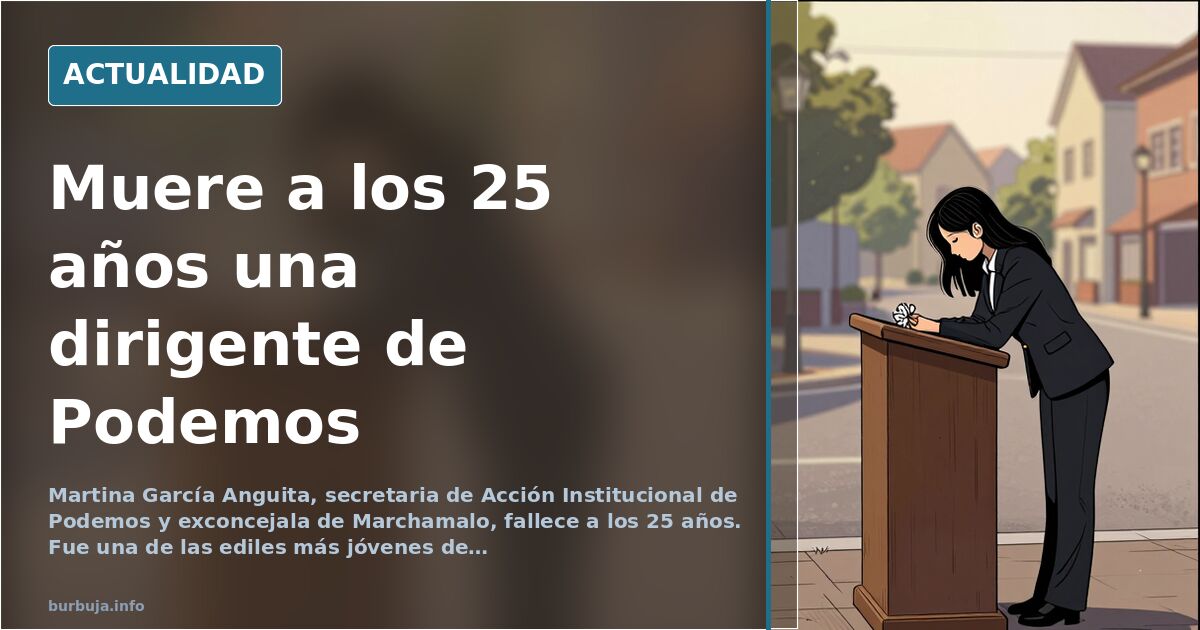
Martina García, Spanish Podemos Leader, Dies at 25
Martina García Anguita, Secretary of Institutional Action for the Spanish party Podemos and former councilor for Marchamalo (Guadalajara), has died at age 25. The party confirmed her passing in a press release, with colleagues describing her as "a kind person with an enormous desire to live and fight." In 2019, at just 19 years old, she became one of the youngest councilors in Spain's history.
The announcement highlighted that she was a law student, spokesperson for the Youth Area of Podemos Castilla-La Mancha, and head of its Feminist Movement Working Group until 2024. At the regional citizens' assembly concluded on December 15, she was elected citizen councilor with the fifth-highest support in the community. Two roles, two stages, and a political career that began before high school ended.
What is known about Martina García Anguita's death
Podemos's official statement does not specify the cause. This lack of detail has fueled much of the subsequent discussion: the absence of an explicit diagnosis in the communiqué has left room for various hypotheses, ranging from serious illness to theories about adverse reactions to treatments. None of these hypotheses have been officially confirmed by available sources.
What is documented is the deceased's profile: 25 years old, graduating in Law, holding internal party responsibilities since adolescence. Regional coordinator José Luis García Gascón and General Secretary Ione Bellara expressed their condolences, stating that "her example inspires us, and we will keep her memory immortal."
A political career that started at 19
García Anguita's trajectory is statistically anomalous. Councilor at 19, area spokesperson at 20, and citizen councilor at 25. In Spain, where the average age of local elected officials exceeds 45, her case places her in the small club of teenage councilors, a group so rare it can be counted on one hand per legislative term.
This fact, far from generating unanimous admiration, has triggered much of the controversy. Some view it as merit, while others interpret it as a symptom of a quota system that prioritizes youth over experience. The debate is not new: every time a party places a twenty-something on a list, the same arguments resurface.
The debate on causes and unsupported theories
In the margins of the news, a repertoire of explanations has circulated, ranging from plausible to conspiratorial. Speculation has included prior serious illnesses, work stress, accidents, and adverse effects of treatments. It is important to clarify: none of these versions are confirmed by official sources or the family, and several circulate based solely on rumor.
This phenomenon is not unique to this case. The death of a young public figure always activates two reflexes: the search for a single cause and the temptation to turn grief into political argument. Both occurred here, notably so.
Double standards criticized on social media
Part of the public commentary has pointed out the asymmetry between how deaths of allied political figures are treated versus those of opponents. Incidents of celebration or mockery upon the deaths of people from opposing sides are cited, criticizing the demand for respect now when it wasn't practiced then. This accusation is recurrent across the political spectrum and difficult to quantify.
Another, more pragmatic current argues that the deceased's age should close the debate before it opens. No one, they argue, deserves to die at 25, regardless of their political affiliation. This position has gained weight as the issue cools down.
What happens next with her seat and role
The death of an elected official automatically triggers a substitution procedure. For a councilor, the vacancy is filled by the next candidate on the list according to the 2019 results, unless they explicitly decline. For the internal party role—citizen councilor—it falls to the party's internal bodies to decide on coverage.
Podemos has not detailed specific steps in its communiqué. However, it has emphasized García Anguita's importance in the regional structure and her role in feminist and youth areas, two spaces where the party has concentrated its renewal strategy.
The case leaves an uncomfortable statistic: 25 years old, three roles, and a career cut short before it truly began. It also leaves a question unanswered by documents: why did the official statement avoid naming the cause? That is where analysis stalls, and remains.
Martina García Anguita, Secretary of Institutional Action for the Spanish party Podemos and former councilor for Marchamalo (Guadalajara), has died at age 25. The party confirmed her passing in a press release, with colleagues describing her as "a kind person with an enormous desire to live and fight." In 2019, at just 19 years old, she became one of the youngest councilors in Spain's history.
The announcement highlighted that she was a law student, spokesperson for the Youth Area of Podemos Castilla-La Mancha, and head of its Feminist Movement Working Group until 2024. At the regional citizens' assembly concluded on December 15, she was elected citizen councilor with the fifth-highest support in the community. Two roles, two stages, and a political career that began before high school ended.
What is known about Martina García Anguita's death
Podemos's official statement does not specify the cause. This lack of detail has fueled much of the subsequent discussion: the absence of an explicit diagnosis in the communiqué has left room for various hypotheses, ranging from serious illness to theories about adverse reactions to treatments. None of these hypotheses have been officially confirmed by available sources.
What is documented is the deceased's profile: 25 years old, graduating in Law, holding internal party responsibilities since adolescence. Regional coordinator José Luis García Gascón and General Secretary Ione Bellara expressed their condolences, stating that "her example inspires us, and we will keep her memory immortal."
A political career that started at 19
García Anguita's trajectory is statistically anomalous. Councilor at 19, area spokesperson at 20, and citizen councilor at 25. In Spain, where the average age of local elected officials exceeds 45, her case places her in the small club of teenage councilors, a group so rare it can be counted on one hand per legislative term.
This fact, far from generating unanimous admiration, has triggered much of the controversy. Some view it as merit, while others interpret it as a symptom of a quota system that prioritizes youth over experience. The debate is not new: every time a party places a twenty-something on a list, the same arguments resurface.
The debate on causes and unsupported theories
In the margins of the news, a repertoire of explanations has circulated, ranging from plausible to conspiratorial. Speculation has included prior serious illnesses, work stress, accidents, and adverse effects of treatments. It is important to clarify: none of these versions are confirmed by official sources or the family, and several circulate based solely on rumor.
This phenomenon is not unique to this case. The death of a young public figure always activates two reflexes: the search for a single cause and the temptation to turn grief into political argument. Both occurred here, notably so.
Double standards criticized on social media
Part of the public commentary has pointed out the asymmetry between how deaths of allied political figures are treated versus those of opponents. Incidents of celebration or mockery upon the deaths of people from opposing sides are cited, criticizing the demand for respect now when it wasn't practiced then. This accusation is recurrent across the political spectrum and difficult to quantify.
Another, more pragmatic current argues that the deceased's age should close the debate before it opens. No one, they argue, deserves to die at 25, regardless of their political affiliation. This position has gained weight as the issue cools down.
What happens next with her seat and role
The death of an elected official automatically triggers a substitution procedure. For a councilor, the vacancy is filled by the next candidate on the list according to the 2019 results, unless they explicitly decline. For the internal party role—citizen councilor—it falls to the party's internal bodies to decide on coverage.
Podemos has not detailed specific steps in its communiqué. However, it has emphasized García Anguita's importance in the regional structure and her role in feminist and youth areas, two spaces where the party has concentrated its renewal strategy.
The case leaves an uncomfortable statistic: 25 years old, three roles, and a career cut short before it truly began. It also leaves a question unanswered by documents: why did the official statement avoid naming the cause? That is where analysis stalls, and remains.
Summary of a discussion on Burbuja.info - Foro de economía, actualidad y política., translated from Spanish and reviewed before publication. Read the full discussion (184 replies).
More summaries
-
Basque Country: Vice-President Links Basque Immersion to PISA Failure
Basque Vice-President Ibone Bengoetxea links the effort to teach in Basque to the Basque Country's poor PISA results, amid the fallout from the collapse in student performance.
-
Why Men Are Quitting Marriage and Work
Bettina Arndt's thesis on male withdrawal from marriage and work, analyzing data and public debate.
-
Spain's 2026 anti-smoking law could ban balcony smoking
Spain's new 2026 anti-smoking law, combined with horizontal property regulations, allows neighbors to report those who smoke on their balconies.
-
Ceuta: Unconfirmed Police Shooting Claims Fuel Migration Tensions
Unverified allegations of UIP police firing in Ceuta reignite migration debates and social unrest in the Spanish autonomous city.
-
Mariló Montero Marries African Partner in Namibia
Mariló Montero confirms her marriage to an African man met in Namibia, sparking debate on the union's impact.
-
Racial Integration Debate Remains Polarized
Analysis of polarization in racial integration discourse and social dynamics.