
Market Garden: 82 years after a failure that wasn't bad luck
34,000 men, 103 kilometers on one road, 48 hours: 82 years after the Market Garden failure and the unresolved search for accountability.
English · Original discussion in Spanish · Published
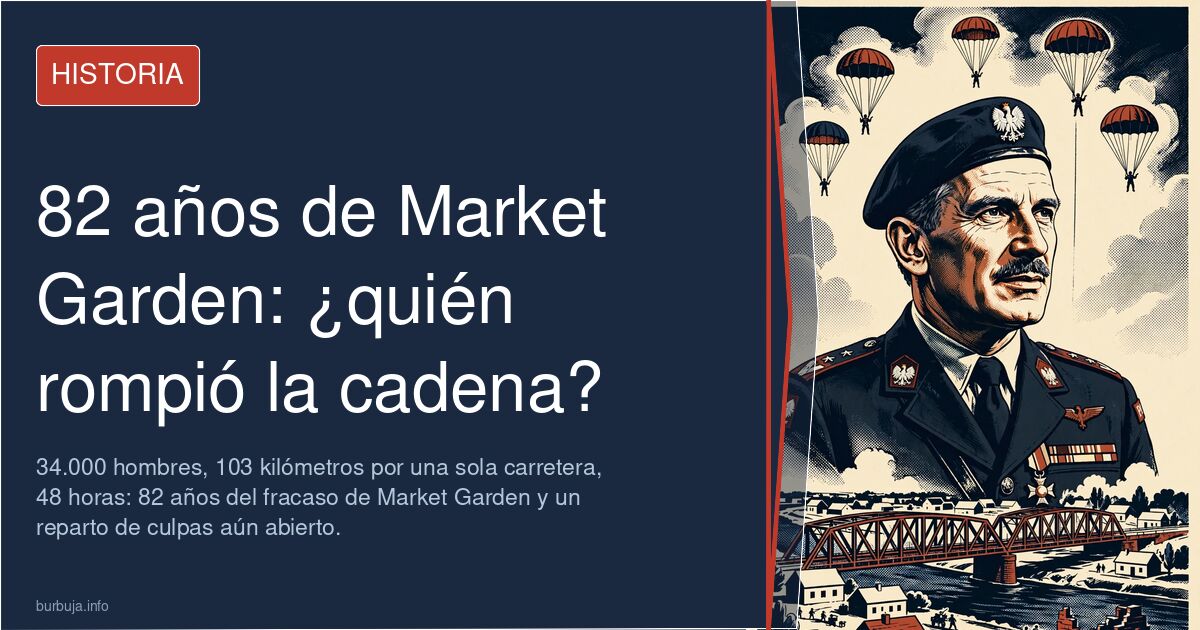
Market Garden: 34,000 men, one road, and 48 impossible hours
The 82nd anniversary of the airborne assault on the Netherlands has peine a discussion that has gone without closure for eight decades. On September 17, 1944, 34,000 men parachuted into the Netherlands with the promise of ending the war before Christmas. Nine days later, survivors crossed the Rhine by swimming, returning in darkness.
And no, it wasn't bad luck. Market Garden failed because its plan was a chain, and a chain either works entirely or it doesn't: it allows no partial successes.
Why Did Operation Market Garden Fail?
The design was of an almost insulting ambition. Three airborne divisions stretched along a single axis, all bridges between Eindhoven and Arnhem in Allied hands, and an armoured body traversing 103 kilometers on that same road in 48 hours to reach the final bridge into Germany. A single axis, a single timeline, zero margin for error.
The terrain compounded the issue. The road was elevated over a wet polder, with soft ground on either side: tanks could not deploy or fight off the asphalt.
To this were added radio failures, the blown bridge at Son, and landing zones situated miles from their objectives. Half of the Urquhart division was unavailable on day one because it had to secure landing zones for the second wave.
The Nijmegen Bridge and the Accusation Against General Gavin
Some maintain that the only objective of day one that was not met was taking the Nijmegen bridge, and that the failure was not due to German resistance but because General James Gavin refused to advance on it, citing a Panzer division on the flank—a detail no one has ever successfully documented.
According to this view, the Germans gained the necessary time to reinforce it, and when XXX Corps arrived at Nijmegen on the 19th, the bridge was still in German hands.
Conversely, there is a difficult argument: the Urquhart division also did not achieve all its objectives in time. Frost's battalion took the northern end of the Arnhem bridge on the 17th and held it until the 21st, with a force that the debate qualifies as insufficient and unsupported. One participant adds that this was more than what Gavin's division achieved.
The Polish Scapegoat and the Division of Blame
The chain of command helps to understand how the post-war narrative became distorted. In the airborne component, Eisenhower was above Lewis Brereton, and he was above Frederick Browning, second in command of the operation. On the ground, Montgomery and Dempsey were outside that line.
Yet, almost all responsibility ultimately fell upon Montgomery and Browning.
The clearest example is that of General Stanisław Sosabowski, who predicted the operation's failure and was ultimately blamed for it. According to accounts in the debate, Browning instigated this version and never retracted it: he fell out of favour, was transferred to a secondary post, and retired without writing memoirs or giving interviews. The Americans subsequently corrected this, shifting the blame to Montgomery and Browning while absolving themselves of responsibility.
The fidelity of the cinematic account, by the way, has an explanation: Attenborough's film adapted Cornelius Ryan’s 1974 book, which was compiled from hundreds of interviews with veterans, several of whom—Frost, Urquhart, Horrocks—were consulted during filming. The skeleton was real. The assignment of blame, not so much.
Eighty-two years later, the official story still has a hole the size of a bridge. If no one documents that alleged Panzer division on Gavin's flank, we will continue to recount the battle incompletely. And every anniversary will once again poke at the sore spot.
The 82nd anniversary of the airborne assault on the Netherlands has peine a discussion that has gone without closure for eight decades. On September 17, 1944, 34,000 men parachuted into the Netherlands with the promise of ending the war before Christmas. Nine days later, survivors crossed the Rhine by swimming, returning in darkness.
And no, it wasn't bad luck. Market Garden failed because its plan was a chain, and a chain either works entirely or it doesn't: it allows no partial successes.
Why Did Operation Market Garden Fail?
The design was of an almost insulting ambition. Three airborne divisions stretched along a single axis, all bridges between Eindhoven and Arnhem in Allied hands, and an armoured body traversing 103 kilometers on that same road in 48 hours to reach the final bridge into Germany. A single axis, a single timeline, zero margin for error.
The terrain compounded the issue. The road was elevated over a wet polder, with soft ground on either side: tanks could not deploy or fight off the asphalt.
To this were added radio failures, the blown bridge at Son, and landing zones situated miles from their objectives. Half of the Urquhart division was unavailable on day one because it had to secure landing zones for the second wave.
The Nijmegen Bridge and the Accusation Against General Gavin
Some maintain that the only objective of day one that was not met was taking the Nijmegen bridge, and that the failure was not due to German resistance but because General James Gavin refused to advance on it, citing a Panzer division on the flank—a detail no one has ever successfully documented.
According to this view, the Germans gained the necessary time to reinforce it, and when XXX Corps arrived at Nijmegen on the 19th, the bridge was still in German hands.
Conversely, there is a difficult argument: the Urquhart division also did not achieve all its objectives in time. Frost's battalion took the northern end of the Arnhem bridge on the 17th and held it until the 21st, with a force that the debate qualifies as insufficient and unsupported. One participant adds that this was more than what Gavin's division achieved.
The Polish Scapegoat and the Division of Blame
The chain of command helps to understand how the post-war narrative became distorted. In the airborne component, Eisenhower was above Lewis Brereton, and he was above Frederick Browning, second in command of the operation. On the ground, Montgomery and Dempsey were outside that line.
Yet, almost all responsibility ultimately fell upon Montgomery and Browning.
The clearest example is that of General Stanisław Sosabowski, who predicted the operation's failure and was ultimately blamed for it. According to accounts in the debate, Browning instigated this version and never retracted it: he fell out of favour, was transferred to a secondary post, and retired without writing memoirs or giving interviews. The Americans subsequently corrected this, shifting the blame to Montgomery and Browning while absolving themselves of responsibility.
The fidelity of the cinematic account, by the way, has an explanation: Attenborough's film adapted Cornelius Ryan’s 1974 book, which was compiled from hundreds of interviews with veterans, several of whom—Frost, Urquhart, Horrocks—were consulted during filming. The skeleton was real. The assignment of blame, not so much.
Eighty-two years later, the official story still has a hole the size of a bridge. If no one documents that alleged Panzer division on Gavin's flank, we will continue to recount the battle incompletely. And every anniversary will once again poke at the sore spot.
Summary of a discussion on Burbuja.info - Foro de economía, actualidad y política., translated from Spanish and reviewed before publication. Read the full discussion (25 replies).
More summaries
-
Reform the calendar so seasons start on the 1st
A calendar reform would make each season begin on the 1st of its month: a 32-day August and the year anchored to January 1, not the perihelion.
-
When did Europe's national football teams start to get more diverse?
France fielded a Black player as early as 1938 and Portugal four in 1966. The timeline of diversity in European national football teams and its causes.
-
Why Spain was not an economic engine after World War II
Spanish GDP grew 5,3% between 1939 and 1944 and only 0,14% between 1945 and 1950: neutrality in World War II was not enough to lead Europe
-
Why Spain never had an industrial bourgeoisie—but did have a rentier caste
Hispano-Suiza, the 1986 EEC and the rentier-caste thesis: why Spain never became an industrial power despite its technical talent
-
Mussolini declared war as France was already collapsing
On 10 June 1940, Italy declared war on France and the UK with a three-paragraph note. Greece, Africa and Gibraltar changed the plan.
-
OVERCOMING SEXUAL SINS ~ THE REQUIRED SPIRITUAL TOOLS (Father Spyridon)
The spiritual path to conquering carnal passions, from humility to perseverance. Discover the teachings of the Church Fathers.