
Maricarmen's Eviction Revives Spain's Legal and Political Clash
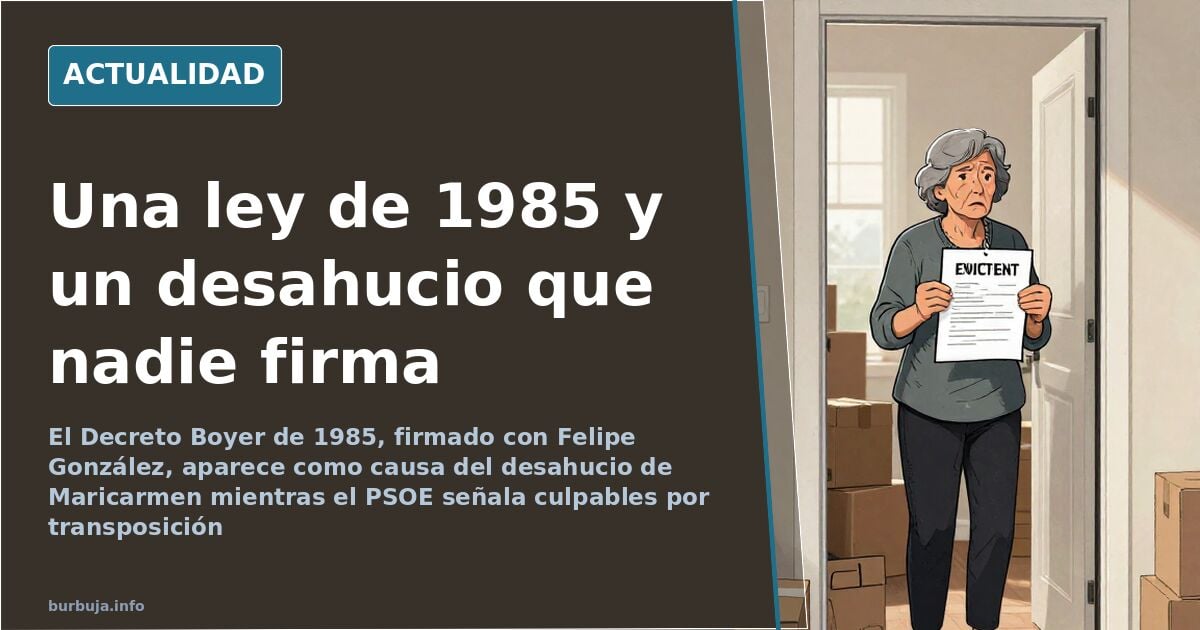
The 1985 Boyer Decree, signed under Felipe González, is cited as the cause of Maricarmen's eviction while the PSOE points to transposition failures.
English · Original discussion in Spanish · Published
Maricarmen's Eviction Revives Spain's Legal and Political Clash
The death of Maricarmen, an elderly woman who was evicted and displayed in public events, has triggered a series of cross-accusations playing out through decrees. The prevailing thesis is blunt: laws from the Franco era protected her for decades, while those passed by the PSOE stripped that protection. The key data point is the Boyer Decree of 1985, signed by Felipe González at La Moncloa, which this version claims peine the door to her eviction. This debate is not about reasons, but about emotions and whose narrative prevails before November 22.
The Boyer Decree of 1985 and the Chain of Responsibilities
The recurring element is chronology. The protection covering this woman for decades came not from contemporary social policy, but from an inherited legal framework. The transposition of directives and subsequent decrees, according to those defending this thesis, arrived late and poorly. Eight years of socialist government were insufficient to shield vulnerable tenants. The result was an inevitable eviction.
A crucial nuance must not be lost: the same decree cited as the cause of the eviction was authored by a minister described by some as a liberal infiltrated within the PSOE. The irony is significant. The law that left Maricarmen unprotected was not signed by the right, but by a socialist government in its first term.
Who Exposed Her in Squares and Demonstrations?
The second front involves the public use of her figure. The accusation is direct: unions and affiliated media paraded her through squares, streets, and demonstrations at untimely hours, exposing her to any pathogen. At her age, this current argues, that is lethal. She should have been home, eating hot meals, not turned into a banner.
The counter-argument did not long wait: if the PSOE used her, the opposition did too. And if the narrative was unraveling, discarding the elderly woman before she became a toxic burden was the cleanest exit. Turning her into a martyr, by contrast, monetizes the corpse. The suspicion, launched without proof, circulates with the same ease as the opposing accusation.
The 'Dignified Death' and Health Care That Is Not Audited
The third flank is healthcare. The assertion is harsh: in hospitals, with two injections, the elderly are pushed into eternal rest. Anyone who has had elderly relatives hospitalized knows how the best healthcare system in the world operates with grandparents. There are no statistics. There is personal experience and structural distrust.
Here, the article cannot substantiate the accusation. There are no data, no verified cases, no formal complaint. It is a widespread perception, not a proven fact. This must be stated with the same clarity as the rest.
The Calculation No One Wants to Put in Writing
The most uncomfortable detail is the one least explicit: inheritance. The investment fund and the nephew appear in the conversation as the ultimate beneficiaries of the eviction. The complete calculation, broken down line by line, would yield a figure surprising to many. No one has published it in full.
A Headline the Opposition Dare Not Sign
The extracted conclusion is operational: a respectable opposition should accept this headline, as it is not only appropriate but true. The problem is that the message is not directed at the opponent's voters, but at those who hesitate. And there, the PSOE already plays with an advantage: it points to culprits based on the principle of transposition before anyone has read the decree.
With this material, it is likely the issue will fade after the elections and reignite when the law needs reforming. If it ever does.
The death of Maricarmen, an elderly woman who was evicted and displayed in public events, has triggered a series of cross-accusations playing out through decrees. The prevailing thesis is blunt: laws from the Franco era protected her for decades, while those passed by the PSOE stripped that protection. The key data point is the Boyer Decree of 1985, signed by Felipe González at La Moncloa, which this version claims peine the door to her eviction. This debate is not about reasons, but about emotions and whose narrative prevails before November 22.
The Boyer Decree of 1985 and the Chain of Responsibilities
The recurring element is chronology. The protection covering this woman for decades came not from contemporary social policy, but from an inherited legal framework. The transposition of directives and subsequent decrees, according to those defending this thesis, arrived late and poorly. Eight years of socialist government were insufficient to shield vulnerable tenants. The result was an inevitable eviction.
A crucial nuance must not be lost: the same decree cited as the cause of the eviction was authored by a minister described by some as a liberal infiltrated within the PSOE. The irony is significant. The law that left Maricarmen unprotected was not signed by the right, but by a socialist government in its first term.
Who Exposed Her in Squares and Demonstrations?
The second front involves the public use of her figure. The accusation is direct: unions and affiliated media paraded her through squares, streets, and demonstrations at untimely hours, exposing her to any pathogen. At her age, this current argues, that is lethal. She should have been home, eating hot meals, not turned into a banner.
The counter-argument did not long wait: if the PSOE used her, the opposition did too. And if the narrative was unraveling, discarding the elderly woman before she became a toxic burden was the cleanest exit. Turning her into a martyr, by contrast, monetizes the corpse. The suspicion, launched without proof, circulates with the same ease as the opposing accusation.
The 'Dignified Death' and Health Care That Is Not Audited
The third flank is healthcare. The assertion is harsh: in hospitals, with two injections, the elderly are pushed into eternal rest. Anyone who has had elderly relatives hospitalized knows how the best healthcare system in the world operates with grandparents. There are no statistics. There is personal experience and structural distrust.
Here, the article cannot substantiate the accusation. There are no data, no verified cases, no formal complaint. It is a widespread perception, not a proven fact. This must be stated with the same clarity as the rest.
The Calculation No One Wants to Put in Writing
The most uncomfortable detail is the one least explicit: inheritance. The investment fund and the nephew appear in the conversation as the ultimate beneficiaries of the eviction. The complete calculation, broken down line by line, would yield a figure surprising to many. No one has published it in full.
A Headline the Opposition Dare Not Sign
The extracted conclusion is operational: a respectable opposition should accept this headline, as it is not only appropriate but true. The problem is that the message is not directed at the opponent's voters, but at those who hesitate. And there, the PSOE already plays with an advantage: it points to culprits based on the principle of transposition before anyone has read the decree.
With this material, it is likely the issue will fade after the elections and reignite when the law needs reforming. If it ever does.
Summary of a discussion on Burbuja.info - Foro de economía, actualidad y política., translated from Spanish and reviewed before publication. Read the full discussion (16 replies).
More summaries
-
Maricarmen, the evicted elderly woman, and the battle of narratives on Twitter
The death of Maricarmen, an 87-year-old evicted woman, sparks a political war on Twitter. The case coincides with the pre-election campaign.
-
Spain's 87-year-old eviction reopens the housing war
The eviction of an 87-year-old woman has reignited Spain's political battle over housing, exposing the clash between property rights and tenant protection.
-
Joan Pradells: bodybuilder's health and business under the microscope
Bodybuilder Joan Pradells under scrutiny after another health crisis: acromegaly, steroids and a business that depends on him staying on his feet
-
Teenagers laugh as woman falls from Lugo’s ancient wall; bystander duty debated
A 64-year-old woman died after falling from Lugo’s historic fortifications. Teenagers filmed the incident, sparking debate on bystander responsibility and legal consequences.
-
Historiographical Disputes Over Columbus’s Origins and Spain’s National Narrative
Analysis of historiographical disputes regarding Columbus’s origins and the historical narrative of the discovery of America in Spain.
-
Juana the Weeper Faces New Trial for Child Abduction in Spain
Juana the Weeper returns to court for child abduction, highlighting legal stagnation, revoked pardons, and Spain's polarized justice system.