
María de Mora, Madame: Dies the Intermediary of Discreet Luxury
María de Mora, a Madrid-based discreet luxury madame, has died, reigniting debate on intermediation, exclusive venues, and the role of luxury hotels in this sector.
English · Original discussion in Spanish · Published
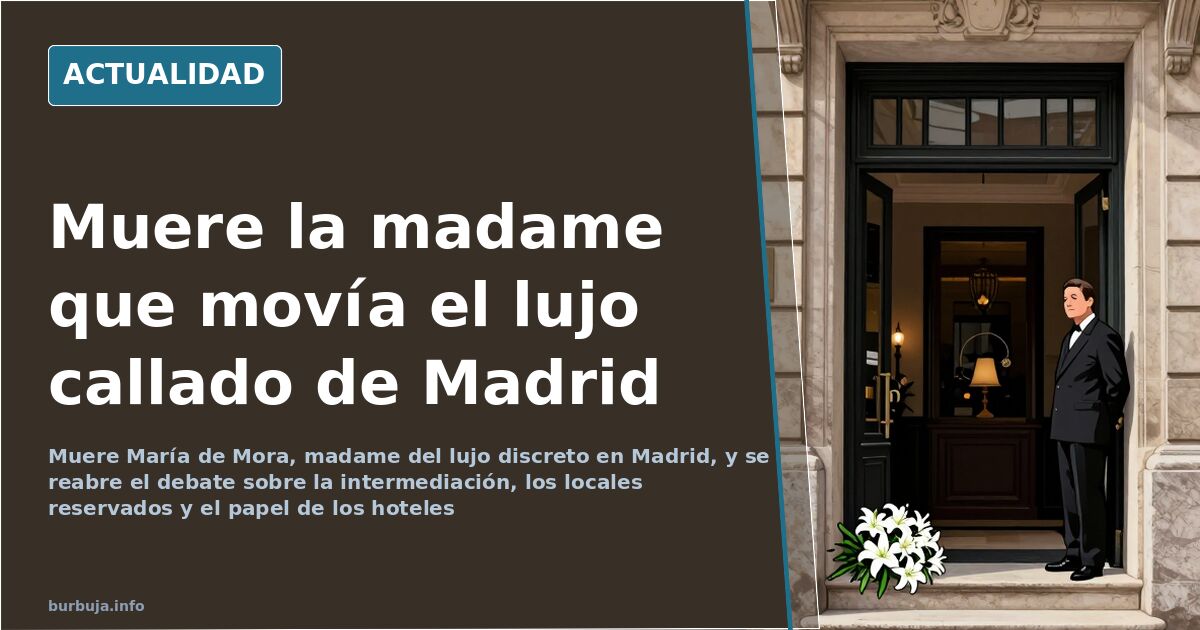
María de Sarracena, the madame of Madrid's discreet business, has died
María de Sarracena has died. The news circulates without an obituary, press release, or official confirmation, mirroring the secrecy surrounding her alleged role as a madame in Madrid's high-end companionship circuit. Her name appears in no public registry, yet it is whispered in conversations among Madrid's elite—those frequenting private rooms, luxury hotels, and influential circles. Her death has peine an uncomfortable question for the sector: what is the role of an intermediary today, when any professional can maintain their own profile?
What exactly did a madame do?
The figure of the madame—or the agency, which serves the same function under a different name—did not sell contact. Anyone can do that today. They sold the filter: separating solvent clients from curious onlookers, setting prices, and ensuring the encounter did not end in police involvement or scandal. A saying attributed to Chicago gangsters is often repeated: clients are paid not for the service, but for the subsequent silence. It is a simplification, but it explains why this business survives in the shadows rather than in the spotlight.
In this scheme, discretion is the product, not the encounter. Those who pay dearly do not buy companionship; they buy the assurance that their name will not appear anywhere afterwards. Hence, intermediation has always relied on spaces designed to leave no trace.
From La Poupée to El Amante: Venues That Set the Standard
The geography of this business in Madrid has proper names. La Poupée, founded according to the most repeated version by three waiters from the now-defunct Pinarello, presented itself as the capital's first topless bar. Mayte Zaldívar passed through there in her youth, where Julián Muñoz met her as a client. The anecdote is worth more than any statistic: the venue where power met and the venue where a political scandal later erupted were, fundamentally, the same type of place.
In the Palacio neighborhood, Calle Oriente functioned almost like a dead end, and in its apartments—according to repeating accounts—the Family Book, the document hotels used to register couples, was not requested. A bureaucratic detail that summarizes the entire logic of the place. The basements of Calle Órense, now Capitán Haya, or what was the street prostitution zone around those blocks, complete a map that almost no one recognizes today.
Luxury Hotels as Guarantors of Anonymity
The Villamagna appears in several circulating versions. The reason is architectural: an inner courtyard and glass elevators. The client enters, is seen going up, and if someone asks the next day, the perfect excuse always exists: "we coincided in the hallway." There is no record of with whom, only that they were there. That is the whole point.
Small five-star hotels served the same function without the storefront. Here it is important to be clear: beneath the narrative of luxury lies a less bright reality, that of a business sustained by workers without contracts, collective agreements, or protection. The death of one of the figures organizing it reveals, above all, the fragility of a sector that answers to no one.
Are Intermediaries Obsolete in the Instagram Era?
The underlying debate is economic. With Instagram and adult content platforms, direct contact between client and professional is trivial: a "like," a private message, and on to the next thing. From that logic, the intermediary is an unnecessary cost, a toll justified only by the filter and security. And here lies the sustancia ilegal: without someone to set prices, screen clients, and respond if something goes wrong, the business becomes cheaper but also more exposed.
Those who defend the continued necessity of intermediaries appeal to security; those who argue otherwise believe the market self-regulates through social networks. Both can be true simultaneously. The fine calculation—who retains how much from each encounter, and how much the commission weighs against the risk—is what is never published, because no one audits it.
The Narrative That Always Protected the Client
There is a pattern that repeats every time this thread is pulled. The case of Sandra Mozarowski, who died in the 1970s under circumstances never fully clarified, returned to the news in the mid-2000s with publications linking her to certain circles. It never gained traction. Further back, in the early 20th century, the so-called vampire of Raval ran a brothel frequented by the Catalan aristocracy, and upon her arrest, she was attributed a list of illustrious clients that would have been conveniently archived.
The mechanism is identical: first, legend points to a famous person, then the clarification appears. In the case of actor Paco Martínez Soria, it has been maintained that who managed certain venues was a relative of his, not he himself—a man who invested in real estate and guarded his money. That, too, has not been proven. The provisional conclusion is always the same: the client's name is protected more and better than that of the person who served them.
The death of María de Sarracena leaves a list of unanswered questions that do not close. There are no public heirs to the business, no accounting trail, and no explanation that fits entirely. When a trade lives by leaving no trace, even its end is written without papers.
María de Sarracena has died. The news circulates without an obituary, press release, or official confirmation, mirroring the secrecy surrounding her alleged role as a madame in Madrid's high-end companionship circuit. Her name appears in no public registry, yet it is whispered in conversations among Madrid's elite—those frequenting private rooms, luxury hotels, and influential circles. Her death has peine an uncomfortable question for the sector: what is the role of an intermediary today, when any professional can maintain their own profile?
What exactly did a madame do?
The figure of the madame—or the agency, which serves the same function under a different name—did not sell contact. Anyone can do that today. They sold the filter: separating solvent clients from curious onlookers, setting prices, and ensuring the encounter did not end in police involvement or scandal. A saying attributed to Chicago gangsters is often repeated: clients are paid not for the service, but for the subsequent silence. It is a simplification, but it explains why this business survives in the shadows rather than in the spotlight.
In this scheme, discretion is the product, not the encounter. Those who pay dearly do not buy companionship; they buy the assurance that their name will not appear anywhere afterwards. Hence, intermediation has always relied on spaces designed to leave no trace.
From La Poupée to El Amante: Venues That Set the Standard
The geography of this business in Madrid has proper names. La Poupée, founded according to the most repeated version by three waiters from the now-defunct Pinarello, presented itself as the capital's first topless bar. Mayte Zaldívar passed through there in her youth, where Julián Muñoz met her as a client. The anecdote is worth more than any statistic: the venue where power met and the venue where a political scandal later erupted were, fundamentally, the same type of place.
In the Palacio neighborhood, Calle Oriente functioned almost like a dead end, and in its apartments—according to repeating accounts—the Family Book, the document hotels used to register couples, was not requested. A bureaucratic detail that summarizes the entire logic of the place. The basements of Calle Órense, now Capitán Haya, or what was the street prostitution zone around those blocks, complete a map that almost no one recognizes today.
Luxury Hotels as Guarantors of Anonymity
The Villamagna appears in several circulating versions. The reason is architectural: an inner courtyard and glass elevators. The client enters, is seen going up, and if someone asks the next day, the perfect excuse always exists: "we coincided in the hallway." There is no record of with whom, only that they were there. That is the whole point.
Small five-star hotels served the same function without the storefront. Here it is important to be clear: beneath the narrative of luxury lies a less bright reality, that of a business sustained by workers without contracts, collective agreements, or protection. The death of one of the figures organizing it reveals, above all, the fragility of a sector that answers to no one.
Are Intermediaries Obsolete in the Instagram Era?
The underlying debate is economic. With Instagram and adult content platforms, direct contact between client and professional is trivial: a "like," a private message, and on to the next thing. From that logic, the intermediary is an unnecessary cost, a toll justified only by the filter and security. And here lies the sustancia ilegal: without someone to set prices, screen clients, and respond if something goes wrong, the business becomes cheaper but also more exposed.
Those who defend the continued necessity of intermediaries appeal to security; those who argue otherwise believe the market self-regulates through social networks. Both can be true simultaneously. The fine calculation—who retains how much from each encounter, and how much the commission weighs against the risk—is what is never published, because no one audits it.
The Narrative That Always Protected the Client
There is a pattern that repeats every time this thread is pulled. The case of Sandra Mozarowski, who died in the 1970s under circumstances never fully clarified, returned to the news in the mid-2000s with publications linking her to certain circles. It never gained traction. Further back, in the early 20th century, the so-called vampire of Raval ran a brothel frequented by the Catalan aristocracy, and upon her arrest, she was attributed a list of illustrious clients that would have been conveniently archived.
The mechanism is identical: first, legend points to a famous person, then the clarification appears. In the case of actor Paco Martínez Soria, it has been maintained that who managed certain venues was a relative of his, not he himself—a man who invested in real estate and guarded his money. That, too, has not been proven. The provisional conclusion is always the same: the client's name is protected more and better than that of the person who served them.
The death of María de Sarracena leaves a list of unanswered questions that do not close. There are no public heirs to the business, no accounting trail, and no explanation that fits entirely. When a trade lives by leaving no trace, even its end is written without papers.
Summary of a discussion on Burbuja.info - Foro de economía, actualidad y política., translated from Spanish and reviewed before publication. Read the full discussion (291 replies).
More summaries
-
Elite technician ruined by ex-lover's complaint
A professional with 30+ years' experience, devastated by a harassment complaint without trial or sentence. The media trial has delivered its verdict.
-
Radio Maria and the Holy Rosary
Radio Maria promotes devotion to the Holy Rosary, offering guidance for daily prayer on air and online. Discover its power.
-
Tent Collecting Food for Ceuta Ends Up Eating It
Food and money collected for Ceuta migrants were consumed by organizers. The destination of the funds remains unknown.
-
Child's death and hospitalization after dental sedation in Alzira, Spain
A girl died and another was hospitalized after dental sedation in Alzira, Spain. Investigations reveal arrests linked to anesthesia theft.
-
Why Adult Friendships Fade and Social Isolation Grows
Analysis of why adult friendships erode and why many choose social isolation, exploring the fragility of human bonds and the rise of self-imposed distance.
-
Pedro Sánchez's health sparks political debate
Analysis of rumors about Pedro Sánchez's health: physical decline, cancellations, and the politicization of illness.