
Man sentenced to two years and two months for breaking into a Mercedes in Spain
A Spanish court sentences a 24-year-old to two years and two months for stealing from a Mercedes in Benetússer, near Valencia, and orders him to pay the owner 530 euros for his injured knuckles.
English · Original discussion in Spanish · Published
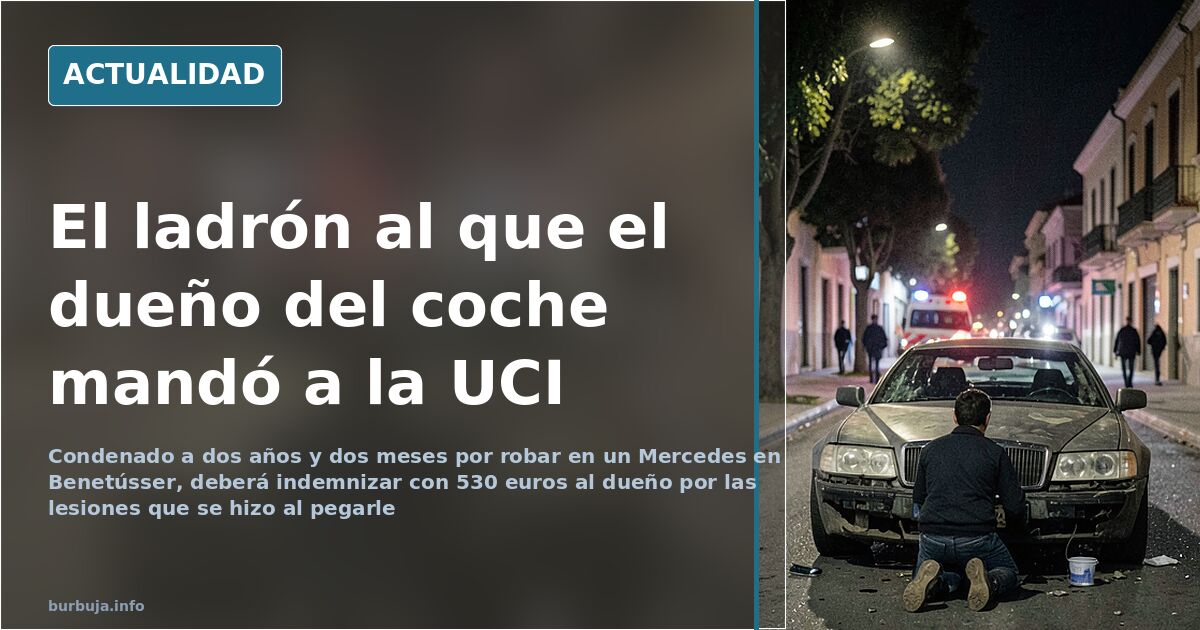
Two years in prison for a robbery that ended in intensive care
A court in Valencia has sentenced a 24-year-old man to two years and two months in prison for attempting to steal from inside a Mercedes in Benetússer on 17 March 2026. So far, just another case for the 18th Incivil Section of the Court of First Instance of Valencia. The striking part comes next: the car's owner, who caught the thieves in the act and ended up beating one of them so badly that he spent three days in the intensive care unit of Hospital Doctor Peset, will receive 530 euros from the convicted man for the injuries he himself sustained in his knuckles while hitting him.
The ruling, the result of a plea agreement, reduces the initial request of three years and three months and replaces the prison sentence with expulsion from Spanish territory and a five-year entry ban. The convicted man must also pay a 180-euro fine for a minor assault offence, arising from the blow with a motorcycle helmet delivered to the owner by his unidentified accomplice.
What peine on Calle Almirante Císcar
The proven facts place two individuals breaking the rear left window of a Mercedes A-Class 200 at 9:30 in the morning. They took a bum bag containing documents, keys and cash. The owner was leaving a gym and caught them with the belongings. From there, the prosecution's version and the defence's diverge: the former claims the thief pulled out a screwdriver and the owner fought him off; the latter, that the owner chased them and beat them as they fled on a moped.
The result was a fracture of the nasal bones and three days in intensive care. The defence argued disproportionate force and that the owner took the law into his own hands. The owner's medical report records a bruised right hand, abrasions, a head injury and a frontal haematoma. Nothing requiring more than initial medical attention.
The compensation nobody expected
The ruling recognises the Mercedes owner's right to receive 530 euros for the injuries he suffered in his knuckles while punching the thief. The defence attributed those injuries precisely to the punches, and the court partly agrees with him: it recognises them as compensable damage to be paid by the convicted man. The 180-euro fine, on the other hand, corresponds to the helmet blow delivered by the accomplice who fled.
The case leaves a scene bordering on the absurd: the man who prevented the robbery ends up collecting compensation from the man who tried to rob him, while the latter escapes prison in exchange for leaving Spain for five years. Some see in the ruling a small swing of the pendulum after years of case law that seemed to protect the offender more than the victim. Others warn that the incivil conviction does not prevent a later civil claim for the beating, which could push the bill well above those 530 euros.
Expulsion as a legal shortcut
The Spanish Incivil Code allows prison sentences of more than one year imposed on foreigners to be replaced by expulsion from the territory, unless the judge sees reasons to enforce them. For sentences of between one and five years, the substitution can be direct; above five years, a substantial part must be served in prison. At two years and two months, the convicted man falls into the range that allows the shortcut: not a single day behind bars and five years out of the country.
The question hanging over the case is what happens to the three days in intensive care, paid for with public money. There is no health agreement with Algeria that would allow them to be reclaimed, and the ruling does not include them in the compensation. The car's owner will collect 530 euros; the rest of the bill is borne by the taxpayer.
With all this, the ruling is unlikely to close the case: the civil route over the beating remains open, along with the doubt over whether the expulsion will actually be enforced or remain a dead letter. The prediction, with reservations: the debate over where the limits of self-defence lie will return sooner than it seems.
Summary of a discussion on Burbuja.info - Foro de economía, actualidad y política., translated from Spanish and reviewed before publication. Read the full discussion (41 replies).
More summaries
-
Father acquitted for driving at 228 km/h to take sick daughter to hospital
Spain's Cuenca Court of Appeal acquits a father caught speeding at 228 km/h while rushing his ill 11-year-old daughter to the hospital, citing necessity.
-
Uber passenger arrested in Estepona, Spain, turns out to be fugitive wanted by France
Local police arrested an Uber passenger overnight on an international warrant for drug trafficking and weapons offences. He was travelling under a false identity.
-
Spain: applause for police crackdown on housing protesters sparks backlash
A thread links the Valencia floods, Ceuta and squatting in a debate over public order and Spain's housing protests.
-
ETA resurgence debate after Basque Country unrest
After attacks in the Basque Country during the World Cup, debate resurges over whether ETA is returning. Analysis of opposing views: from those who see a remnant…
-
Teachers' working conditions spark debate on Spanish education
A viral video of a classroom performance highlights teachers' poor working conditions, shifting the public debate in Spain from student outcomes to educator welfare.
-
Ayuso splits from boyfriend amid tax fraud probe
Madrid leader Isabel Díaz Ayuso ends relationship with Alberto González Amador after months of strain linked to his €350,951 tax fraud investigation.