
Man Regrets Marriage Proposal One Week After Her 'Yes'
He proposed, she said yes, and seven days later he regretted it. Here is the cost of backing out of an announced engagement.
English · Original discussion in Spanish · Published
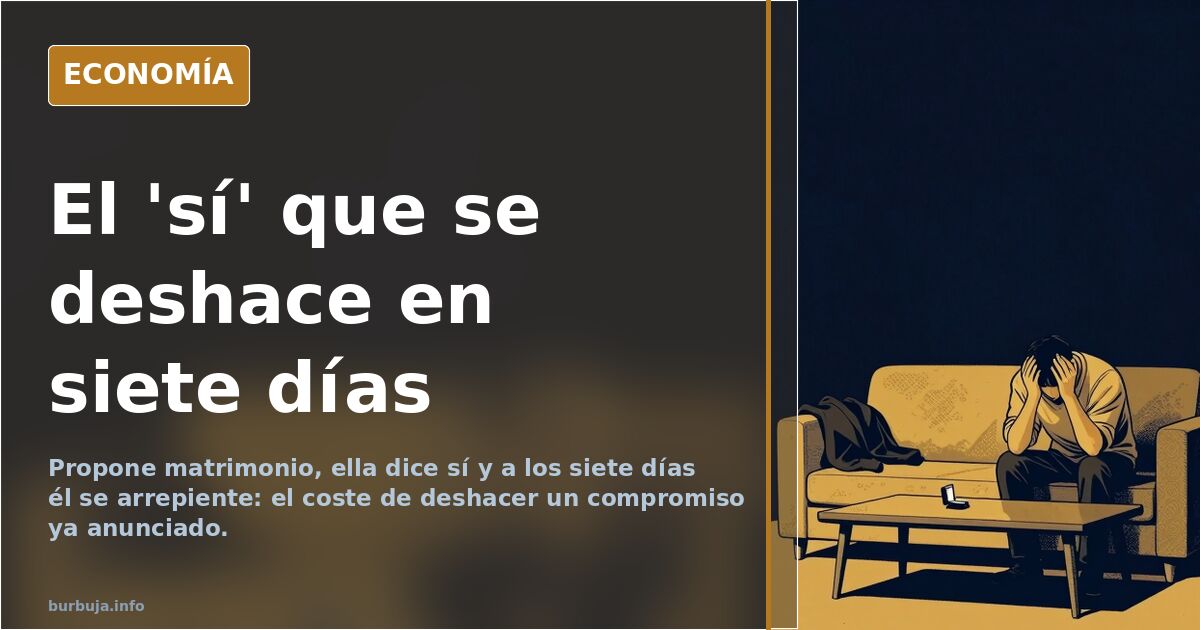
The 'yes' that lasts a week: regretting a marriage proposal
Can you undo a marriage proposal seven days after making it? You can. What you cannot undo is the echo: if the other party has told everyone, stepping back requires explaining yourself to family, friends, and neighbors who already set the date. The case that brought this issue to the table is textbook. A man proposes to his girlfriend, she says yes, and a week later he confesses he doesn't want to get married, that he regrets it, and that he doesn't know how to get out of the mess. The useful question isn't how to hide, but how much each exit costs.
What's at stake for those who sign up for a marriage they don't want
The most widely circulated warnings aren't about love; they're about assets. They highlight the fine print that comes into play when two people marry without agreeing on financial terms beforehand: bank accounts that cease to be individual, a home bought jointly where one person practically pays much more than the other, and a division of assets that, if necessary, applies by default without anyone bothering to read it. The economic conditions of marriage weigh much more heavily than the ceremony suggests.
And there is a detail that is almost never looked at: the timeline. The longer the conversation is delayed, the more has already been invested in signals, arras (traditional wedding gifts), and reservations. The more expensive it becomes to back out. This is the part of the matter no one wants to face head-on.
Divorce as a statistical horizon
Among the responses circulates a figure repeated like a mantra: that eight out of ten marriages end in divorce and that it only takes enduring four or five years to get burned. It is a data point launched without a source and should be taken with caution, but it reflects a climate: the prior suspicion that things won't work out. From there, everyone does their own math.
Also appearing is the phenomenon viewed from the reverse side. When the one who regrets it is the other party, what usually happens — it is said — is that they start changing their treatment, creating tension, and straining cohabitation until the other person takes the step to break up. It is a way to exit the commitment without saying the uncomfortable phrase. It works out cheaper in the short term and much more expensive in the medium term.
Exits proposed by popular imagination
Setting aside sensible advice, the list of ideas is long and highly inadvisable: feigning regret under the influence of something, disappearing "for a cigarette" and not returning, simulating one's own death in the style of a famous fugitive and reappearing on another continent, or behaving so intolerably that the other party cancels. All share the same flaw: they shift the cost to the other person and multiply the damage.
The responsibility of the given word
Some responses do not stop at economic calculation, but focus on commitment. It is pointed out that proposing marriage was a free decision and that the real problem is not marriage, but the tendency to seek someone else to bear the responsibility for one's own determination. In parallel, jabs about age increase: some emphasize that at their age one should know what they want, and others, using irony, note that at that stage one has had time to make this kind of mistake. Neither resolves anything, but they place the focus where it hurts: the ball is in the court of the one who proposed.
Talk it now or pay later
One analysis presents only two scenarios. Tell them now: you almost certainly lose the relationship, but you lose it once. Move forward: you almost certainly lose the marriage, later, with lawyers involved and with a much larger financial and emotional bill. Between the two, there is no clean third way. Those disguised as solutions — postponing the date, inventing a work problem, letting it cool off — only buy time.
And time, in these cases, always plays against the one who stays silent. Every week that passes without saying it adds guests to the list, gifts to the calendar, and people convinced that the yes was voluntary and considered.
No one disputes the core: the uncomfortable conversation is the only exit that doesn't end in court. What everyone argues about is how to have it without looking like the bad guy in the movie. And there, truthfully, no manual helps. The dilemma admits no frills: muster courage for one week, or muster courage three years later with a lawyer by your side. The uncomfortable conversation doesn't appear on any wedding gift registry, and remains the only free solution.
Can you undo a marriage proposal seven days after making it? You can. What you cannot undo is the echo: if the other party has told everyone, stepping back requires explaining yourself to family, friends, and neighbors who already set the date. The case that brought this issue to the table is textbook. A man proposes to his girlfriend, she says yes, and a week later he confesses he doesn't want to get married, that he regrets it, and that he doesn't know how to get out of the mess. The useful question isn't how to hide, but how much each exit costs.
What's at stake for those who sign up for a marriage they don't want
The most widely circulated warnings aren't about love; they're about assets. They highlight the fine print that comes into play when two people marry without agreeing on financial terms beforehand: bank accounts that cease to be individual, a home bought jointly where one person practically pays much more than the other, and a division of assets that, if necessary, applies by default without anyone bothering to read it. The economic conditions of marriage weigh much more heavily than the ceremony suggests.
And there is a detail that is almost never looked at: the timeline. The longer the conversation is delayed, the more has already been invested in signals, arras (traditional wedding gifts), and reservations. The more expensive it becomes to back out. This is the part of the matter no one wants to face head-on.
Divorce as a statistical horizon
Among the responses circulates a figure repeated like a mantra: that eight out of ten marriages end in divorce and that it only takes enduring four or five years to get burned. It is a data point launched without a source and should be taken with caution, but it reflects a climate: the prior suspicion that things won't work out. From there, everyone does their own math.
Also appearing is the phenomenon viewed from the reverse side. When the one who regrets it is the other party, what usually happens — it is said — is that they start changing their treatment, creating tension, and straining cohabitation until the other person takes the step to break up. It is a way to exit the commitment without saying the uncomfortable phrase. It works out cheaper in the short term and much more expensive in the medium term.
Exits proposed by popular imagination
Setting aside sensible advice, the list of ideas is long and highly inadvisable: feigning regret under the influence of something, disappearing "for a cigarette" and not returning, simulating one's own death in the style of a famous fugitive and reappearing on another continent, or behaving so intolerably that the other party cancels. All share the same flaw: they shift the cost to the other person and multiply the damage.
The responsibility of the given word
Some responses do not stop at economic calculation, but focus on commitment. It is pointed out that proposing marriage was a free decision and that the real problem is not marriage, but the tendency to seek someone else to bear the responsibility for one's own determination. In parallel, jabs about age increase: some emphasize that at their age one should know what they want, and others, using irony, note that at that stage one has had time to make this kind of mistake. Neither resolves anything, but they place the focus where it hurts: the ball is in the court of the one who proposed.
Talk it now or pay later
One analysis presents only two scenarios. Tell them now: you almost certainly lose the relationship, but you lose it once. Move forward: you almost certainly lose the marriage, later, with lawyers involved and with a much larger financial and emotional bill. Between the two, there is no clean third way. Those disguised as solutions — postponing the date, inventing a work problem, letting it cool off — only buy time.
And time, in these cases, always plays against the one who stays silent. Every week that passes without saying it adds guests to the list, gifts to the calendar, and people convinced that the yes was voluntary and considered.
No one disputes the core: the uncomfortable conversation is the only exit that doesn't end in court. What everyone argues about is how to have it without looking like the bad guy in the movie. And there, truthfully, no manual helps. The dilemma admits no frills: muster courage for one week, or muster courage three years later with a lawyer by your side. The uncomfortable conversation doesn't appear on any wedding gift registry, and remains the only free solution.
Summary of a discussion on Burbuja.info - Foro de economía, actualidad y política., translated from Spanish and reviewed before publication. Read the full discussion (179 replies).
More summaries
-
Germany to Block Accounts for Far-Right Threats
Germany's 13-point plan by Nancy Faeser allows blocking accounts and seizing funds for 'far-right threats' and monitoring donations.
-
Why Men Avoid Marriage: Financial Risk or Commitment Crisis?
With 80% of divorces initiated by women, marriage poses a financial threat to men. Is this a commitment crisis or a calculated economic decision?
-
Officials Flee Ministries to Avoid Signing Illegal Documents
Ministry officials under suspicion request transfers to avoid signing illegal documents. Political pressure and fear of reprisals trigger a mass exodus...
-
Spanish worker fired after confronting protesters in Madrid
A Spanish airport handling employee was dismissed after a viral video showed him harassing protesters at Puerta del Sol, sparking debate on free speech.
-
60% of Spanish workers reject promotions due to tax trap
Employers pay €1.30 for every €0.56 net gain after a promotion, as high taxes and low salary gaps drive rejection.
-
Trump, Markets and War: Geopolitical Volatility Takes Center Stage
Analysis of how US-Iran conflict statements impacted stocks and oil, highlighting geopolitical volatility.