
Man dies in Tarragona after asking for cigarette
A man died in Tarragona, Spain, after a dispute over a cigarette. The incident sparks debate on bystander intervention and public safety.
English · Original discussion in Spanish · Published
Man dies in Tarragona after asking for cigarette
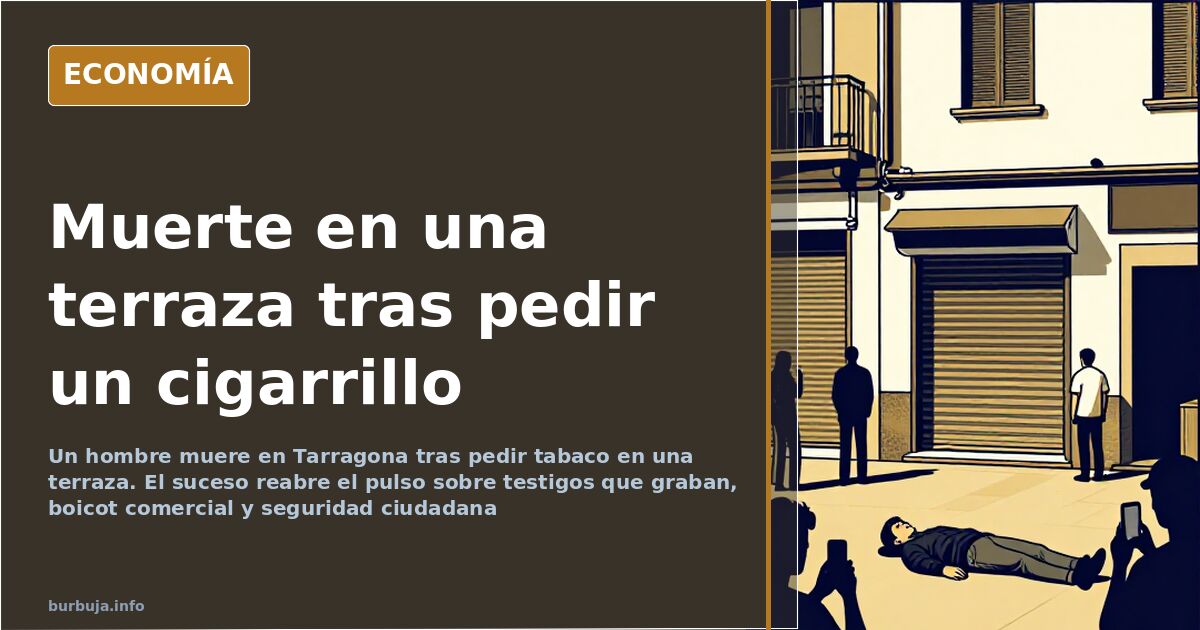
A terrace in Tarragona, a request for a cigarette, and minutes later, a man on the ground. The incident, of which only partial accounts are known, leaves one dead and another person identified as the alleged aggressor. No identities have been verified and there is no judicial ruling: what circulates is a developing narrative, with debates on security and coexistence already heated.
What is known about the Tarragona incident
The most repeated account places the weapon as a broken bottle. According to this version, the aggression was not a brief exchange: the alleged attacker allegedly pinned the victim down with their knee for about ten minutes and only stopped when police arrived. Emergency services, according to the same account, would have treated the injured person an hour after the fight began.
From this comes the first uncomfortable question. How long did it take someone to call the police? The circulated timeline leaves a gap of nearly fifteen minutes between the start of the altercation and the arrival of agents. There is no official confirmation of that interval, but it is enough to shift half the conversation away from the aggressor and toward those who watched.
The witness who records and the one who walks away
One of the most commented clips shows a woman turning her back and continuing on her way while the attack continues behind her. Some interpret this as pure indifference, while others point out that with two people struggling, anyone’s instinctive reaction is to retreat. The debate repeats itself regarding those recording: holding up a phone instead of making a call.
One current view is clear: recording is voyeurism, not help. Another argues the opposite, that video provides evidence for the investigation. A third, more uncomfortable view, admits bluntly that they would do nothing out of antiestéticar.
The real cost of intervening
This is where the analysis becomes economic. Breaking up an armed fight involves physical risk, yes, but also subsequent costs: lawsuits, compensation, lawyer fees, and possible conviction if the force used is deemed excessive. Deterrence is not just antiestéticar of injury, it is antiestéticar of the courtroom.
In this context, a name resurfaces that almost no one remembers anymore, that of a teacher who suffered severe consequences after intervening in an attack. The conclusion many draw —and others reject as cowardly— fits in one sentence: better not be anyone’s hero except your family’s.
From incident to narrative: origin, commerce, and boycotts
From here, the conversation detaches from the facts. Part of the analysis shifts focus from the specific aggression to the nationality of the alleged perpetrator and immigration policy in general. It is the classic pattern: an individual case becomes proof of a collective thesis, and nuances disappear along the way.
Another current proposes concrete consumer measures. It calls for not entering certain shops run by migrants and not buying anything there, under the idea that coexistence is a war and money its ammunition. It is also argued that organized networks dedicated to extortion exist in some commercial areas. Others reject these generalizations due to lack of supporting data, and the debate remains open.
International comparison as a wildcard
Much of the exchange jumps to legal cases in other countries to reinforce the idea of a cultural pattern. These are comparisons launched without context and do not allow sustaining a generalization by nationality. A case tried in one country, with its circumstances and verdict, does not describe an entire group, and that distinction is exactly what is lost once the discussion heats up.
The unsettling data
Ten minutes with a knee on top. One hour until emergency attention. Between those two numbers lie almost all open questions and no comfortable answers. One can debate borders, boycotts, and the price of vicarious heroism. What cannot be sustained is that, with a person pinned to the ground for ten minutes in full view, the primary problem was whether or not to record.
Also available in: Deutsch
Summary of a discussion on Burbuja.info - Foro de economía, actualidad y política., translated from Spanish and reviewed before publication. Read the full discussion (177 replies).
More summaries
-
Spanish ex-police officer, 70, kills partner and commits suicide
A 70-year-old former Spanish police officer killed his 58-year-old partner, Raquel, after an eight-hour standoff that negotiators and GEOS failed to resolve.
-
Anti-money-laundering police chief arrested with €20m hidden in walls
A senior Spanish National Police inspector and his partner were detained with over €20m in cash hidden inside the walls of their home in Alcalá de Henares.
-
Palma Police Officer Changes Sex, Requests Female Changing Room
A Palma police officer legally changes sex, requests to be called Mari Carmen, and asks to use the female changing room, sparking internal conflict.
-
The Simon Perez phenomenon: from obscurity to live self-destruction
The phenomenon of Simón Pérez, aka 'Bocata de Pollo', resurfaces on streaming. An analysis of his self-destruction, the donation business and its impact.
-
Spain debates death of 87-year-old woman after eviction and the political narrative
A forum thread mixes the death of an 87-year-old woman with her eviction, Spain's rental law and the political narrative, without confirming any causal link.
-
Vox opposed eIDAS 2 in 2024, but backed Chat Control in 2021
The European Parliament approved eIDAS 2 with 335 votes in favour and 190 against. Spain's Vox voted no, but records show it backed Chat Control in 2021.