
Man Dies in Fire After Crashing His Xiaomi SU7 in Chengdu
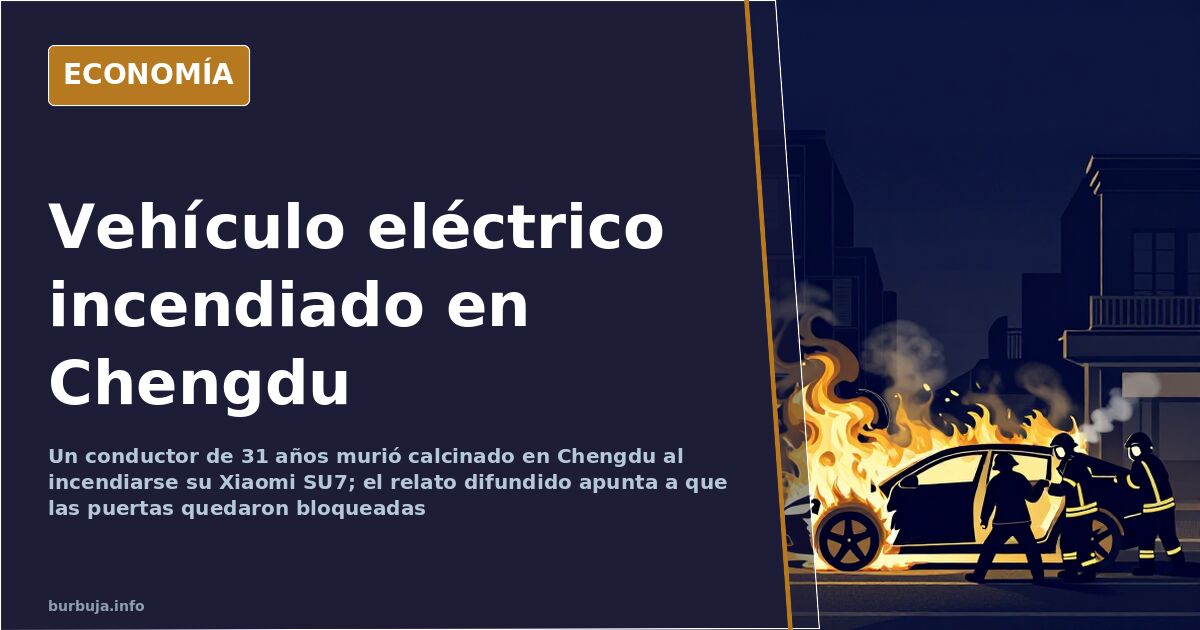
A 31-year-old driver died in a fiery crash in his Xiaomi SU7 in Chengdu. Reports suggest the car's doors became locked, preventing escape.
English · Original discussion in Spanish · Published
Man Dies in Xiaomi SU7 Fire in Chengdu
Can a car turn its own safety antiestéticatures into a deadly trap? This is the question left by the Chengdu incident. A 31-year-old driver died in a fire inside his Xiaomi SU7 after a crash. According to the widely circulated account, the vehicle caught fire and the electronic doors became locked, preventing witnesses from pulling him out of the cabin. Several bystanders recorded the scene with their phones, and the video spread quickly enough to impact the company's stock price. The debate rages on. And the pun is, quite literally, intended.
What is known about the Xiaomi SU7 accident in Chengdu?
The story that spread is short and brutal: crash, fire, and locked doors. The video, recorded by witnesses, shows several people hitting the window in vain as the fire spreads. The market reaction was immediate: the company's shares plummeted as the images went viral.
From there, nuance begins to emerge. Some argue that the impact was so severe that it could have deformed the bodywork and jammed any door, electric or mechanical, just as would happen in an internal combustion car. The absence of fire extinguishers in rescue attempts is also mentioned, although several messages admit they probably wouldn't have changed the outcome. The opening system, in any case, is at the center of the controversy: some defend that the locking mechanism is the same in all cars, electric or combustion.
Electronic Doors: The Lock No One Tested in a Fire
The flush door handles, which retract to improve aerodynamics, have become the symbol of the problem. According to one participant, the energy saving from this antiestéticature is ridiculous, especially in city driving where aerodynamics matter less. In exchange, a mechanical action—pulling a handle—is replaced by an electronic command that depends on the 12-volt battery and a control unit.
This issue is not exclusive to Chinese brands. On the rear doors of some Teslas, the user only has a button, and the manual emergency release cable is hidden behind a carpeted panel in the door or glove compartment. Some owners install accessories precisely to be able to pull that cable without dismantling half the panel. The difference between a car and a coffin on wheels is, literally, a handle that hasn't been retracted.
Do Electric Cars Burn More Than Gasoline Cars?
Here, the figures are debated. Statistics were cited in the discussion—attributed to an artificial intelligence assistant—according to which electric vehicles catch fire up to 80 times less than gasoline cars, and significantly less than hybrids, which combine both systems. The conclusion drawn is not that electric cars are harmless, but that the problem is not frequency: it is intensity and escape capability.
The calculation is tricky, and those who use it know it. A low fire rate says nothing about what happens when a lithium battery catches fire. At that point, the vehicle stops behaving like a car and starts behaving like a chemical reactor.
Lithium vs. Diesel: Where the Fire Starts
The discussion holds that a diesel car does not ignite on its own and needs an external ignition source, whereas a lithium battery can ignite spontaneously. It is mentioned in the discussion that a vehicle fire can reach 2,750 ºC, a temperature at which water and onboard extinguishers are merely decorative. The operational question is not how much it burns, but how much time you have to get out and how you open the door.
It is also recalled that gasoline has always been dangerous: there were vehicles with the fuel tank inside the cabin, and a combustion car carries 60 liters of flammable liquid under the chassis. The argument has merit, but it doesn't address what happens when the system that should open the door shuts down before you do.
The Stock Market Hit and the Chinese Electric Car Narrative
The stock market drop is not just a reaction to the accident: it's a reaction to the accident's virality. In a sector that has built its value on the promise of superior technology, a ten-second video weighs more than a quarterly report. And the underlying distrust looms large: for years, it has been repeated that what Chinese industry manufactures is disposable, and a case like this reopens that doubt, even if statistics say otherwise.
What remains is an unresolved contradiction. Aggregate data says electric cars catch fire less often. The video says that when they do catch fire, the door won't open. No one has yet demonstrated which of these two factors should carry more weight when making a purchase.
Next time someone tries to sell you a car based on its touchscreen, ask them where the manual handle is. You never miss it until you need it, and by then, there's no one to pull it.
Can a car turn its own safety antiestéticatures into a deadly trap? This is the question left by the Chengdu incident. A 31-year-old driver died in a fire inside his Xiaomi SU7 after a crash. According to the widely circulated account, the vehicle caught fire and the electronic doors became locked, preventing witnesses from pulling him out of the cabin. Several bystanders recorded the scene with their phones, and the video spread quickly enough to impact the company's stock price. The debate rages on. And the pun is, quite literally, intended.
What is known about the Xiaomi SU7 accident in Chengdu?
The story that spread is short and brutal: crash, fire, and locked doors. The video, recorded by witnesses, shows several people hitting the window in vain as the fire spreads. The market reaction was immediate: the company's shares plummeted as the images went viral.
From there, nuance begins to emerge. Some argue that the impact was so severe that it could have deformed the bodywork and jammed any door, electric or mechanical, just as would happen in an internal combustion car. The absence of fire extinguishers in rescue attempts is also mentioned, although several messages admit they probably wouldn't have changed the outcome. The opening system, in any case, is at the center of the controversy: some defend that the locking mechanism is the same in all cars, electric or combustion.
Electronic Doors: The Lock No One Tested in a Fire
The flush door handles, which retract to improve aerodynamics, have become the symbol of the problem. According to one participant, the energy saving from this antiestéticature is ridiculous, especially in city driving where aerodynamics matter less. In exchange, a mechanical action—pulling a handle—is replaced by an electronic command that depends on the 12-volt battery and a control unit.
This issue is not exclusive to Chinese brands. On the rear doors of some Teslas, the user only has a button, and the manual emergency release cable is hidden behind a carpeted panel in the door or glove compartment. Some owners install accessories precisely to be able to pull that cable without dismantling half the panel. The difference between a car and a coffin on wheels is, literally, a handle that hasn't been retracted.
Do Electric Cars Burn More Than Gasoline Cars?
Here, the figures are debated. Statistics were cited in the discussion—attributed to an artificial intelligence assistant—according to which electric vehicles catch fire up to 80 times less than gasoline cars, and significantly less than hybrids, which combine both systems. The conclusion drawn is not that electric cars are harmless, but that the problem is not frequency: it is intensity and escape capability.
The calculation is tricky, and those who use it know it. A low fire rate says nothing about what happens when a lithium battery catches fire. At that point, the vehicle stops behaving like a car and starts behaving like a chemical reactor.
Lithium vs. Diesel: Where the Fire Starts
The discussion holds that a diesel car does not ignite on its own and needs an external ignition source, whereas a lithium battery can ignite spontaneously. It is mentioned in the discussion that a vehicle fire can reach 2,750 ºC, a temperature at which water and onboard extinguishers are merely decorative. The operational question is not how much it burns, but how much time you have to get out and how you open the door.
It is also recalled that gasoline has always been dangerous: there were vehicles with the fuel tank inside the cabin, and a combustion car carries 60 liters of flammable liquid under the chassis. The argument has merit, but it doesn't address what happens when the system that should open the door shuts down before you do.
The Stock Market Hit and the Chinese Electric Car Narrative
The stock market drop is not just a reaction to the accident: it's a reaction to the accident's virality. In a sector that has built its value on the promise of superior technology, a ten-second video weighs more than a quarterly report. And the underlying distrust looms large: for years, it has been repeated that what Chinese industry manufactures is disposable, and a case like this reopens that doubt, even if statistics say otherwise.
What remains is an unresolved contradiction. Aggregate data says electric cars catch fire less often. The video says that when they do catch fire, the door won't open. No one has yet demonstrated which of these two factors should carry more weight when making a purchase.
Next time someone tries to sell you a car based on its touchscreen, ask them where the manual handle is. You never miss it until you need it, and by then, there's no one to pull it.
Summary of a discussion on Burbuja.info - Foro de economía, actualidad y política., translated from Spanish and reviewed before publication. Read the full discussion (202 replies).
More summaries
-
Irene Montero promises €1,800 minimum wage and 30 working hours per week
Irene Montero promises €1,800 minimum wage and 30 hours per week by 2027: the payroll linked to the minimum wage has multiplied by 28 since 2000.
-
Euthanasia in Old Age: Autonomy vs. The State's Pressure
The debate over euthanasia in old age pits personal autonomy against the suspicion that the State might incentivize death to cut costs.
-
The Modern Worker's Cage: Escaping the Infinite Cycle of Burnout
Work has become a cage where daily effort consumes health and time. Discover why we push ourselves so hard and how to break the cycle.
-
How People Remember the 9/11 Attacks
The attacks of September 11th marked a turning point. Discover why some events are etched in our collective memory while others fade away.
-
Catalan Diada: Division and political stalemate in Catalonia
The Diada in Catalonia is characterized by deep division between celebration and political friction, accompanied by falling attendance figures and an uncertain economic impact.
-
Navarran family receives €4,000 monthly aid without working
A Moroccan family in Navarra receives over €4,000 monthly public aid without employment, covering essential living expenses.