
Man arrested for throwing water at Málaga's Cristo de la Crucifixión
An arrest for throwing water at Málaga's Cristo de la Crucifixión reopens the debate over respect for religious traditions in the street
English · Original discussion in Spanish · Published
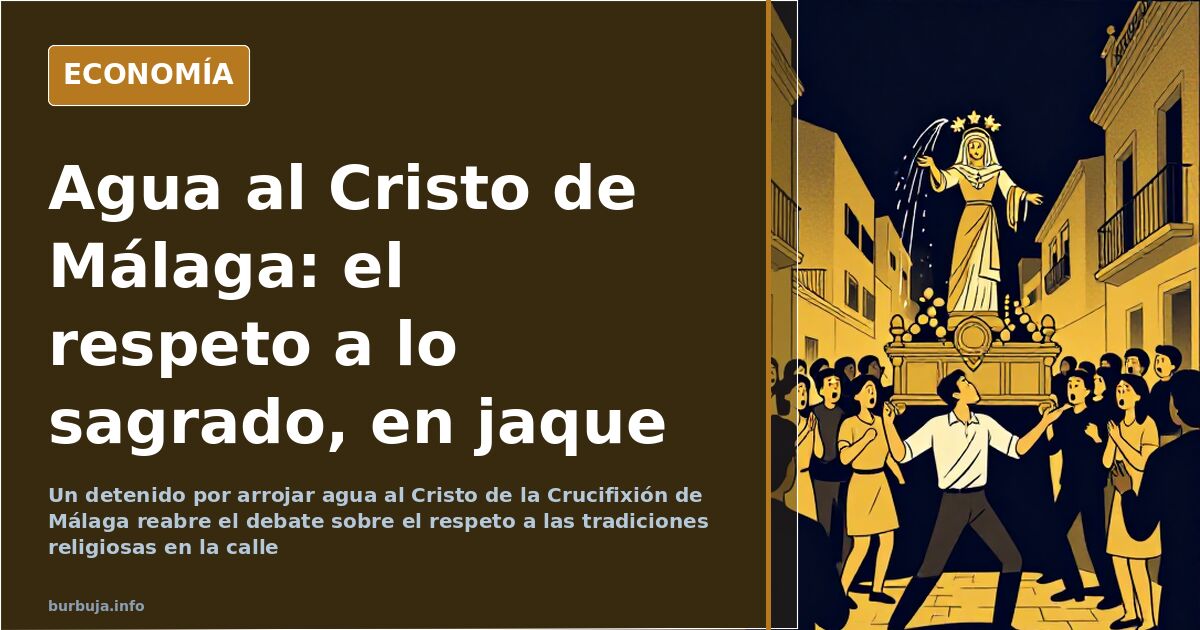
Water thrown at Málaga's Cristo and the fracture of respect for the sacred
A man threw water at the float of the Cristo de la Crucifixión during a procession in Málaga and ended up arrested. That is the fact. The rest —the noise that trinc— says much more about the collective mood than about a glass of water. Because the episode reopens an uncomfortable question: who should respect what when a religious tradition takes over the street and how much reciprocity can be demanded in return. The gesture lasted seconds. The echo, much longer.
What peine in the Crucifixión procession
The facts are easy to summarize and hard to swallow for anyone who experiences Holy Week as their own. During the parade of the float of the Cristo de la Crucifixión, a man threw water on the image and was arrested for it. Diario Sur and several media outlets captured the moment on video, and from there the scene spread unchecked on social media. There is no record of material damage or injuries: technically, a minor act.
And that is precisely why it stung. In a liturgy where images are prepared for months and brotherhoods rehearse all year, the offense is measured not in liquid spilled but in the message. The most repeated reading was that of a symbolic challenge: no person was attacked; disrespect was shown to a symbol shared by much of an entire neighborhood.
Why reciprocity with other countries is invoked
The argument that dominated much of the conversation was that of asymmetry. Some argue that in Muslim-majority countries an equivalent gesture against their religious symbols would have much more severe consequences, and recall that a non-Muslim cannot enter Mecca without facing serious penalties. On that basis, equivalent treatment is demanded here.
Against it weighs a nuance that also appears: the demand for reciprocity rests on comparison with states where a different legal system and a different scale of penalties apply, so importing that logic would clash with Spain's own legal framework. The struggle, therefore, is not only cultural: it is about which standard of respect applies on each shore.
Holy Week as a stage for cultural tensions
The second front was the defense of the procession as heritage, not only as worship. The most repeated line insists that the images, the bands and the brotherhoods are the cultural legacy of a people, just like the language or the cathedrals, and that failing them is failing something common. Believers and non-believers mix there: it is enough to accept that the street, on that day, belongs to everyone.
That framework explains why the incident was experienced as a collective affront and not as a simple act of hooliganism. Also why some call for a forceful neighborhood reaction in the moment, and others warn that that same reaction would turn an isolated act into a larger conflict. The point of friction is not in condemning the gesture —almost no one defends it— but in calibrating the response.
The migration backdrop and the bishops' request
Beneath the episode throbs the migration debate, which in the same period had its own chapter. The Conferencia Episcopal Española (Spanish bishops' conference) called for processing the popular legislative initiative to regularize the situation of half a million migrants, arguing that they contribute to the common good. That request generated confusion among those who locate the origin of the conflict in reception policies.
The paradox that some underline is precisely that: the institution asking to regularize and the flock that feels unprotected in the street do not always speak the same language. The Málaga case was read, in that context, as the tip of a broader iceberg, with scattered examples of friction in processions and public spaces.
An open-ended closing
With these ingredients, what is foreseeable is that isolated incidents will continue to feed headlines and that the discussion will become heated every procession season. More episodes and more noise than substance can be expected. What is not written is whether that tension will be managed with the calm of a coexistence problem or with the fuse of a clash narrative. There, for now, there is no forecast.
A man threw water at the float of the Cristo de la Crucifixión during a procession in Málaga and ended up arrested. That is the fact. The rest —the noise that trinc— says much more about the collective mood than about a glass of water. Because the episode reopens an uncomfortable question: who should respect what when a religious tradition takes over the street and how much reciprocity can be demanded in return. The gesture lasted seconds. The echo, much longer.
What peine in the Crucifixión procession
The facts are easy to summarize and hard to swallow for anyone who experiences Holy Week as their own. During the parade of the float of the Cristo de la Crucifixión, a man threw water on the image and was arrested for it. Diario Sur and several media outlets captured the moment on video, and from there the scene spread unchecked on social media. There is no record of material damage or injuries: technically, a minor act.
And that is precisely why it stung. In a liturgy where images are prepared for months and brotherhoods rehearse all year, the offense is measured not in liquid spilled but in the message. The most repeated reading was that of a symbolic challenge: no person was attacked; disrespect was shown to a symbol shared by much of an entire neighborhood.
Why reciprocity with other countries is invoked
The argument that dominated much of the conversation was that of asymmetry. Some argue that in Muslim-majority countries an equivalent gesture against their religious symbols would have much more severe consequences, and recall that a non-Muslim cannot enter Mecca without facing serious penalties. On that basis, equivalent treatment is demanded here.
Against it weighs a nuance that also appears: the demand for reciprocity rests on comparison with states where a different legal system and a different scale of penalties apply, so importing that logic would clash with Spain's own legal framework. The struggle, therefore, is not only cultural: it is about which standard of respect applies on each shore.
Holy Week as a stage for cultural tensions
The second front was the defense of the procession as heritage, not only as worship. The most repeated line insists that the images, the bands and the brotherhoods are the cultural legacy of a people, just like the language or the cathedrals, and that failing them is failing something common. Believers and non-believers mix there: it is enough to accept that the street, on that day, belongs to everyone.
That framework explains why the incident was experienced as a collective affront and not as a simple act of hooliganism. Also why some call for a forceful neighborhood reaction in the moment, and others warn that that same reaction would turn an isolated act into a larger conflict. The point of friction is not in condemning the gesture —almost no one defends it— but in calibrating the response.
The migration backdrop and the bishops' request
Beneath the episode throbs the migration debate, which in the same period had its own chapter. The Conferencia Episcopal Española (Spanish bishops' conference) called for processing the popular legislative initiative to regularize the situation of half a million migrants, arguing that they contribute to the common good. That request generated confusion among those who locate the origin of the conflict in reception policies.
The paradox that some underline is precisely that: the institution asking to regularize and the flock that feels unprotected in the street do not always speak the same language. The Málaga case was read, in that context, as the tip of a broader iceberg, with scattered examples of friction in processions and public spaces.
An open-ended closing
With these ingredients, what is foreseeable is that isolated incidents will continue to feed headlines and that the discussion will become heated every procession season. More episodes and more noise than substance can be expected. What is not written is whether that tension will be managed with the calm of a coexistence problem or with the fuse of a clash narrative. There, for now, there is no forecast.
Summary of a discussion on Burbuja.info - Foro de economía, actualidad y política., translated from Spanish and reviewed before publication. Read the full discussion (206 replies).
More summaries
-
Euthanasia in Old Age: Autonomy vs. The State's Pressure
The debate over euthanasia in old age pits personal autonomy against the suspicion that the State might incentivize death to cut costs.
-
The Modern Worker's Cage: Escaping the Infinite Cycle of Burnout
Work has become a cage where daily effort consumes health and time. Discover why we push ourselves so hard and how to break the cycle.
-
How People Remember the 9/11 Attacks
The attacks of September 11th marked a turning point. Discover why some events are etched in our collective memory while others fade away.
-
Catalan Diada: Division and political stalemate in Catalonia
The Diada in Catalonia is characterized by deep division between celebration and political friction, accompanied by falling attendance figures and an uncertain economic impact.
-
Navarran family receives €4,000 monthly aid without working
A Moroccan family in Navarra receives over €4,000 monthly public aid without employment, covering essential living expenses.
-
Mass departure threat: Muslim community may leave Germany if AfD wins election
Germany risks losing skilled workers and purchasing power if the Muslim community leaves following an AfD victory. We analyze the economic implications.