
Malibu fires destroy $6M-$210M homes; brick won't return
Homes worth $6M to $210M destroyed in Malibu. Land retains value, but rebuilding faces bureaucracy and wood construction hurdles.
English · Original discussion in Spanish · Published
Malibu burns: $6M-$210M homes lost, brick doesn't return
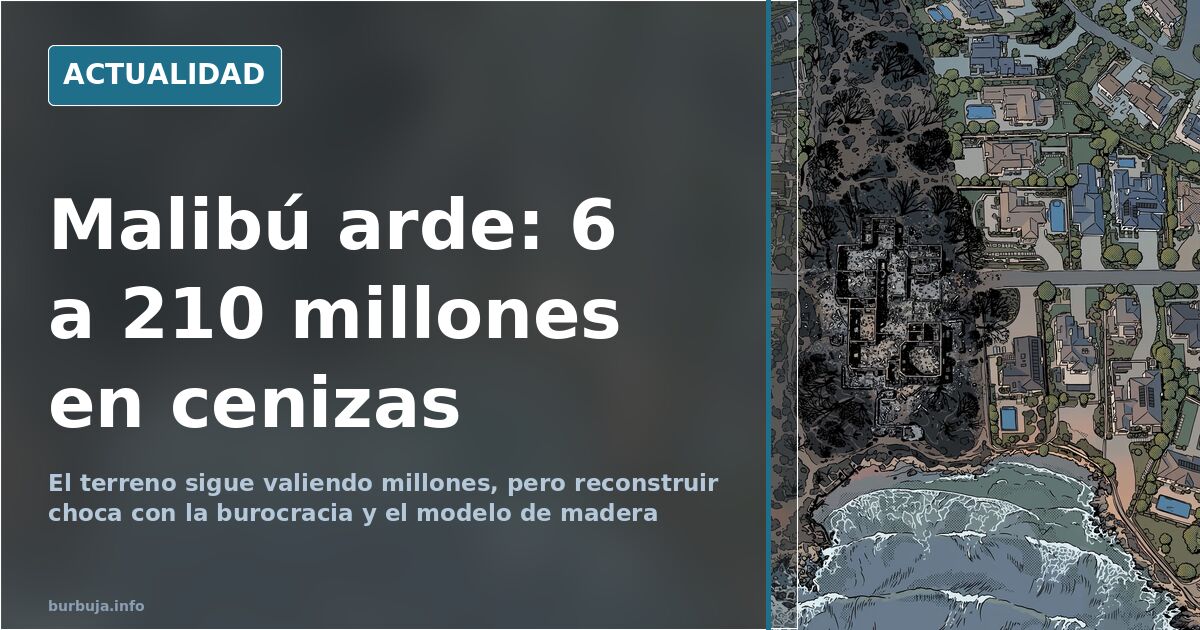
Beachfront homes in Malibu (California) have been destroyed by the fire. Starting prices for these properties range from $6 million to as high as $210 million, according to industry data. What the fire took wasn't just wood: it was a building method viewed with skepticism in Europe but standard in the US for decades.
The question hovering over any discussion of the disaster isn't how much each house cost, but how much the land is worth. Because the plot remains there, beachfront, with Pacific views and near Los Angeles. Rebuilding a 200-square-meter luxury chalet shouldn't exceed €300,000, according to circulating estimates, a figure ridiculous compared to the land's value. Wood structures, panels, and flammable materials explain why the fire jumped from one lot to another with ease that would be hard to believe in Spain.
Why are Malibu homes made of wood?
In the United States, single-family housing is predominantly built with wooden frames and light cladding. This isn't a Malibu exception: it's the national standard. The result, when a fire, hurricane, or flood hits, is the same: the house disappears, leaving only the lot. In the Spanish collective imagination persists the image of that tornado that ravaged a city, leaving standing only one house, built by a Spanish emigrant using brick and concrete. The anecdote has circulated for years and well summarizes the construction gap between both countries.
Some argue the reason is not just cultural but economic: if insurance covers reconstruction and the land is what truly holds value, building cheaply and replacing quickly makes sense. Others point out that private insurers have spent decades refusing to cover homes in high-fire-risk zones, pushing owners to minimize investment in structure. The debate over whether insurance will pay is on the table, and it's no minor detail.
Land, insurance, and bureaucracy: what Malibu really risks
The real value of those plots lies not in the bricks but in the location. That's the thesis running through any serious analysis of the Californian real estate market. However, rebuilding won't be automatic. In California, building permits are a labyrinth: some leave a partition wall standing so the work counts as renovation rather than new construction, thus bypassing part of the process. That practice, known in the sector, could repeat after the fire.
Local bureaucracy adds another layer of complexity. Procedures to install solar panels or renovate a facade can drag on for years, generating wear that sometimes changes the public stance of some owners. The result is tension between those who want to rebuild ASAP and those demanding environmental and urban planning requirements be met before raising a single beam.
Can we prevent this from happening again?
The prevention debate has two fronts. On one hand, brush clearing and vegetation management: some defend that laws preventing clearing have worsened the risk. On the other, the very location of homes: building on the first line of the beach, with forest across the road, is a bet nature collects sooner or later.
Wind also transports embers long distances, explaining why fire reaches apparently isolated houses, without immediate vegetation, with the beach on one side and asphalt on the other. You don't need a forest next to the porch for a house to burn: a spark and flammable materials suffice.
Malibu's reconstruction won't be quick or cheap. The land still holds millions in value, but the construction model and administrative tangle set the pace. It remains to be seen if the next fire finds the same wooden houses in the same place or if, conversely, someone will have learned something from the Three Little Pigs story.
Beachfront homes in Malibu (California) have been destroyed by the fire. Starting prices for these properties range from $6 million to as high as $210 million, according to industry data. What the fire took wasn't just wood: it was a building method viewed with skepticism in Europe but standard in the US for decades.
The question hovering over any discussion of the disaster isn't how much each house cost, but how much the land is worth. Because the plot remains there, beachfront, with Pacific views and near Los Angeles. Rebuilding a 200-square-meter luxury chalet shouldn't exceed €300,000, according to circulating estimates, a figure ridiculous compared to the land's value. Wood structures, panels, and flammable materials explain why the fire jumped from one lot to another with ease that would be hard to believe in Spain.
Why are Malibu homes made of wood?
In the United States, single-family housing is predominantly built with wooden frames and light cladding. This isn't a Malibu exception: it's the national standard. The result, when a fire, hurricane, or flood hits, is the same: the house disappears, leaving only the lot. In the Spanish collective imagination persists the image of that tornado that ravaged a city, leaving standing only one house, built by a Spanish emigrant using brick and concrete. The anecdote has circulated for years and well summarizes the construction gap between both countries.
Some argue the reason is not just cultural but economic: if insurance covers reconstruction and the land is what truly holds value, building cheaply and replacing quickly makes sense. Others point out that private insurers have spent decades refusing to cover homes in high-fire-risk zones, pushing owners to minimize investment in structure. The debate over whether insurance will pay is on the table, and it's no minor detail.
Land, insurance, and bureaucracy: what Malibu really risks
The real value of those plots lies not in the bricks but in the location. That's the thesis running through any serious analysis of the Californian real estate market. However, rebuilding won't be automatic. In California, building permits are a labyrinth: some leave a partition wall standing so the work counts as renovation rather than new construction, thus bypassing part of the process. That practice, known in the sector, could repeat after the fire.
Local bureaucracy adds another layer of complexity. Procedures to install solar panels or renovate a facade can drag on for years, generating wear that sometimes changes the public stance of some owners. The result is tension between those who want to rebuild ASAP and those demanding environmental and urban planning requirements be met before raising a single beam.
Can we prevent this from happening again?
The prevention debate has two fronts. On one hand, brush clearing and vegetation management: some defend that laws preventing clearing have worsened the risk. On the other, the very location of homes: building on the first line of the beach, with forest across the road, is a bet nature collects sooner or later.
Wind also transports embers long distances, explaining why fire reaches apparently isolated houses, without immediate vegetation, with the beach on one side and asphalt on the other. You don't need a forest next to the porch for a house to burn: a spark and flammable materials suffice.
Malibu's reconstruction won't be quick or cheap. The land still holds millions in value, but the construction model and administrative tangle set the pace. It remains to be seen if the next fire finds the same wooden houses in the same place or if, conversely, someone will have learned something from the Three Little Pigs story.
Summary of a discussion on Burbuja.info - Foro de economía, actualidad y política., translated from Spanish and reviewed before publication. Read the full discussion (149 replies).
More summaries
-
Los Angeles wildfires force 30,000 evacuations and power cuts
Massive wildfires in Los Angeles force 30,000 people to evacuate. Power and internet outages. Causes under investigation as flames advance.
-
US Prepares Potential Military Action Around Cuba, CBS Reports
CBS reports the US is preparing possible military action around Cuba, not within. Spain's "law of grandchildren" and oil factor influence calculations.
-
Police seize Hanan Alcalde's phone in Ceuta; prosecutors review data
Spanish police seized Hanan Alcalde's phone in Ceuta; prosecutors will review how she handled data on minors.
-
Ceuta crisis: Spanish enclave's residents unheard
The Ceuta migration crisis is reported externally, lacking local voices. We analyze the Government response, force debates, and identity issues.
-
Bilbao police force video sparks debate on proportionality
A video of Bilbao municipal police using force in El León reignites discussions on police limits and racism.
-
Argentina Hate or Antisemitism? Debate Divides
Is it sports criticism or antisemitism? Digital attacks on Argentina after the World Cup revive debate on hidden prejudice and football geopolitics.