
Male Literary Canon: Why Men Avoid Female Authors
Forum users admit avoiding books by women. The male-dominated literary canon raises questions about gender bias in reading habits.
English · Original discussion in Spanish · Published
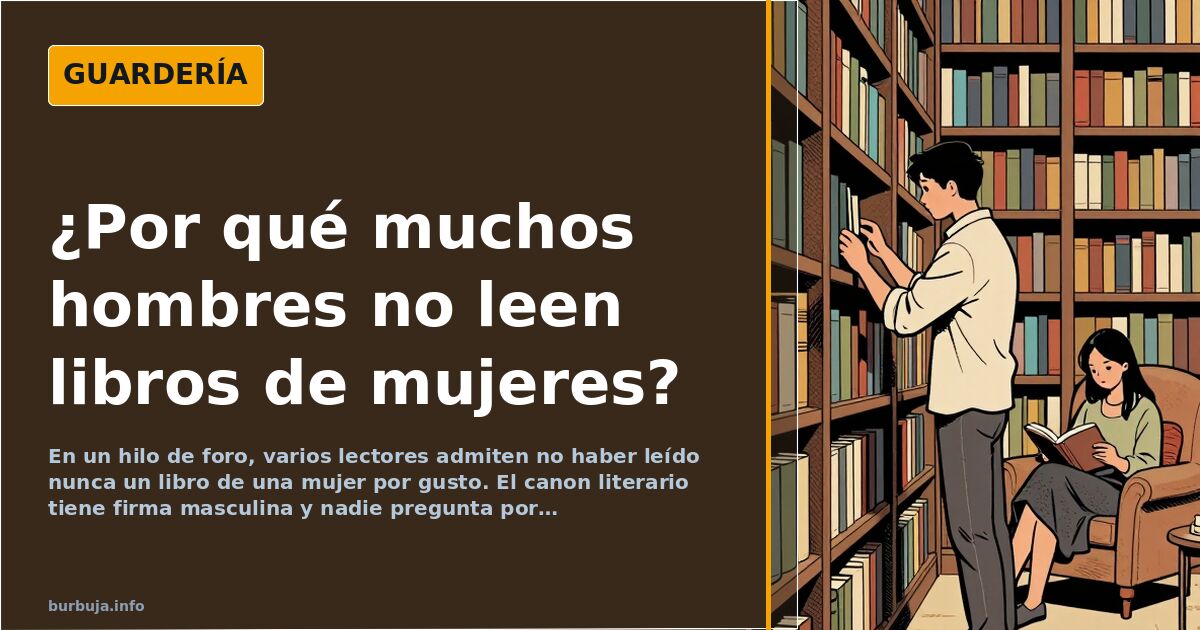
The Male Literary Canon: Choosing Not to Read Women
In a forum thread, several readers admitted they have never finished a book written by a woman of their own free will. Not due to bans or lack of access, but simply because they don't feel like it. They say this without shame, with a mix of pride and humor that invites reflection on how our reading choices are shaped.
The starting point is an unfiltered confession: one reader claims the only female-authored book he read was forced upon him in high school, leaving him scarred for life. From there, the discussion devolves into a list of exceptions, suspicions, and score-settling that reveals more about reader prejudice than literature itself.
Exceptions That Prove the Rule
Names appear: Margaret Weis, Agatha Christie, Patricia Highsmith, Virginia Woolf, Edith Wharton, Carson McCullers, Colleen McCullough, Ana María Matute, Carmen Laforet, Emilia Pardo Bazán. The list is long and varied, but almost always accompanied by a qualifier that neutralizes it: "she's the exception because she was half-masculine," "her husband wrote it," "it doesn't count because she co-authored with her husband." The mechanism is consistent: if a woman writes well, efforts are made to strip away her femininity.
Some argue that women's contribution to great literature is collectively smaller than men's. Counterarguments suggest the canon has been built, revised, and taught primarily by men for centuries, turning perceived inferiority into a self-fulfilling prophecy. The debate remains unresolved.
The McCullough Case: 600 Pages Beyond Debate
One name withstands scrutiny: Colleen McCullough. Her series on Rome, comprising six novels of 600 to 800 pages each, is cited as some of the best historical fiction ever written. It reconstructs Caesar as a child, Augustus as a youth, Marius, Sulla, Servilia, maintaining coherence over thousands of pages. Defenders allow no nuance: "Don't diminish the merit of one of the greatest historical novel series in history."
The contrast with other authors is stark. The same person who praises McCullough without reservation admits quitting a bestselling historical essay by a woman after page 20. It's not about gender, they insist; it's that the author can't write. This blunt statement captures the tension: female authors are judged by their work, yet their work is suspected because they are women.
The Trap of 'Feminine Style'
A recurring accusation is that women's writing is "noticeably feminine," possessing a quality that naturally repels readers. However, when specific examples are provided, the argument collapses. Carson McCullers, with her deliberately neutral name and dry style, is cited as a writer anyone would enjoy. Robert Graves, an excellent novelist, exhibits traits often attributed negatively to women solely based on gender, according to another comment.
The implicit conclusion is uncomfortable: what is detected as "feminine" is not a style, but an expectation. If you know the author is a woman, you read differently. If you don't know, you just read the book.
The Disorienting Data Point
One comment summarizes the absurdity better than any analysis: a reader admits not having read any books by women, clarifying that he barely reads anything outside of internet content. Thus, the issue isn't bias, but illiteracy. Yet, the original question still holds relevance for him.
The discussion turns darker when suggestions arise that reading women helps "understand the female worldview" to manipulate them. The response is immediate: those who manipulate best haven't read a book in their lives. The argument self-destructs.
What Remains
Between the misogyny of some and the condescension of others, the result is a precise portrait of how literary taste forms: through imitation, prestige, and laziness. No one banned anything. No one burned books. Simply, for generations, the canon came with a male signature, and no one asked why.
The lingering question isn't whether women write well. It's why an exception is needed to read them.
In a forum thread, several readers admitted they have never finished a book written by a woman of their own free will. Not due to bans or lack of access, but simply because they don't feel like it. They say this without shame, with a mix of pride and humor that invites reflection on how our reading choices are shaped.
The starting point is an unfiltered confession: one reader claims the only female-authored book he read was forced upon him in high school, leaving him scarred for life. From there, the discussion devolves into a list of exceptions, suspicions, and score-settling that reveals more about reader prejudice than literature itself.
Exceptions That Prove the Rule
Names appear: Margaret Weis, Agatha Christie, Patricia Highsmith, Virginia Woolf, Edith Wharton, Carson McCullers, Colleen McCullough, Ana María Matute, Carmen Laforet, Emilia Pardo Bazán. The list is long and varied, but almost always accompanied by a qualifier that neutralizes it: "she's the exception because she was half-masculine," "her husband wrote it," "it doesn't count because she co-authored with her husband." The mechanism is consistent: if a woman writes well, efforts are made to strip away her femininity.
Some argue that women's contribution to great literature is collectively smaller than men's. Counterarguments suggest the canon has been built, revised, and taught primarily by men for centuries, turning perceived inferiority into a self-fulfilling prophecy. The debate remains unresolved.
The McCullough Case: 600 Pages Beyond Debate
One name withstands scrutiny: Colleen McCullough. Her series on Rome, comprising six novels of 600 to 800 pages each, is cited as some of the best historical fiction ever written. It reconstructs Caesar as a child, Augustus as a youth, Marius, Sulla, Servilia, maintaining coherence over thousands of pages. Defenders allow no nuance: "Don't diminish the merit of one of the greatest historical novel series in history."
The contrast with other authors is stark. The same person who praises McCullough without reservation admits quitting a bestselling historical essay by a woman after page 20. It's not about gender, they insist; it's that the author can't write. This blunt statement captures the tension: female authors are judged by their work, yet their work is suspected because they are women.
The Trap of 'Feminine Style'
A recurring accusation is that women's writing is "noticeably feminine," possessing a quality that naturally repels readers. However, when specific examples are provided, the argument collapses. Carson McCullers, with her deliberately neutral name and dry style, is cited as a writer anyone would enjoy. Robert Graves, an excellent novelist, exhibits traits often attributed negatively to women solely based on gender, according to another comment.
The implicit conclusion is uncomfortable: what is detected as "feminine" is not a style, but an expectation. If you know the author is a woman, you read differently. If you don't know, you just read the book.
The Disorienting Data Point
One comment summarizes the absurdity better than any analysis: a reader admits not having read any books by women, clarifying that he barely reads anything outside of internet content. Thus, the issue isn't bias, but illiteracy. Yet, the original question still holds relevance for him.
The discussion turns darker when suggestions arise that reading women helps "understand the female worldview" to manipulate them. The response is immediate: those who manipulate best haven't read a book in their lives. The argument self-destructs.
What Remains
Between the misogyny of some and the condescension of others, the result is a precise portrait of how literary taste forms: through imitation, prestige, and laziness. No one banned anything. No one burned books. Simply, for generations, the canon came with a male signature, and no one asked why.
The lingering question isn't whether women write well. It's why an exception is needed to read them.
Also available in: Deutsch
Summary of a discussion on Burbuja.info - Foro de economía, actualidad y política., translated from Spanish and reviewed before publication. Read the full discussion (132 replies).
More summaries
-
TV presenter María Verdoy reports two sexual harassments in one week
María Verdoy reports two sexual harassments in a week, one outside a gym, and highlights the social normalisation of harassment.
-
Forum Debate on Spanish Porn Star's Body and Odor
A Spanish forum has debated for 740 days over a porn actress's changing physique and alleged body odor, splitting users between admiration and disgust.
-
Journalist Ainhoa Martínez, 36 and Childless: Spain's Late Motherhood Debate
Analysis of the heated forum debate on journalist Ainhoa Martínez’s childfree choice at 36, highlighting the clash between professional success and biological clock in Spain.
-
Spain's social aversions: who everyone dislikes
A Spanish forum debate on types of people generating rejection, from climbers to hypocrites and heirs.
-
Loss of family, money and health drive most suicides
Family loss, financial ruin and illness are recurring suicide triggers. Loneliness and economic shame are key factors.
-
Scarface: Moroder’s Synth Score and Miami’s Cocaine Era
Giorgio Moroder’s synth-heavy score for Scarface is as divisive as the film itself, defining Miami’s cocaine culture.