
Madrileños: cockiness as a badge of identity
The stereotype of the pushy Madrid local is examined using hospitality and political data. Real cockiness or a myth fueled by nostalgia?
English · Original discussion in Spanish · Published
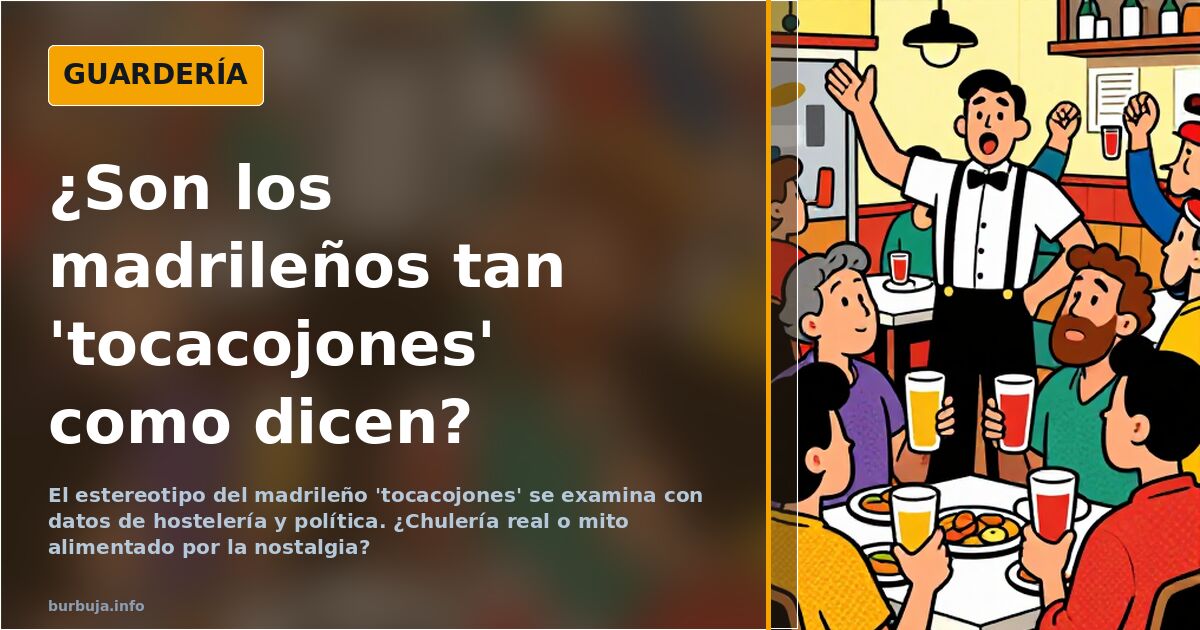
Madrileños: cockiness as a badge of identity and the myth of the perfect barman
At a bar in Madrid, a waiter runs the entire counter alone, pushes the kitchen to its limits and serves with a confidence some call cockiness and others, professionalism. That scene, repeated in thousands of bars, feeds the stereotype of the Madrid local as a «tocacojones»: cocky, arrogant and a know-it-all. But is it real or a self-serving construct?
The myth of the perfect waiter
Madrid's hospitality industry was once famed as the best in Spain. Bar professionals were considered great masters: fast, efficient, and with a touch of swagger that was tolerated as part of the trade. That fruta, however, has been fading. Some claim standards have plummeted and that those professionals of the past are gone. Nostalgia for a golden age, between 1960 and 1990, blends with the complaint that the Madrid locals «who were worth it» are no longer around.
Politics and identity: the «cayetano» and the «pepero»
The stereotype has also become politicized. People talk about «cayetanos» to refer to a posh, smug and conservative Madrid upper class, and the Madrid local is associated with voting for the Partido Popular (Spain's conservative party) and with figures like Isabel Díaz Ayuso. In many cases, the criticism is not aimed at the city but at its government. Some argue that Madrid has been «marvadísima» — fiercely defiant — for refusing to let the Socialists enrich it, while others see in that attitude mere capital arrogance.
The Madrid local through the visitor's eyes
From the outside, the Madrid local comes across as someone who feels like a capital dweller and looks down on anyone arriving from the provinces. But there is a nuance: Madrid banter is usually not contempt, but a way of testing the visitor. Understanding that code, some say, is the key to not feeling offended. The problem would not lie with the Madrid local, but with the one expecting the same treatment they get back home.
Nostalgia for the 1960-1990 era, when the Madrid locals «who were worth it» were still around, leaves an uncomfortable question: is the tocacojones stereotype a reflection of a city that has changed, or an excuse to avoid admitting that the problem lies with whoever feels inferior?
Also available in: Deutsch
Summary of a discussion on Burbuja.info - Foro de economía, actualidad y política., translated from Spanish and reviewed before publication. Read the full discussion (16 replies).
More summaries
-
Ayuso at 47: how a beach photo outshines her record
A beach photo of Isabel Díaz Ayuso at 47 is generating more public conversation than much of her governing: the weight of physical appearance in politics.
-
France vs England for World Cup bronze: the match Real Madrid fans didn't expect
France and England face off for third place at the World Cup, with Mbappé and Bellingham as the stars. For Real Madrid fans, this clash feels like their own kind of final.
-
James Wallestein's Shift to Patreon: Passion or Survival Strategy?
Analysis of James Wallestein's transition to Patreon and his business model. Is it passion or a survival strategy?
-
Nolan's The Odyssey: visual genius or emotional shortfall?
Spectacular but cold: Nolan's new Odyssey divides critics between its visual virtuosity and its lack of emotional depth, with a diverse cast that some…
-
The short journey behind the 'emotional' Ceuta video
A video from Ceuta, Spain shows migrants swimming barely 10 metres after being dropped off by Moroccan patrol boats. The media narrative sells it as an epic ordeal.
-
Neither nirvana nor peace: the apathy that comes with burnout
Apathy as a false nirvana: wisdom or exhaustion? The person going through it admits he wants to leave, but must keep working.