
Madrid's Ayuso closes Sol station over health hazard after three-week encampment
The Madrid regional government has closed Sol station over unsanitary conditions following three weeks of a protest encampment. A report detected toxic gases from organic waste.
English · Original discussion in Spanish · Published
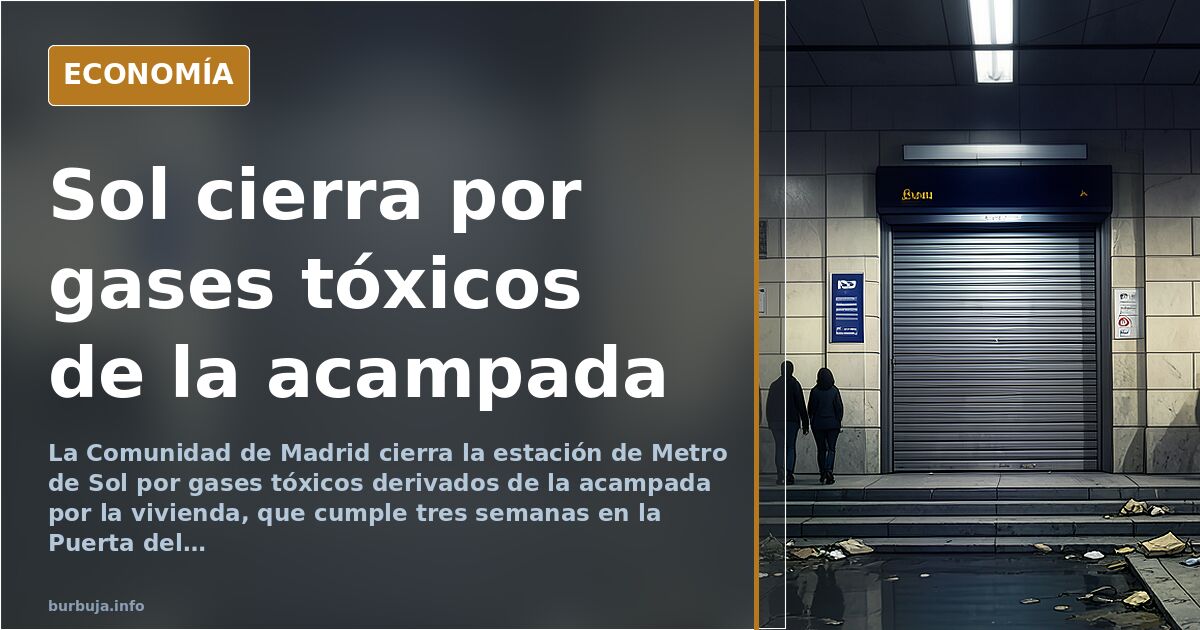
Madrid's Ayuso closes Sol station over health hazard after three-week encampment
The Community of Madrid has ordered the immediate closure of Sol metro station due to "unsanitary conditions" caused by the housing protest encampment, which this Saturday marks three weeks at Puerta del Sol. Regional premier Isabel Díaz Ayuso announced the measure on EsRadio: "We are going to have to close it. It was requested by occupational risk prevention and the trade unions." A technical report detected toxic gases from the accumulation of urine, excrement and other organic waste in wells and ventilation shafts. The station will remain closed for an as yet undetermined period.
A closure that hits public transport
Sol is no ordinary stop. Cercanías commuter trains also run through it, and its closure affects thousands of daily users. The decision came after National Police briefly closed the entrances on Wednesday due to overcrowding during a teachers' demonstration. The political standoff is served: some argue Ayuso is seeking to punish the campers at the expense of commuters, while others maintain the unsanitary conditions are an objective risk requiring intervention. In any case, the measure leaves local shopkeepers facing losses that are hard to quantify.
Detention and tensions at the camp
The encampment has also seen episodes of violence. In the early hours of Friday, a 61-year-old man was arrested after allegedly threatening a coordinator with a knife. According to police sources, the suspect threw a beer at her and chased her among the tents. No knife was found in the search, but hashish was. The detainee remains in police custody. The incident has fuelled the debate over safety and coexistence in the square.
Open encampment or closed bunker?
Comparison with the 15M movement is inevitable. Several participants point out that back then the square was open, people could move around and join the discussion circles. Now, they describe a closed space, almost a bunker, where access is not allowed to anyone who is not known. That perception feeds the criticism: "It looks like a bunker or trenches, and it doesn't seem like they let you take part if they don't know you," one speaker summed up. The encampment, which began as a housing protest, has turned into a public order and sanitation conflict.
The political calculation: votes and attrition
In electoral terms, some argue that each day of the encampment costs the PSOE (Spain's Socialist Party) support, while others believe the closure of Sol damages Ayuso by affecting citizens. The d'Hondt system could dilute any increase in left-wing votes, it is said. The debate over the consistency of public officials also looms: critics point out that those demanding affordable housing own multiple properties. Far from being settled, the matter remains open.
The closure of Sol is the latest twist in a conflict mixing housing, public order and electoral strategy. With the station shut and the encampment still standing, Madrid is witnessing a standoff in which no one seems willing to back down. The question is how long the closure can be sustained before the political and economic cost becomes unsustainable for everyone.
Also available in: Deutsch
Summary of a discussion on Burbuja.info - Foro de economía, actualidad y política., translated from Spanish and reviewed before publication. Read the full discussion (48 replies).
More summaries
-
The rabble can occupy the country's Kilometro Cero without the UIP (Spain's riot police) stepping in, then dictate which citizens aren't allowed through.
Incidents at Puerta del Sol during a housing protest. Assaults and police presence marked the day.
-
The Simon Perez phenomenon: from obscurity to live self-destruction
The phenomenon of Simón Pérez, aka 'Bocata de Pollo', resurfaces on streaming. An analysis of his self-destruction, the donation business and its impact.
-
Iceland votes no on resuming EU accession talks
52.5% of Icelanders voted against restarting negotiations with Brussels. Wealthy countries don't want to foot the bill.
-
A birthday with no wishes: the freedom of going it alone
An August 6 without a single birthday wish: the story of a birthday spent alone and a claim for individual freedom over social validation.
-
Video of teenage girls exposes social tensions on social media
A video of teenage girls making comments about Maghrebi men reopens the debate on integration and double standards on social media.
-
Trump and Ashtar: the NESARA GESARA prophecy promising to wipe out debt
Gold hits 50 record highs while the NESARA GESARA prophecy promises to erase all debts, with Trump and Ashtar cast as saviors.