
Madrid's 3 Million Inhabitants: Water, Housing, and Metro
Critics attribute to Díaz Villanueva the goal of adding 3 million people to Madrid to rival London and Paris, sparking debate over water, housing, and metro infrastructure.
English · Original discussion in Spanish · Published
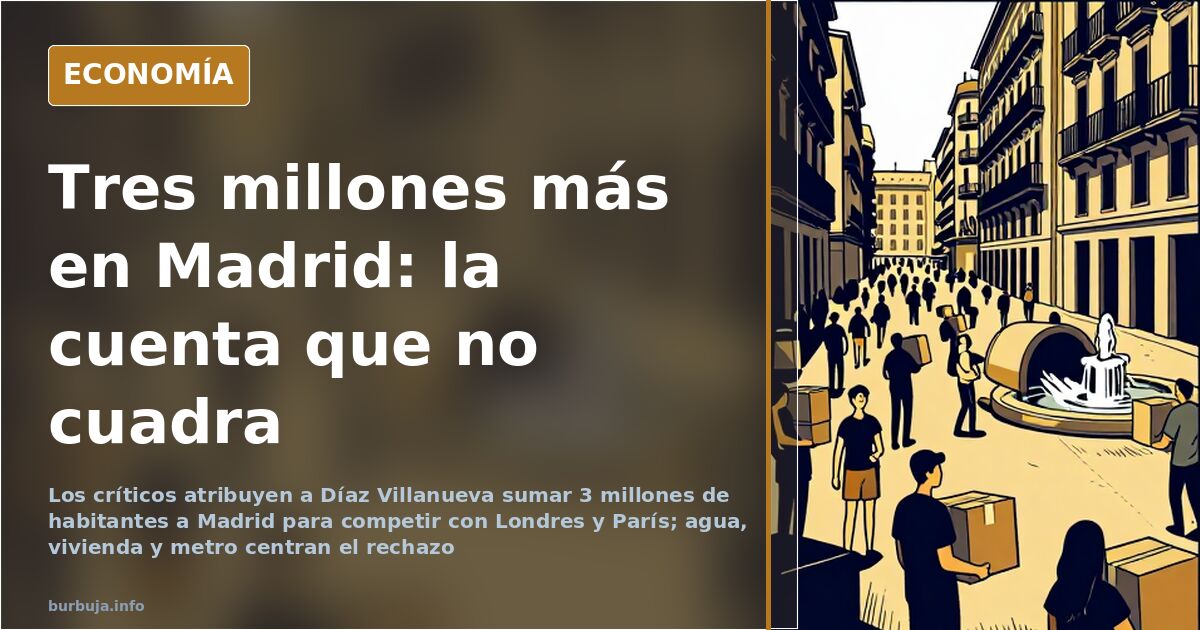
Madrid with 3 million more people: water, housing, and metro
Díaz Villanueva reportedly proposes adding three million inhabitants to Madrid—mostly foreigners—to compete with London and Paris. The proposal includes building sufficient housing, cutting taxes, and deregulation. However, critics question where this population would fit, how it would be supplied with water, and who would fund the transport.
Díaz Villanueva's proposal for Madrid
The argument is based on the idea that without critical mass, there is no first-tier capital. The measure is described as "precisely what young people need to get ahead in life". Yet, the text ignores land, water, and the electrical grid.
His intervention also defends the Puente de Vallecas district. He notes it is not a neighborhood, but a district, located across the M-30, and is Madrid's second most populous, with 260,000 inhabitants. This distinction highlights the debate over a city within a city.
London and Paris: the broken mirror
Comparing Madrid to these European capitals is where the argument unravels. Some claim these cities grew beyond natural growth, with indigenous populations becoming minorities and crime rising. These are perceptions, not closed statistics.
Others argue that if this is the result, it is not desirable. The idea that a capital's greatness is measured by its population volume clashes with those who value the city built by the French, not the superimposed layers. Moreover, high per capita income countries are often less populous.
What if Madrid reached 8 or 9 million inhabitants?
This scenario poses serious supply problems. With 8 or 9 million people, water rationing would be necessary, and the electrical grid would fail. Industries and real estate developments already struggle with connections, making it harder to accommodate more people.
Transport is part of the equation. Madrid is installing platform screen doors, present on Line 6 and planned for Line 10, but retrofitting existing lines is expensive and unions resist due to seniority-based driver positions. Comparisons with Seville, which has had these stations for years, highlight Madrid's infrastructure gaps. Visitors to Beijing and Shanghai in 2012 and 2013 recall that only some lines had automatic trains then.
Vallecas as a social thermometer
The district reflects existing inequalities without adding three million people. The conversation shifts to internal geography: Numancia differs from Palomeras or Entrevías, and outcomes vary by side of the Albufera Avenue. Closer to the Valencia highway is better; closer to the Andalusia highway is worse.
This portrait of inequality shows that the problem is not how many people arrive, but how existing residents are treated. The district becomes an uncomfortable example of growth measured in inhabitants, not services.
Who pays the bill?
Liberal arguments and critics intersect here. It is claimed that businesses and property owners benefit from population growth, turning reception policies into a business for a few. The counterargument is that one sector's interest does not make public policy a plan for that sector.
The practical question remains: with three million more, how will this population survive? The bleakest hypothesis suggests an economy of package distribution and chained services, with low salaries and high prices. No net employment figure has been presented, leaving the discussion at the headline level.
The final counterattack needs no rhetoric. Looking at the most populous metropolitan areas: Delhi (33-34 million), São Paulo (22-23), Mexico City (22), Dhaka (22-23), Cairo (21-22), Karachi (20-22), and Lagos (15-21). Size alone guarantees nothing. This data leaves the discussion open: if adding inhabitants were the formula, greatness would have a different map.
Díaz Villanueva reportedly proposes adding three million inhabitants to Madrid—mostly foreigners—to compete with London and Paris. The proposal includes building sufficient housing, cutting taxes, and deregulation. However, critics question where this population would fit, how it would be supplied with water, and who would fund the transport.
Díaz Villanueva's proposal for Madrid
The argument is based on the idea that without critical mass, there is no first-tier capital. The measure is described as "precisely what young people need to get ahead in life". Yet, the text ignores land, water, and the electrical grid.
His intervention also defends the Puente de Vallecas district. He notes it is not a neighborhood, but a district, located across the M-30, and is Madrid's second most populous, with 260,000 inhabitants. This distinction highlights the debate over a city within a city.
London and Paris: the broken mirror
Comparing Madrid to these European capitals is where the argument unravels. Some claim these cities grew beyond natural growth, with indigenous populations becoming minorities and crime rising. These are perceptions, not closed statistics.
Others argue that if this is the result, it is not desirable. The idea that a capital's greatness is measured by its population volume clashes with those who value the city built by the French, not the superimposed layers. Moreover, high per capita income countries are often less populous.
What if Madrid reached 8 or 9 million inhabitants?
This scenario poses serious supply problems. With 8 or 9 million people, water rationing would be necessary, and the electrical grid would fail. Industries and real estate developments already struggle with connections, making it harder to accommodate more people.
Transport is part of the equation. Madrid is installing platform screen doors, present on Line 6 and planned for Line 10, but retrofitting existing lines is expensive and unions resist due to seniority-based driver positions. Comparisons with Seville, which has had these stations for years, highlight Madrid's infrastructure gaps. Visitors to Beijing and Shanghai in 2012 and 2013 recall that only some lines had automatic trains then.
Vallecas as a social thermometer
The district reflects existing inequalities without adding three million people. The conversation shifts to internal geography: Numancia differs from Palomeras or Entrevías, and outcomes vary by side of the Albufera Avenue. Closer to the Valencia highway is better; closer to the Andalusia highway is worse.
This portrait of inequality shows that the problem is not how many people arrive, but how existing residents are treated. The district becomes an uncomfortable example of growth measured in inhabitants, not services.
Who pays the bill?
Liberal arguments and critics intersect here. It is claimed that businesses and property owners benefit from population growth, turning reception policies into a business for a few. The counterargument is that one sector's interest does not make public policy a plan for that sector.
The practical question remains: with three million more, how will this population survive? The bleakest hypothesis suggests an economy of package distribution and chained services, with low salaries and high prices. No net employment figure has been presented, leaving the discussion at the headline level.
The final counterattack needs no rhetoric. Looking at the most populous metropolitan areas: Delhi (33-34 million), São Paulo (22-23), Mexico City (22), Dhaka (22-23), Cairo (21-22), Karachi (20-22), and Lagos (15-21). Size alone guarantees nothing. This data leaves the discussion open: if adding inhabitants were the formula, greatness would have a different map.
Summary of a discussion on Burbuja.info - Foro de economía, actualidad y política., translated from Spanish and reviewed before publication. Read the full discussion (256 replies).
More summaries
-
Ayuso compares Ceuta crisis to 2.5 million migrants in Madrid
Ayuso suggests imagining 2.5 million illegal entrants in Madrid to grasp the Ceuta crisis, highlighting silent demographic shifts.
-
The Debate Over a Footballer Whose Potential is Attributed to Age Eight
The debate surrounding a footballer whose age and potential are questioned: doubts over his age, calls for bone scans, and the risk of projecting a career.
-
Spain faces housing crisis from 3 million migrant regularizations
Spanish police estimate 3 million migrants will be regularized in one year, straining Madrid's housing market and public services.
-
Call to prayer at 3 AM in Albacete: town still unidentified
A video without a specific town sparks alarm over a 3:00 AM call to prayer in Albacete. The timing doesn't add up and the controversy gets tangled between hoax, noise and…
-
Spanish party Sumar wants to ban rentals without air conditioning
Sumar proposes requiring air conditioning in all rental properties in Spain. We look at the cost, the climate contradiction and the impact on rents.
-
Feminist regrets that her son is heterosexual
A feminist activist said on television that she regrets her 3-year-old son appears to be heterosexual. Her wish to impose a sexual orientation on a child has sparked controversy.