
Madrid police shut down unauthorized Zumba class in Tierno Galván park
Two municipal police cars stopped a Zumba class in Madrid's Tierno Galván park after a resident complained about unauthorized use of public space and noise.
English · Original discussion in Spanish · Published
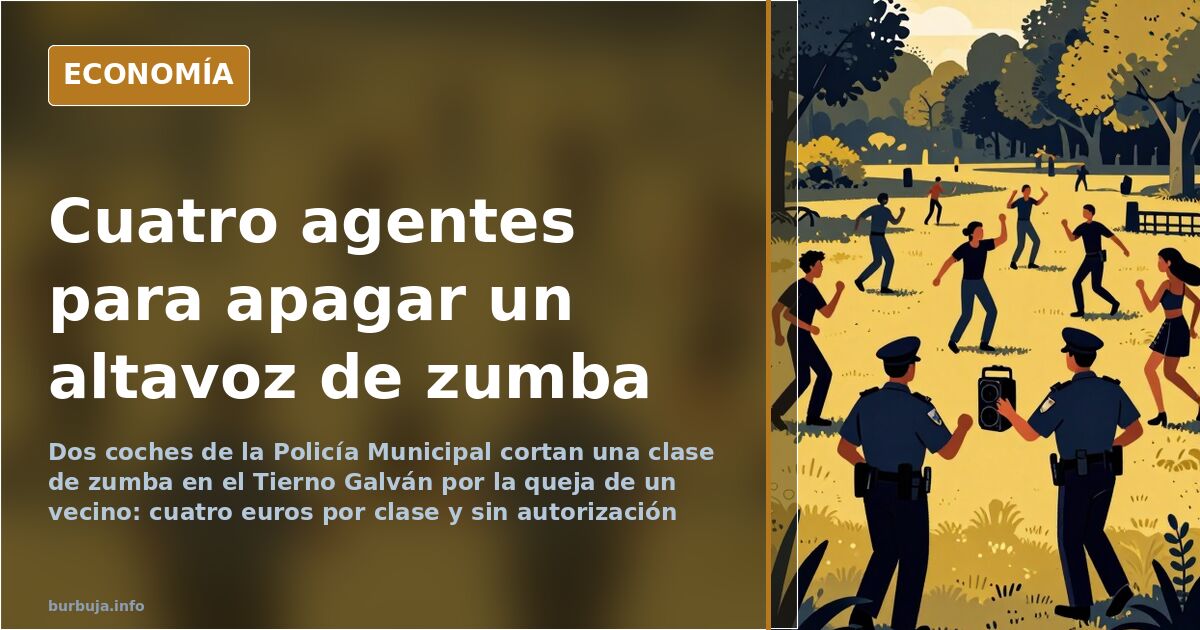
Four officers to silence a speaker in Tierno Galván
In Madrid, you cannot dance in a park with a loudspeaker. That is what two dozen women in workout clothes learned at 39 degrees in the shade when two Madrid City Police cars entered the amphitheater of Enrique Tierno Galván Park and halted their Zumba class. The regulations do not ban dancing. They ban sound amplification without authorization and the commercial occupation of public space. The distance between the two is four euros per class.
Why can't you hold a Zumba class in a public park?
The official explanation fits in one sentence: any activity that generates economic benefit in public space requires authorization to occupy it. Here, the benefit is four euros per class. This is compounded by the fact that sound amplification falls under the Law on Public Shows and Recreational Activities, which requires municipal permits and other obligations for organizers. The instructors claim they requested authorization twice from the Arganzuela Municipal Council and received no response. "We continued because we believe we provide a service to people," defends Ana Córdoba, one of the three instructors.
The deployment involved two patrols: one descended onto the improvised stage, the other flanked the exit from above. Four officers for one speaker. Some residents, from a distance, shouted for them to leave the dancers alone.
The double standard of the amphitheater: 45-euro festivals and election campaigns
The same venue the police cleared on a Tuesday afternoon had been closed for a month by a series of private festivals held there, including the Tomasvistas, with tickets at 45 euros. During those weeks, half the park was closed, the lawn destroyed, and residents were pushed to the viewpoints to walk dogs or exercise. The same stage hosted last Friday the closing campaign rally for Sumar, with Yolanda Díaz. And the Brunch in the Park, antiestéticaturing electronic music, renders the park unusable for the public when it arrives.
This is where the most repeated argument on the street comes from: if it costs money, yes; if it is chill, no. Lucía Quiroga, who comes every Sunday with her group, summarizes it thus: "Things that cost money, yes, but a chill activity, no." She speaks of groups of up to 100 people on weekends, and between 20 and 30 during the week. Classes are held on Tuesdays, Thursdays, and Sundays, originating from the pandemic, when a group of Zumba teachers moved their previously virtual sessions outdoors.
The noise: the unmeasured conflict
Here, the issue shifts from legal to cultural. In Spain, external noise is suffered like a tax, and those who complain also bear the stigma of being party poopers. Those supporting the police action argue it is not five people with a cassette player: it is dozens with a speaker at full volume, three days a week, and that some people sleep during the day due to work schedules. The instructor denies this with an auditory fact: "You don't hear the music until you reach the top of the amphitheater."
Without a sound meter, there is no figure, and without a figure, everyone is right. The City Police assure they always respond to complaints and that if organizers have authorization and a third party still complains, acoustic measurements would be needed to check if permitted decibels are exceeded. No one has measured anything in Tierno Galván.
Can you dance with headphones to avoid disturbing others?
This is the proposal one officer made on the spot and the one that has circulated most afterwards. Córdoba rejects it: headphones "isolate you, and what they aim for is precisely to get people out of there." In the forum, some suggest each participant connect to the same phone via Bluetooth to dance without amplifying a single watt, and one user claims they already do this with headphones in the Retiro Park. The formula has a catch: if each participant scatters a hundred meters, the result could be a drip of simultaneous music rather than a single localized source.
The Arganzuela group has been meeting in the same amphitheater since the pandemic. Among the participants, there is a consensus that goes beyond dancing: "We are all women from the neighborhood," says Quiroga, who recalls that after class many stay for a beer and that new friendships have emerged from it. Once every two weeks, the class is cut short.
What comes next
With authorization unresolved, the speaker on, and complaints unmeasured, the foreseeable outcome is that the group returns next Sunday and someone calls again. If the administrative response continues to take as long as before, coexistence in that amphitheater will continue to be decided by a much less technical criterion: who dials the phone number first. Until there is a decibel figure on the table, the law will not be enough to close the debate, nor common sense.
In Madrid, you cannot dance in a park with a loudspeaker. That is what two dozen women in workout clothes learned at 39 degrees in the shade when two Madrid City Police cars entered the amphitheater of Enrique Tierno Galván Park and halted their Zumba class. The regulations do not ban dancing. They ban sound amplification without authorization and the commercial occupation of public space. The distance between the two is four euros per class.
Why can't you hold a Zumba class in a public park?
The official explanation fits in one sentence: any activity that generates economic benefit in public space requires authorization to occupy it. Here, the benefit is four euros per class. This is compounded by the fact that sound amplification falls under the Law on Public Shows and Recreational Activities, which requires municipal permits and other obligations for organizers. The instructors claim they requested authorization twice from the Arganzuela Municipal Council and received no response. "We continued because we believe we provide a service to people," defends Ana Córdoba, one of the three instructors.
The deployment involved two patrols: one descended onto the improvised stage, the other flanked the exit from above. Four officers for one speaker. Some residents, from a distance, shouted for them to leave the dancers alone.
The double standard of the amphitheater: 45-euro festivals and election campaigns
The same venue the police cleared on a Tuesday afternoon had been closed for a month by a series of private festivals held there, including the Tomasvistas, with tickets at 45 euros. During those weeks, half the park was closed, the lawn destroyed, and residents were pushed to the viewpoints to walk dogs or exercise. The same stage hosted last Friday the closing campaign rally for Sumar, with Yolanda Díaz. And the Brunch in the Park, antiestéticaturing electronic music, renders the park unusable for the public when it arrives.
This is where the most repeated argument on the street comes from: if it costs money, yes; if it is chill, no. Lucía Quiroga, who comes every Sunday with her group, summarizes it thus: "Things that cost money, yes, but a chill activity, no." She speaks of groups of up to 100 people on weekends, and between 20 and 30 during the week. Classes are held on Tuesdays, Thursdays, and Sundays, originating from the pandemic, when a group of Zumba teachers moved their previously virtual sessions outdoors.
The noise: the unmeasured conflict
Here, the issue shifts from legal to cultural. In Spain, external noise is suffered like a tax, and those who complain also bear the stigma of being party poopers. Those supporting the police action argue it is not five people with a cassette player: it is dozens with a speaker at full volume, three days a week, and that some people sleep during the day due to work schedules. The instructor denies this with an auditory fact: "You don't hear the music until you reach the top of the amphitheater."
Without a sound meter, there is no figure, and without a figure, everyone is right. The City Police assure they always respond to complaints and that if organizers have authorization and a third party still complains, acoustic measurements would be needed to check if permitted decibels are exceeded. No one has measured anything in Tierno Galván.
Can you dance with headphones to avoid disturbing others?
This is the proposal one officer made on the spot and the one that has circulated most afterwards. Córdoba rejects it: headphones "isolate you, and what they aim for is precisely to get people out of there." In the forum, some suggest each participant connect to the same phone via Bluetooth to dance without amplifying a single watt, and one user claims they already do this with headphones in the Retiro Park. The formula has a catch: if each participant scatters a hundred meters, the result could be a drip of simultaneous music rather than a single localized source.
The Arganzuela group has been meeting in the same amphitheater since the pandemic. Among the participants, there is a consensus that goes beyond dancing: "We are all women from the neighborhood," says Quiroga, who recalls that after class many stay for a beer and that new friendships have emerged from it. Once every two weeks, the class is cut short.
What comes next
With authorization unresolved, the speaker on, and complaints unmeasured, the foreseeable outcome is that the group returns next Sunday and someone calls again. If the administrative response continues to take as long as before, coexistence in that amphitheater will continue to be decided by a much less technical criterion: who dials the phone number first. Until there is a decibel figure on the table, the law will not be enough to close the debate, nor common sense.
Summary of a discussion on Burbuja.info - Foro de economía, actualidad y política., translated from Spanish and reviewed before publication. Read the full discussion (326 replies).
More summaries
-
Which celebrity will offer a home to the evicted woman?
Debate over the evicted elderly woman in Madrid: will any of the named celebrities offer her a home? Wyoming is attributed 19 properties.
-
Lindsay Clancy: Jury Deadlocks 11-1 on Insanity Defense
Eleven of twelve jurors found Lindsay Clancy not guilty by reason of insanity for her children's deaths, leaving one holdout and reopening the debate on mental illness defenses.
-
Aitana and Hypergamy: Anatomy of a Media Rise
From Operación Triunfo to Yves Saint Laurent and the Bernabéu: analyzing Aitana's career through hypergamy, and the objections raised.
-
Yolanda Díaz claims elites plan to flee Earth on rockets
Spanish Deputy PM Yolanda Díaz asserts that wealthy elites are preparing to escape Earth via private rockets, sparking widespread criticism over lack of evidence.
-
Albert Rivera denies romance with woman pictured by Lecturas
Rivera and his team deny a relationship with the woman photographed by Lecturas, leaving the exclusive based on pixelated images.
-
Quique San Francisco in ICU for 40 days with bilateral pneumonia
Spanish actor Quique San Francisco, 65, remains in intensive care for severe bilateral pneumonia amid uncertainty over a possible COVID-19 link.